
A soft landing in economics is a slowdown where growth and inflation cool without broad recessionary contraction. It usually appears in the context of tighter policy, weaker demand, and a labor market that softens without breaking. It is not the same as a hard landing or a confirmed recession outcome, and it does not automatically mean markets are safe, risk assets must rise, or recession risk has disappeared.
Soft landing: an economic outcome where demand cools enough to reduce inflation pressure, but not enough to create broad recessionary contraction.
Core limitation: there is no exact universal threshold that turns a slowdown into a soft landing. The classification depends on the combination of growth, inflation, labor conditions, credit stress, and time lag.
What a soft landing means
A soft landing describes a controlled cooling phase in the business cycle. Growth slows from an overheated pace, inflation pressure eases, and employment conditions remain resilient enough to avoid a broad contraction.
The concept usually appears after monetary policy has tightened. Higher borrowing costs can slow credit creation, reduce demand, and cool price pressure. A soft landing occurs only if that cooling does not turn into widespread job losses, collapsing demand, or a deeper break in financial conditions.
The phrase is useful because it separates slower economic growth from outright contraction. A slowdown can be uncomfortable without becoming a recession, but the boundary is often visible only after enough data has arrived.
Soft landing vs hard landing vs recession
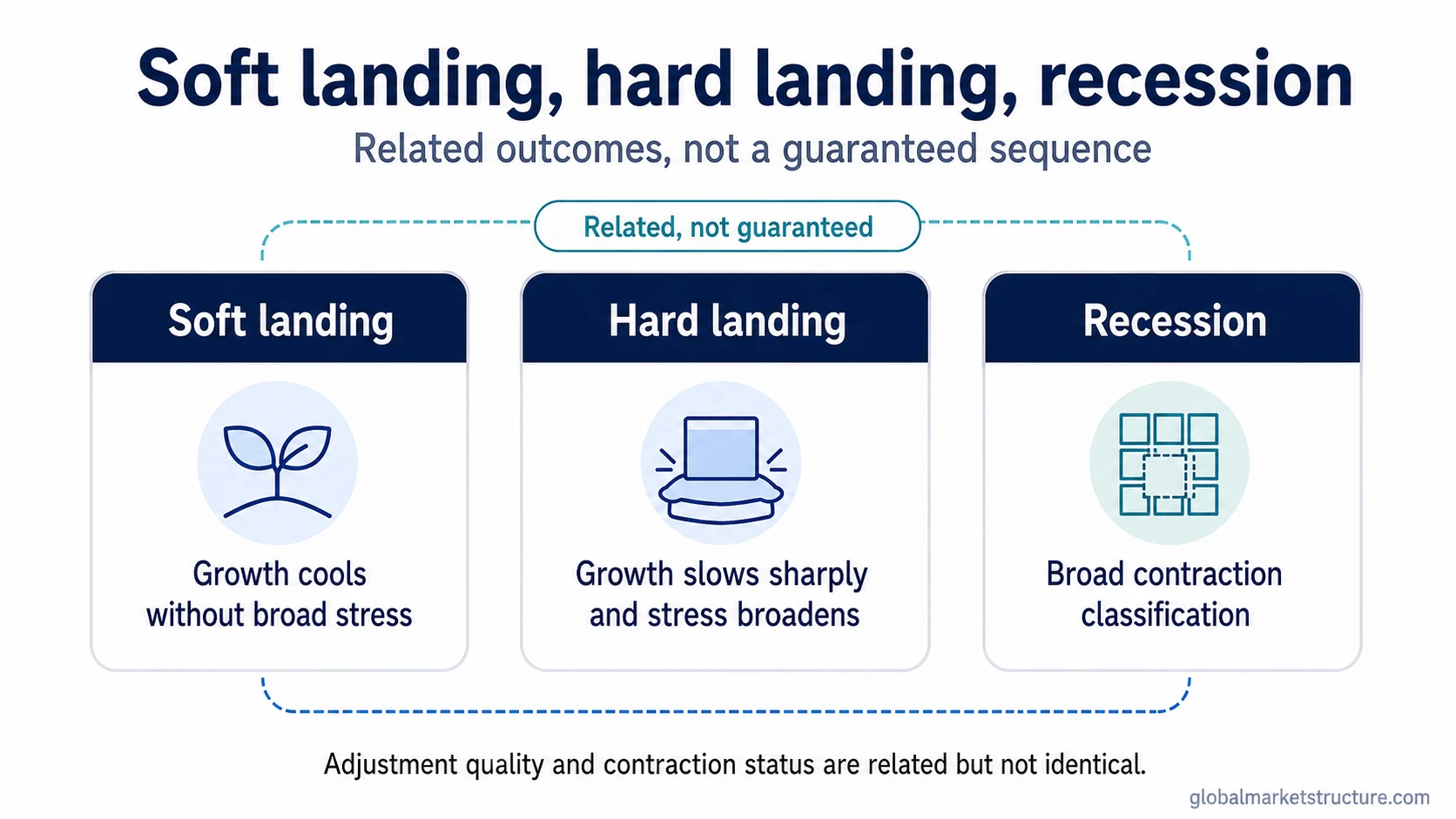
A soft landing, a hard landing, and a recession describe related but different outcomes. They can overlap in market narratives, but they are not a guaranteed sequence.
| Outcome | Main idea | Typical macro pattern |
|---|---|---|
| Soft landing | Growth and inflation cool without broad recessionary contraction | Demand slows, labor weakens only moderately, credit stress stays contained |
| Hard landing | Growth slows sharply and stress broadens | Labor deterioration, tighter credit, weaker demand, and rising financial stress reinforce each other |
| Recession | Broad contraction classification | Economic activity contracts across multiple areas for a sustained period |
A hard landing is the more stressful version of the adjustment. The distinction between soft and hard outcomes depends on whether the slowdown remains orderly or spreads into credit stress, labor-market damage, and sharper contraction risk.
How central-bank tightening can lead to a soft landing
Central banks try to cool inflation by making credit less easy. Higher policy rates can raise borrowing costs, slow housing and investment activity, reduce excess demand, and bring price pressure closer to a more sustainable pace.
The soft-landing condition is delicate. Policy must slow demand enough to ease inflation, but not so much that businesses cut workers aggressively, consumers pull back sharply, or credit conditions tighten into a self-reinforcing downturn.
Policy lag matters: tighter policy affects the economy with delay. A growth slowdown that looks stable early in the process can still weaken later if credit costs, refinancing pressure, or labor-market stress keep building.
Observable channels for a soft-landing interpretation
No single indicator confirms a soft landing. The interpretation becomes more credible when several channels cool together without showing broad stress.
| Channel | What would support a soft-landing interpretation | What would weaken the interpretation |
|---|---|---|
| Growth | Activity slows from an overheated pace but remains positive enough to avoid broad contraction | Demand falls sharply across consumption, investment, and production |
| Inflation | Price pressure cools without requiring a severe collapse in demand | Inflation reaccelerates or stays sticky while growth weakens |
| Labor market | Hiring cools and wage pressure moderates without a disorderly rise in unemployment | Job losses broaden and household income pressure becomes self-reinforcing |
| Credit stress | Spreads and lending conditions remain contained enough to avoid forced deleveraging | Credit spreads widen, lending standards tighten sharply, and refinancing pressure rises |
| Market breadth and leadership | Risk appetite improves beyond a narrow set of defensive or mega-cap leaders | Leadership narrows, breadth deteriorates, and cyclical areas fail to confirm the growth narrative |
| Policy lag | Delayed effects of tightening remain manageable as inflation cools | Earlier tightening continues to hit credit, employment, or demand after markets have priced relief |
What a soft landing does not mean for markets
A soft landing is an economic outcome or narrative classification, not a standalone market signal. It does not mean stocks must rise, credit risk has vanished, or every cyclical asset becomes attractive.
Markets can price a soft-landing narrative before the economy fully confirms it. That can affect leadership rotation, style sensitivity, credit appetite, and risk-on positioning. The interpretation is stronger when breadth, credit conditions, earnings expectations, and liquidity conditions confirm the same message.
Common false reading: treating “soft landing” as a buy signal. A softer inflation path can support risk appetite, but market outcomes still depend on valuations, earnings durability, liquidity, credit conditions, and whether the slowdown keeps spreading.
Why soft landings remain uncertain
Soft landings are difficult to identify in real time because the economy adjusts with delays. Inflation, labor, credit, and growth data do not move together perfectly, and early resilience can later give way to stress.
The uncertainty also comes from classification. A mild slowdown, a late-cycle pause, a rolling sector recession, and an early recession risk phase can all look similar before the final outcome is clear.
A more disciplined interpretation separates observed conditions from market narrative. Cooling inflation is observed through data. A successful soft landing is an interpretation of the whole adjustment. Market optimism is a pricing response, not proof that the economic outcome is complete.
Practical macro scenario
A soft-landing narrative can develop when inflation cools, growth slows but remains positive, and unemployment rises only gradually. Risk assets may respond positively if investors believe policy pressure can ease before earnings or credit conditions break.
The same scenario weakens if credit spreads widen, lending tightens, market leadership narrows, or labor deterioration accelerates. The difference is not the word “slowdown”; the difference is whether the slowdown stays orderly or becomes self-reinforcing stress.
Clean definition for market interpretation
A soft landing is best treated as a conditional macro outcome: inflation and demand cool, but the economy avoids broad contraction. It is not a guarantee, not an official binary label, and not a shortcut for market direction.
The strongest interpretation looks for alignment across growth, inflation, labor, credit, breadth, and policy lag. The weakest interpretation relies on one favorable data point while ignoring delayed tightening effects or stress beneath the surface.
Related concepts
Economic growth helps separate slower expansion from outright contraction.
Hard landing describes the more stressful version of a slowdown, where labor, credit, and demand weakness broaden.
Soft landing vs hard landing is the cleaner comparison when the main question is whether the adjustment stays orderly or turns into broader stress.
FAQ
What is a soft landing in economics?
A soft landing is an economic slowdown where growth and inflation cool without broad recessionary contraction. It usually follows a period of tighter policy or weaker demand.
Is a soft landing the same as avoiding a recession?
Not exactly. Avoiding recession is part of the idea, but a soft landing also implies that inflation and demand cool in an orderly way rather than through a sharp collapse in activity.
What is the difference between a soft landing and a hard landing?
A soft landing keeps the slowdown contained. A hard landing involves sharper growth damage, broader stress, and a higher risk that weakness spreads through labor, credit, and demand.
Does a soft landing mean stocks will rise?
No. A soft landing can support risk appetite, but it does not guarantee positive market returns. Valuation, earnings, liquidity, credit stress, and market breadth still matter.