
Output gap is the difference between actual economic output and estimated potential output. A positive gap means actual output is above estimated capacity, while a negative gap means output is below estimated capacity. Because potential output is not directly observed, the output gap is best treated as a macro pressure and slack estimate, not as a direct market-timing signal.
Definition: Output gap compares what an economy is producing with what it is estimated to be capable of producing without creating unsustainable pressure. The concept is most useful when it separates actual activity from capacity.
Core distinction: actual output is observed economic production, while potential output is an estimate of sustainable production capacity.
Interpretation boundary: output gap can frame slack, excess demand, inflation pressure, and policy sensitivity, but it does not by itself predict asset direction, recession timing, or a central-bank decision.
Key Points
- Output gap compares actual output with estimated potential output.
- A positive gap points to excess demand or capacity pressure.
- A negative gap points to slack or underused capacity.
- Potential output is estimated, so the reading is uncertain and model-dependent.
- For market-structure analysis, the concept is one macro-context input, not a trading signal.
What Is the Output Gap?
Output gap describes the distance between current economic production and estimated sustainable production capacity. If actual output is above potential output, the economy may be operating beyond its estimated capacity. If actual output is below potential output, demand, labor use, or productive resources may be weaker than the economy could sustain.
The concept matters because the same growth rate can mean different things depending on capacity. A fast-growing economy with unused capacity may still have slack. A slower-growing economy already above estimated potential can still create inflation pressure if demand is pressing against supply limits.
The important limitation is measurement. Actual output can be observed through economic data, but potential output must be estimated. That makes the output gap a useful framework for macro interpretation, but not a precise real-time reading.
Output Gap Formula and Plain-English Meaning
The common percentage version compares actual output with estimated potential output, then scales the difference by estimated potential output:
Output gap percentage = (actual output minus estimated potential output) divided by estimated potential output, multiplied by 100.
Plain-language relationship: output gap compares actual output with estimated potential output. A positive gap means actual output is above estimated potential; a negative gap means it is below estimated potential.
A positive number means actual output is higher than estimated capacity. A negative number means actual output is lower than estimated capacity. A near-zero reading suggests output is close to estimated capacity, although the estimate can still change as new data and models change.
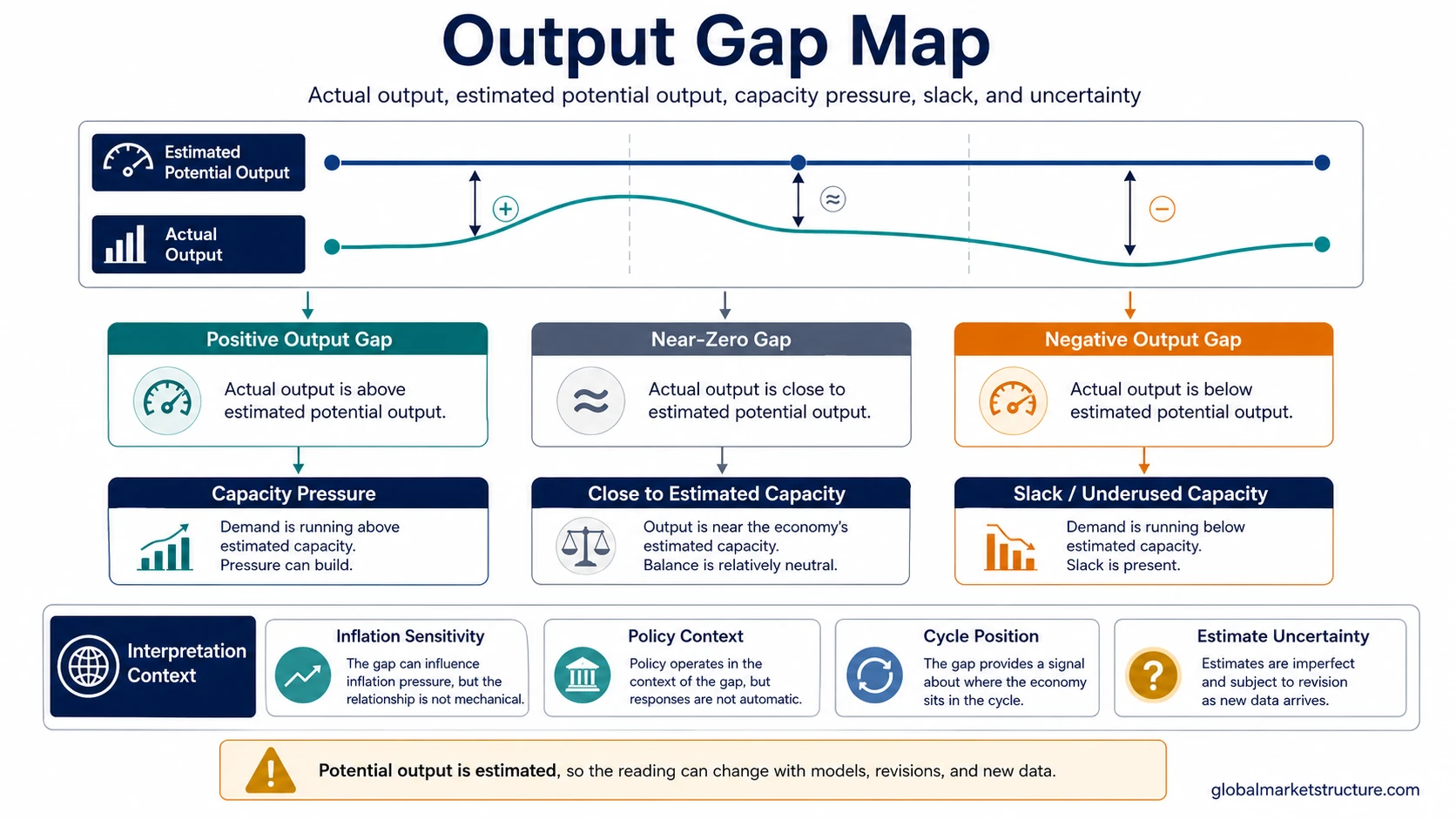
Positive vs Negative Output Gap
The positive-versus-negative distinction is the fastest way to understand the macro signal. The reading does not give a complete market view, but it helps separate capacity pressure from slack.
| Gap type | What it means | Macro interpretation | What not to assume |
|---|---|---|---|
| Positive output gap | Actual output is above estimated potential output. | Demand may be pressing against capacity, which can increase inflation sensitivity and policy attention. | It does not automatically mean asset prices will fall or that policy must tighten immediately. |
| Negative output gap | Actual output is below estimated potential output. | The economy may have slack, underused labor, weaker demand, or spare productive capacity. | It does not automatically mean recession is certain or that markets must price a single outcome. |
| Near-zero output gap | Actual output is close to estimated potential output. | The economy may be near estimated capacity, but the conclusion depends on the model and surrounding data. | It does not prove that macro conditions are balanced, stable, or risk-free. |
Why Output Gap Matters for Market Structure
Output gap is most useful as a capacity-pressure lens. It helps explain whether growth is occurring with spare capacity or against supply constraints. That distinction can change how inflation, labor demand, policy sensitivity, and landing-path risk are interpreted.
The value for market-structure analysis is not the definition alone, but the way the gap helps separate growth with spare capacity from growth that is pressing against estimated supply limits.
Mechanism mini-map:
- Actual output above estimated potential: excess demand may raise capacity pressure.
- Capacity pressure: inflation sensitivity and labor-market tightness can become more important.
- Policy sensitivity: central banks may pay closer attention to overheating risk, but the output gap alone does not prescribe a policy decision.
- Landing-path context: pressure above capacity can make a later slowdown more relevant to hard landing analysis if other indicators deteriorate.
- Actual output below estimated potential: slack may reduce pressure, but weak demand can still matter for earnings, credit, labor, and risk appetite through broader confirmation.
The useful market-structure question is not whether the output gap gives a buy or sell signal. The useful question is whether growth is happening with slack, near capacity, or beyond estimated capacity, and whether other macro signals confirm the same pressure pattern.
How Output Gap Can Be Misread
Output gap is not GDP growth. GDP growth measures how output changes over time. Output gap compares output with estimated potential capacity.
Output gap is not PMI. Purchasing Managers’ Index data reflects survey-based activity momentum, while output gap is a capacity-versus-output concept.
Output gap is not a recession label. A negative gap can point to slack, but recession dating and recession risk require broader evidence.
Output gap is not directly observable. Potential output is estimated, so revisions, model assumptions, and data updates can change the reading.
Output gap is not policy advice. It can influence policy interpretation, but it does not tell a central bank what it should do in isolation.
Output Gap and Other Growth Indicators
Output gap belongs inside the growth-and-activity family, but it answers a different question from nearby indicators. It is about the distance between actual output and estimated capacity, not only whether activity is accelerating, slowing, or surprising expectations.
| Concept | Main question | Difference from output gap |
|---|---|---|
| Output gap | Is actual output above or below estimated sustainable capacity? | Focuses on slack, excess demand, and capacity pressure. |
| GDP growth | How fast is output expanding or contracting? | Measures change over time, not distance from estimated potential. |
| PMI | Is survey-based business activity improving or weakening? | Captures activity momentum, not estimated economy-wide capacity pressure. |
| Hard landing | Is growth deterioration becoming severe enough to threaten a sharper downturn? | Describes a landing-path outcome, not the output-versus-capacity gap itself. |
The strongest interpretation usually comes from combining the output gap with activity momentum, inflation data, labor conditions, credit behavior, and policy expectations. The concept becomes weaker when it is isolated from the broader macro signal stack.
Practical Scenario
Consider a generic economy where output is growing, unemployment is low, and inflation pressure remains sticky. If estimated potential output is not rising as fast as actual output, a positive output gap may suggest that demand is pressing against capacity. That does not prove a market outcome, but it can explain why policy sensitivity remains high even while growth looks healthy.
Now consider a different generic economy where output is below estimated potential and survey momentum is weakening. A negative output gap may point to slack, but the interpretation is incomplete without labor, inflation, credit, and confidence data. The stronger reading comes from confirmation across indicators, not from the output gap alone.
FAQ
Is output gap the same as GDP growth?
No. GDP growth measures the change in output over time. Output gap compares actual output with estimated potential output, so it focuses on slack or capacity pressure rather than growth speed alone.
What does a positive output gap mean?
A positive output gap means actual output is above estimated potential output. It can indicate excess demand, capacity pressure, and higher inflation sensitivity, but it does not automatically predict market direction or a policy move.
What does a negative output gap mean?
A negative output gap means actual output is below estimated potential output. It can point to slack or underused capacity, but it does not prove that a recession is certain.
Why is output gap uncertain?
Output gap is uncertain because potential output is estimated rather than directly observed. Different models, data revisions, and assumptions can produce different readings.
Can output gap predict markets?
Output gap should not be treated as a standalone market predictor. It is more useful as one input for understanding macro pressure, slack, policy sensitivity, and cycle context alongside other indicators.