
A commodity currency is a national currency whose exchange rate tends to be sensitive to the commodity export cycle of its issuing economy. It belongs to foreign exchange and intermarket analysis because commodity prices, export income, trade balances, risk appetite, interest rates, and the U.S. dollar can all affect how the currency behaves.
A commodity currency is not a commodity itself, not commodity money, and not a guaranteed response to commodity prices. The useful reading is conditional: a commodity-linked currency may reflect export income or terms-of-trade pressure, but the relationship can weaken when monetary policy, global dollar strength, capital flows, or risk conditions dominate the commodity channel.
Commodity Currency Definition
Commodity currency means a currency associated with an economy that has meaningful exposure to commodity exports. Common examples often include the Canadian dollar, Australian dollar, New Zealand dollar, and Norwegian krone because those currencies are frequently discussed in connection with energy, metals, agricultural products, or other natural-resource exposure.
The term is most useful as a market-structure label. It helps analysts ask whether a currency is being influenced by commodity prices, export income, risk appetite, or broader dollar conditions. It does not mean the currency is backed by a commodity or that the currency must rise whenever its related commodity rises.
What a Commodity Currency Is and Is Not
| Concept | Correct meaning | Common mistake |
|---|---|---|
| Commodity currency | A national currency whose market behavior can be influenced by the commodity exposure of its economy. | Assuming it is mechanically controlled by one commodity price. |
| Commodity money | Money that has value because it is made from, or directly represents, a commodity such as gold or silver. | Confusing commodity currency with a money system backed by physical commodities. |
| Commodity pair | A foreign-exchange pair involving a currency that is commonly linked to commodity exposure, such as USD/CAD or AUD/USD. | Treating the pair itself as the same thing as the underlying currency category. |
| Commodity proxy | A market used to express or monitor commodity-sensitive conditions indirectly. | Using a currency as a simple substitute for the commodity without checking rates, policy, liquidity, and risk appetite. |
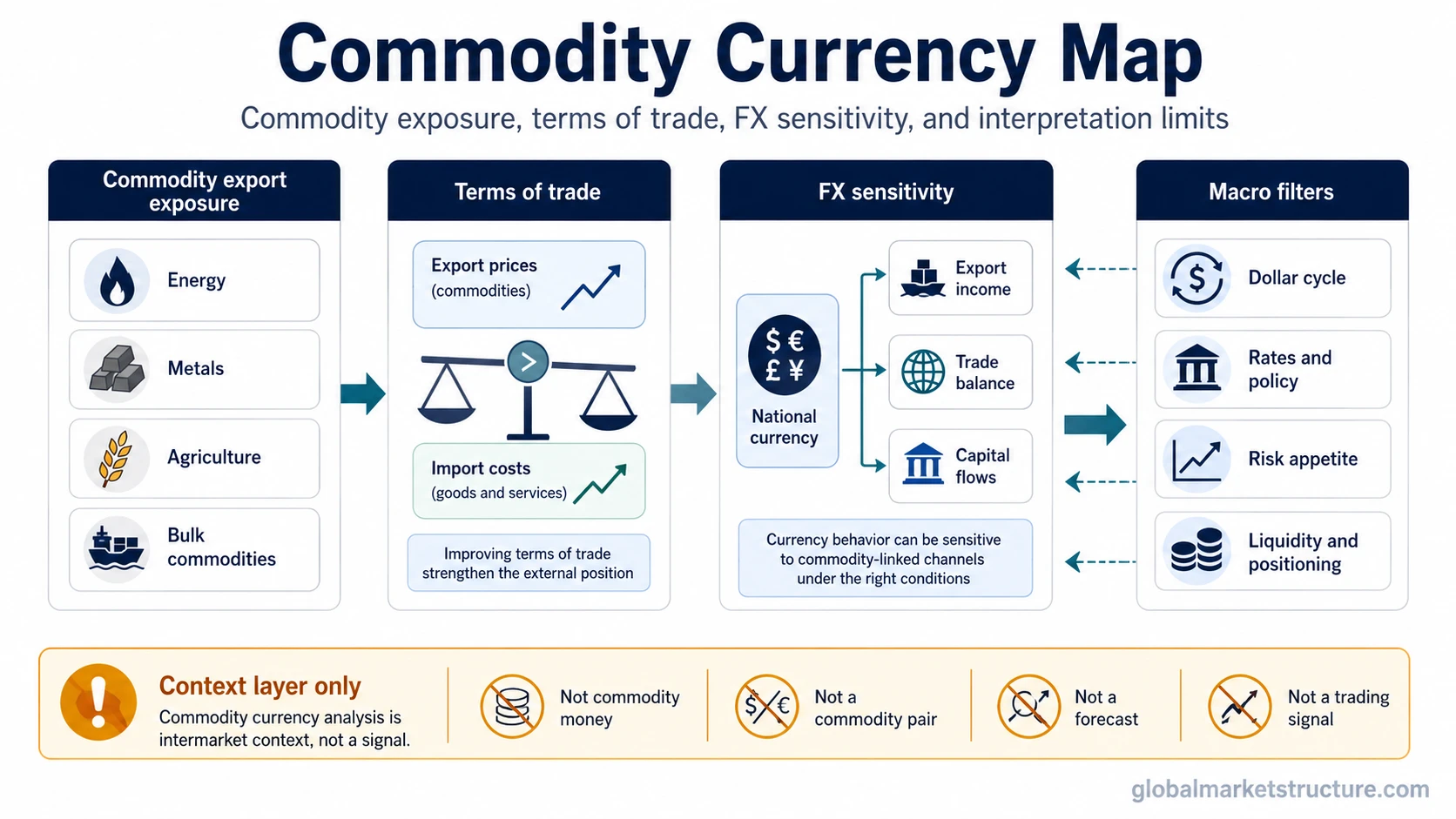
How Commodity Exposure Can Affect a Currency
The basic mechanism starts with export exposure. When commodity prices improve the income received by an export-sensitive economy, the currency may receive support through stronger trade income, firmer growth expectations, or a shift in capital-flow behavior. The link is usually clearest when the commodity move is large enough to affect the economy rather than only the commodity chart.
The channel is often discussed through terms of trade. If export prices rise relative to import prices, the exporting economy may receive more income for what it sells abroad. That can improve the macro backdrop for the currency. If export prices fall, pressure can appear when the affected commodity sector is important enough to influence income, investment, or policy expectations.
This mechanism is still only one layer. Exchange rates also respond to interest-rate expectations, central-bank policy, relative growth, positioning, external funding needs, and global risk appetite. A commodity currency can therefore move differently from its associated commodity when other forces become stronger than the export-price channel.
| Driver | Possible mechanism | Interpretation limit |
|---|---|---|
| Commodity prices | Higher export prices can support income, trade balances, and nominal growth expectations. | The currency may not follow if the U.S. dollar, rates, or risk conditions dominate. |
| Export concentration | Greater dependence on a commodity sector can make the currency more sensitive to that sector. | Broad, diversified economies may dilute the direct commodity link. |
| Terms of trade | Improving export prices relative to import prices can strengthen the macro backdrop. | The effect depends on volume, import costs, policy response, and capital-flow behavior. |
| Interest-rate expectations | Commodity strength can influence inflation expectations and expected central-bank policy. | Policy may react differently if growth weakens, inflation falls, or financial stress appears. |
| Global risk appetite | Some commodity-linked currencies can behave more strongly in risk-on conditions. | Risk-off demand for the U.S. dollar can overpower commodity support. |
| Dollar conditions | A weaker dollar can make commodity-linked FX moves easier to see in USD pairs. | A stronger dollar can pressure many currencies even when local commodity prices are firm. |
Common Commodity Currency Examples
The Canadian dollar is often discussed as a commodity currency because Canadian macro expectations can be sensitive to energy prices and export income. Oil can matter for the Canadian dollar, but USD/CAD also reflects Bank of Canada policy, U.S. dollar strength, U.S.-Canada growth differentials, and global risk appetite.
The Australian dollar is commonly linked to metals and bulk-commodity exposure. AUD can also be sensitive to China-related demand expectations, domestic policy, global yields, and risk sentiment. Commodity strength may support the currency in one environment and fail to do so in another.
The New Zealand dollar is often treated as commodity-linked because agricultural export exposure can matter for the country’s macro backdrop. Its behavior can reflect dairy prices, external demand, domestic policy, and broader risk appetite. The label identifies a possible sensitivity, not a complete explanation.
The Norwegian krone is frequently associated with energy exposure. Oil and gas conditions can influence the macro backdrop, but the krone can still respond strongly to European growth, local policy, liquidity, and global risk conditions.
Why Commodity Currencies Do Not Move Mechanically With Commodities
A commodity currency is not a one-factor model. The commodity link can be visible when the export channel is strong and other macro forces are aligned, but it can fade when markets focus on rates, policy divergence, liquidity stress, or broad U.S. dollar demand.
A common mistake is to assume that a rise in a commodity should automatically strengthen the related currency. That reading ignores the currency pair, the base and quote currency, domestic policy, inflation effects, import costs, positioning, and whether investors are taking or reducing global risk.
A commodity price move and a currency move can also diverge because an FX pair reflects two economies and two policy paths, not only the commodity-exporting side of the pair.
The relationship changes over time. An economy’s export mix can shift, central-bank reaction functions can change, and market participants can price the same commodity move differently depending on the cycle. For that reason, commodity currency analysis should be treated as context, not as a forecast.
Commodity Currency vs Commodity Money
Commodity currency and commodity money are different concepts. Commodity money refers to money that has value because it is made from, or directly tied to, a commodity. A historical gold coin is a simple example of commodity money because the material itself carries value.
A commodity currency, by contrast, is usually a modern national currency issued by a central bank. It is called commodity-linked because the issuing economy has meaningful exposure to commodity exports. The currency is not backed by oil, copper, gold, iron ore, dairy, or any single physical good simply because analysts describe it as a commodity currency.
Commodity Currency vs Commodity Pair
A commodity currency is the category label. A commodity pair is the tradable FX pair in which that currency appears. For example, the Canadian dollar may be discussed as a commodity currency, while USD/CAD is an FX pair that expresses the Canadian dollar against the U.S. dollar.
This distinction matters because a currency pair has two sides. USD/CAD is not only a view on Canada or oil. It also reflects the U.S. dollar, Federal Reserve expectations, U.S. growth, global funding conditions, and market demand for dollar liquidity. The same problem applies to AUD/USD, NZD/USD, and other pairs involving commodity-linked currencies.
How Commodity Currencies Fit Intermarket Analysis
In intermarket analysis, commodity currencies can help connect commodity markets, FX behavior, export conditions, and global risk appetite. They are not final signals by themselves. Their value is in showing whether currency markets are confirming, resisting, or ignoring the message coming from commodities.
Commodity currencies are most useful when they help separate commodity-price pressure, dollar pressure, rate expectations, and risk appetite instead of collapsing those forces into one simple explanation.
For example, if commodity prices rise while a related currency fails to strengthen, the divergence may suggest that another force is stronger. That force could be U.S. dollar strength, domestic policy risk, weaker global growth expectations, or a broader reduction in risk appetite. The useful question is not whether the currency should follow the commodity, but why the normal relationship is not showing up.
The dollar cycle is especially important because many commodities are priced in U.S. dollars and many FX pairs are quoted against the dollar. A strong dollar environment can pressure commodity-linked currencies even when local commodity fundamentals are not weak. A weak dollar environment can make commodity-linked strength easier to see, but it still does not remove the need to check rates, policy, growth, and risk appetite.
How to Interpret Commodity Currency Moves
A commodity-linked currency move is more useful when it is read as part of a wider macro map. A stronger commodity currency can reflect improving export income, stronger global demand, firmer risk appetite, or weaker dollar conditions. A weaker move can reflect falling export prices, policy divergence, risk aversion, or a stronger dollar.
The interpretation becomes more durable when several layers point in the same direction. Commodity prices, terms of trade, interest-rate expectations, credit conditions, equity leadership, and dollar behavior should be checked together. If those layers disagree, the currency move is better treated as unresolved context rather than as a clean macro signal.
| Market observation | Possible interpretation | What to check before trusting it |
|---|---|---|
| Commodity prices rise and the related currency strengthens. | The export-income channel may be visible. | Dollar direction, rates, policy expectations, and risk appetite. |
| Commodity prices rise but the currency does not strengthen. | Another force may be overpowering commodity support. | Dollar strength, local policy risk, growth fears, positioning, and liquidity. |
| The currency strengthens while commodities are flat. | The move may be driven by rates, capital flows, or dollar weakness. | Yield spreads, central-bank expectations, carry conditions, and broader FX behavior. |
| The currency weakens despite firm commodity prices. | Risk aversion or policy divergence may be dominating. | Credit spreads, equity risk appetite, funding conditions, and safe-haven dollar demand. |
Common Mistakes When Reading Commodity Currencies
The first mistake is treating the label as a forecast. Commodity-linked exposure does not turn a currency into a mechanical commodity tracker. It only identifies one channel that may matter under the right conditions.
The second mistake is ignoring the quote currency. Many commodity currency discussions use USD pairs, so dollar strength or weakness can dominate the chart. In those cases, the pair may say as much about dollar conditions as it says about the commodity-exporting economy.
The third mistake is using commodity currencies as proof of a macro regime by themselves. A cleaner intermarket reading needs confirmation from other markets. If commodities, FX, rates, credit, and equity leadership send mixed signals, the correct conclusion may be that the regime signal is still unresolved.
Bottom Line
A commodity currency is best understood as a currency with potential sensitivity to commodity-export conditions. The label is useful when it helps explain how commodities, terms of trade, the dollar cycle, rates, and risk appetite interact across markets.
The label becomes misleading when it is treated as a permanent rule. A commodity currency can help frame macro and intermarket conditions, but it should not be treated as a standalone trading signal, a guaranteed inflation hedge, or proof that commodity prices are controlling the exchange rate.
FAQ
What is a commodity currency?
A commodity currency is a national currency whose exchange rate tends to be sensitive to the commodity export cycle of its issuing economy. The link is conditional and can be affected by rates, policy, dollar strength, capital flows, and risk appetite.
Is a commodity currency the same as commodity money?
No. Commodity money has value because it is made from, or directly tied to, a commodity. A commodity currency is usually a modern national currency associated with an economy that has meaningful commodity export exposure.
What are common commodity currency examples?
Common examples often include the Canadian dollar, Australian dollar, New Zealand dollar, and Norwegian krone. These examples are based on broad commodity-export exposure, not on a guarantee that each currency will always move with one commodity.
Why do commodity currencies sometimes ignore commodity prices?
They can ignore commodity prices when other forces dominate the exchange rate. U.S. dollar strength, interest-rate expectations, central-bank policy, global risk aversion, positioning, and liquidity conditions can all overpower the commodity channel.