
Real yields help explain gold because they change the inflation-adjusted return available from yield-bearing assets. Rising real yields can increase the opportunity cost of holding gold, while falling real yields can reduce it. Dollar conditions, inflation expectations, defensive demand, reserve behavior, liquidity, and the shape of the yield curve can reinforce or offset that channel.
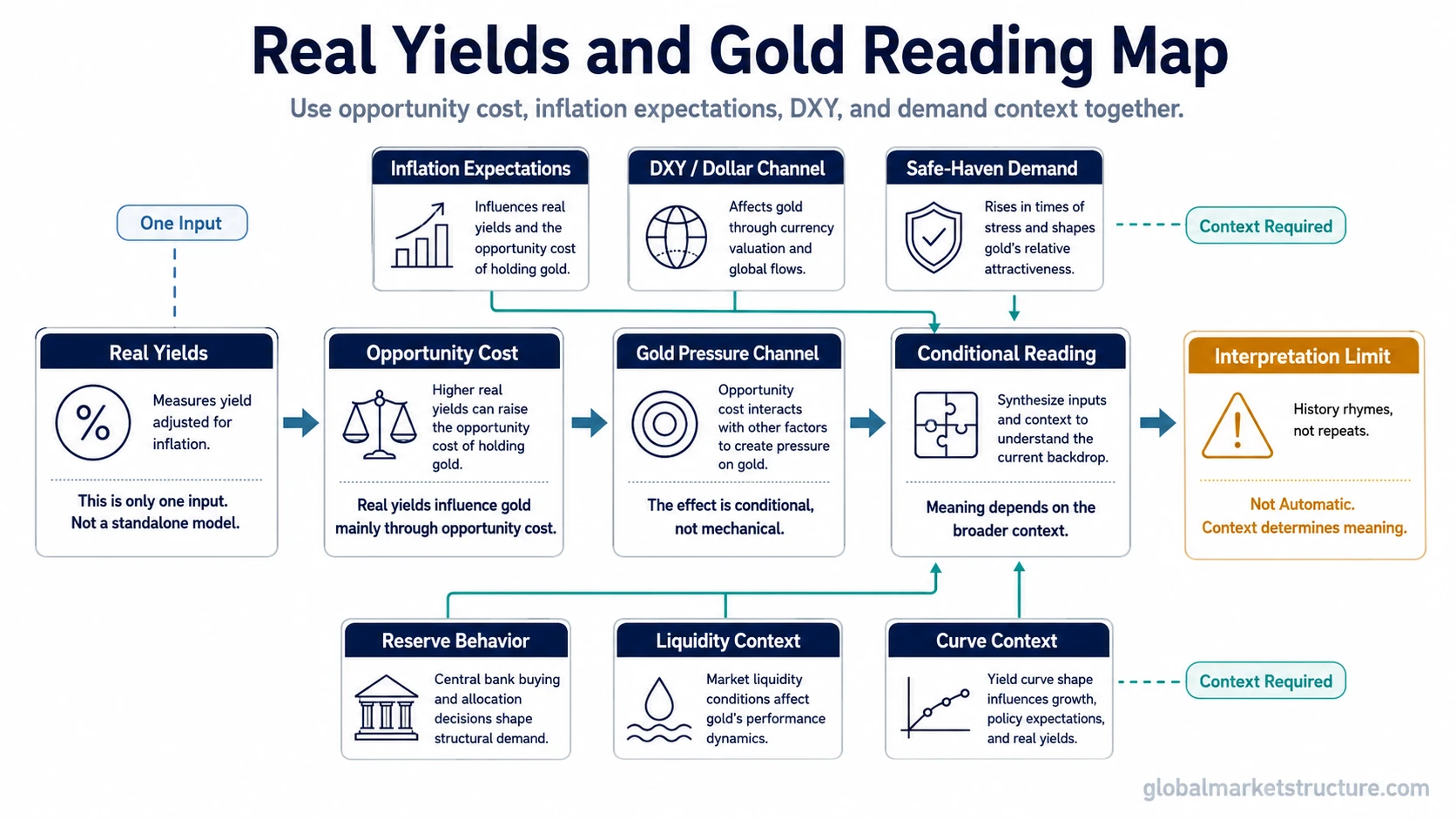
How the Opportunity-Cost Channel Works
Real yields are yields adjusted for expected inflation. For gold, they help show whether the inflation-adjusted return available from yield-bearing assets is becoming more or less competitive with holding a non-yielding asset.
When real yields rise, that competing return becomes more attractive and gold can face additional pressure. When real yields fall, the opportunity-cost pressure can ease. The effect is strongest as an interpretation channel rather than a mechanical relationship because other sources of gold demand can move at the same time.
A rise in nominal Treasury yields does not automatically mean that real yields have tightened. If inflation expectations rise faster than nominal yields, the inflation-adjusted return may change little or even fall. If nominal yields are stable while inflation expectations decline, real yields can rise without a large move in headline rates.
DXY and the Dollar Channel
The DXY Index can reinforce or offset the real-yield channel. A stronger dollar may add pressure to gold, while a weaker dollar can reduce that pressure even when real yields are not especially supportive.
The combination matters more than either input in isolation. Falling real yields alongside a weaker dollar creates a different setting from falling real yields accompanied by broad dollar strength or tighter liquidity.
Reading the Main Combinations
| Condition | Possible Gold Interpretation | What to Check Next |
|---|---|---|
| Real yields rise while inflation expectations are stable or falling | Opportunity cost may increase for holding gold | Check DXY, liquidity conditions, and defensive demand |
| Real yields fall while inflation expectations remain firm | Opportunity-cost pressure may ease | Check whether dollar strength or tighter liquidity is offsetting the move |
| Nominal yields rise while inflation expectations rise faster | Headline rates may look restrictive even though real-yield pressure is less clear | Separate the nominal-rate move from the inflation-adjusted yield |
| DXY strengthens while real yields fall | The real-yield channel may improve while the dollar channel moves against gold | Check whether dollar strength reflects liquidity stress, growth concerns, or policy divergence |
| The real-yield move is concentrated at one maturity | The signal may be narrower than the headline move suggests | Check curve shape, persistence, and whether the move extends across maturities |
A rising real yield increases opportunity-cost pressure, but another source of demand can dominate the move. Defensive demand, reserve buying, inflation uncertainty, a weaker dollar, or changes in liquidity can produce a different price response. In that case, the divergence is information about the regime rather than evidence that the real-yield channel has no value.
The interpretation depends on the maturity being observed, inflation expectations, the dollar, curve structure, liquidity, policy expectations, defensive demand, and reserve behavior. A real-yield move is most useful when those surrounding conditions are checked rather than treated as a standalone directional signal.
Broader Real-Asset Context
Gold also sits inside the broader real assets framework. Depending on the regime, its behavior can reflect monetary conditions, defensive demand, inflation sensitivity, or reserve demand. Real yields help identify the opportunity-cost part of that mix without replacing the wider cross-asset context.