
Financial conditions describe the broader environment for financing cost, credit availability, risk pricing, refinancing pressure, financial stress, and cycle context. The useful question is not only whether conditions are tight or loose, but which part of the financial system is changing.
Use the broad concept when the focus is the overall financing environment. Use indexes for measurement. Use credit, lending, refinancing, stress, and cycle lenses when the issue is more specific than the headline concept.
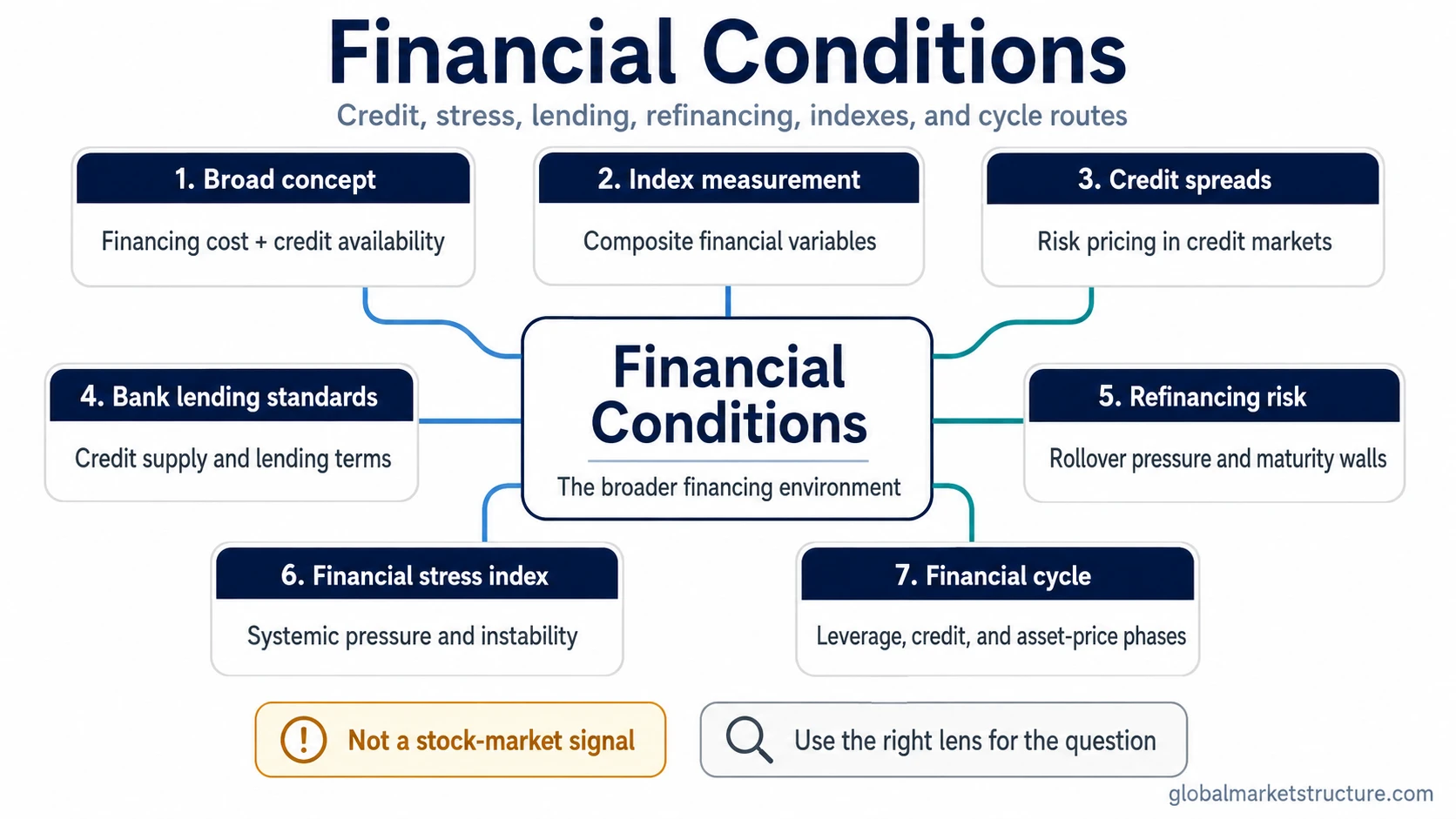
Choose the right financial-conditions lens
| Reader question | Best route | What that page explains |
|---|---|---|
| What are financial conditions? | Financial conditions | The broad concept: financing cost, credit availability, risk pricing, and market stress as one macro environment. |
| How are financial conditions measured? | Financial conditions index | How composite indexes can summarize multiple financial variables without replacing the underlying details. |
| What shows credit-market pressure? | Credit spreads | How the gap between risky credit yields and safer benchmark yields can reflect credit risk and risk appetite. |
| Are banks tightening credit? | Bank lending standards | How lending terms, approval standards, and credit supply can change before the effect is visible in markets. |
| Where does rollover pressure appear? | Refinancing risk | How maturity walls, higher funding costs, and weaker credit access can create pressure when debt must be rolled over. |
| Is this becoming systemic stress? | Financial stress index | How stress measures can help separate normal tightening from broader instability across the financial system. |
| How does this connect to cycles? | Financial cycle | How leverage, credit expansion, asset prices, and balance-sheet pressure can interact across longer financial cycles. |
How the lenses differ
Financial conditions is the broad concept. It describes the financing environment across rates, credit, risk appetite, leverage, and stress. It is the starting point for understanding the wider macro backdrop.
A financial conditions index is a measurement tool. It can summarize many inputs into one reading, but it should not be treated as the whole environment. The index is useful when measurement is the main issue.
Credit spreads focus on risk pricing. They become more useful when investors are demanding more compensation for holding risky debt.
Bank lending standards focus on credit supply. They matter when banks are making it easier or harder for households and businesses to borrow.
Refinancing risk focuses on rollover pressure. It becomes more relevant when borrowers face higher rates, tighter credit access, or large debt maturities.
Financial stress indexes focus on instability. They are most useful when pressure is spreading across markets, funding channels, and financial institutions.
The financial cycle connects financial conditions to longer credit and leverage phases. It is the better route when the focus is how loose or tight conditions build over time.
What financial conditions should not be used for
No single financial-conditions measure captures the full market environment. A composite index can be useful, but it can hide the difference between credit pricing, lending supply, refinancing pressure, funding stress, and cycle context.
Financial conditions should not be treated as a direct stock-market signal, a recession forecast, or a replacement for official data sources. The interpretation becomes more useful when it is tied to the specific channel that is changing: credit spreads, bank lending standards, refinancing risk, financial stress, or the financial cycle.