
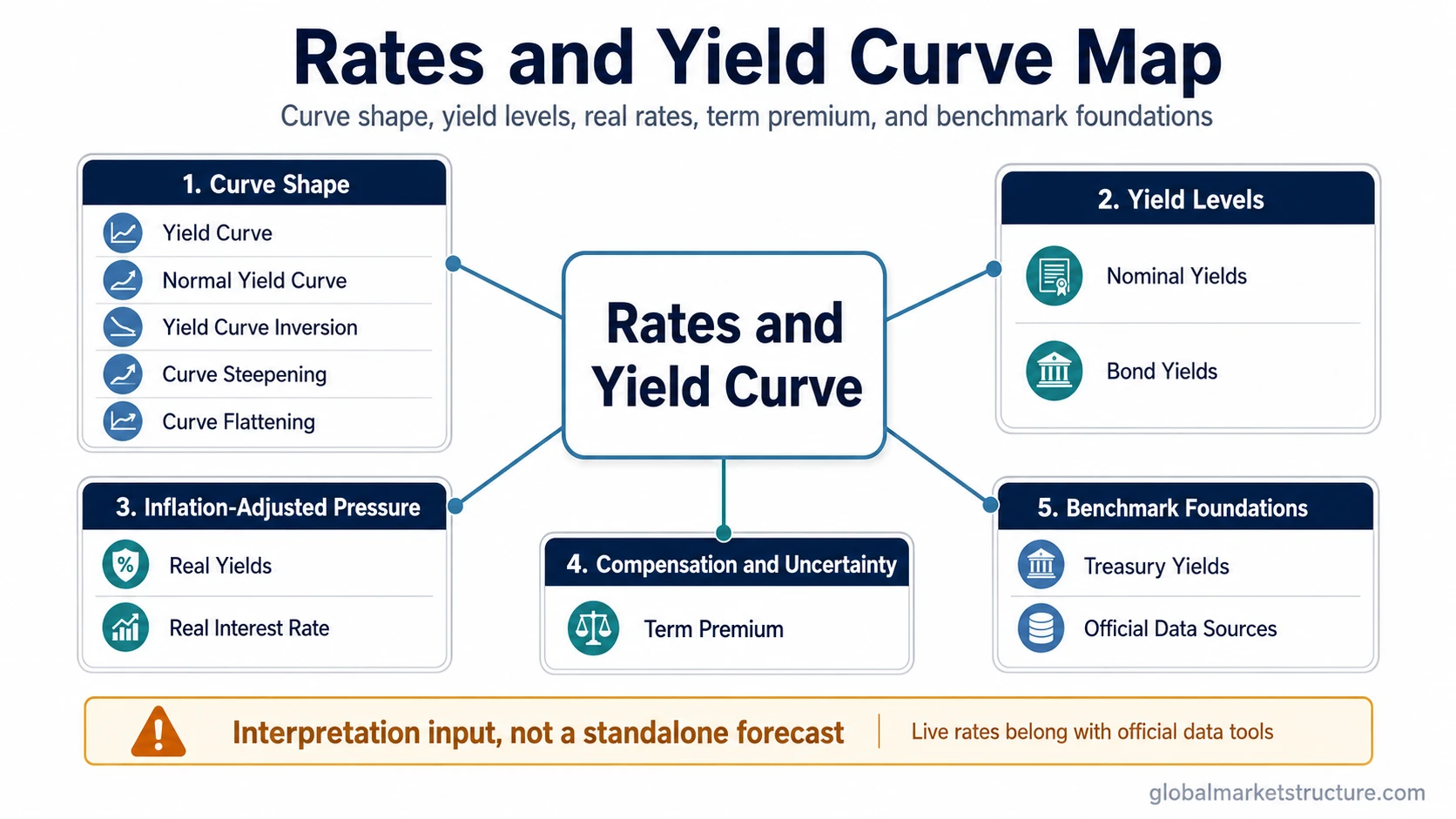
Rates and yield-curve analysis starts with a simple split: some questions are about the shape of the curve, while others are about what yields are pricing across inflation, policy, maturity, and term premium. Curve shape, yield level, real yields, nominal yields, and term premium all affect interpretation, but none of them works as a standalone market forecast.
A curve-shape question usually belongs with yield curve, normal yield curve, yield curve inversion, curve steepening, or curve flattening. A yield-pressure question usually belongs with real yields, nominal yields, real interest rate, term premium, bond yields, or Treasury yields. The useful starting point is the concept that matches the question, not the broad rates label.
Where to Start in the Rates and Yield Curve Group
| If your question is about | Start with | What that concept explains | Why separate treatment matters |
|---|---|---|---|
| What the yield curve is and why maturities are compared | Yield Curve | The structure of yields across maturities and why the curve is used as a macro interpretation tool. | The curve itself is the foundation before inversion, steepening, or flattening can be interpreted. |
| What an upward-sloping curve usually represents | Normal Yield Curve | Ordinary term compensation and the structure of a normal curve. | A normal curve needs different context from inverted or rapidly changing curve shapes. |
| What it means when short yields sit above long yields | Yield Curve Inversion | Inversion, policy pressure, growth concern, and interpretation limits. | Inversion is often overread as a direct recession forecast, so context and limits matter. |
| Why inflation-adjusted yields matter | Real Yields | Real return pressure, valuation sensitivity, and inflation-adjusted policy context. | Real yields can change market interpretation even when nominal yields look similar. |
| What headline yield levels show before inflation adjustment | Nominal Yields | Yield levels before adjusting for inflation expectations or realized inflation. | Nominal yields are useful, but incomplete without real-yield and inflation context. |
| Why longer maturities may require extra compensation | Term Premium | The compensation investors may require for holding longer-term bonds. | Term premium can change the meaning of long-end yield moves. |
| What it means when the curve becomes steeper | Curve Steepening | How short and long yields move relative to each other when the curve steepens. | Steepening can come from different yield movements, so the source of the steepening matters. |
| What it means when the curve becomes flatter | Curve Flattening | How the spread between short and long yields narrows. | Flattening can reflect policy pressure, growth expectations, or maturity-specific repricing. |
| How to think about interest rates after inflation | Real Interest Rate | Interest-rate levels after inflation adjustment. | Real-rate analysis separates purchasing-power pressure from headline rate levels. |
| How bond prices and yields relate | Bond Yields | Yield, price, maturity, credit risk, inflation expectations, and term structure context. | Bond-yield mechanics should not be compressed into curve-shape interpretation alone. |
| How government yield benchmarks fit into macro interpretation | Treasury Yields | Government yield benchmarks and their role in yield-curve interpretation. | Current Treasury rates and official historical data belong with official data tools. |
Core Concept Groups
Curve shape and curve signals include the yield curve, normal yield curve, yield curve inversion, curve steepening, and curve flattening. These concepts focus on how yields compare across maturities and how the curve changes over time.
Yield levels and maturity include bond yields, Treasury yields, and nominal yields. These concepts separate the level of yield from curve shape and from the benchmark or issuer being discussed.
Inflation-adjusted rate pressure includes real yields and the real interest rate. The same nominal yield can carry a different meaning when inflation expectations or realized inflation change.
Compensation and uncertainty centers on term premium. Longer-term yields may move because of expected policy rates, but also because investors may require compensation for maturity, inflation uncertainty, duration risk, or changing demand for longer bonds.
How to Avoid False Readings
Interpretation limit: a curve inversion, steepening, flattening, real-yield move, or term-premium shift is not a complete market-regime signal by itself. The reading becomes more useful when checked against policy expectations, inflation, growth, liquidity, credit spreads, risk appetite, and cross-asset confirmation.
The same curve movement can have different meanings under different conditions. A steepening curve can reflect improving growth expectations in one setting, but rising long-end risk compensation in another. A real-yield move can pressure long-duration assets, but the broader interpretation still depends on growth, earnings expectations, liquidity, and positioning.
Rates and yield-curve concepts work best as interpretation inputs. They help organize macro context, but they should not be treated as direct investment instructions, recession guarantees, or standalone forecasts.
Which Concept Comes Next
Start with curve shape when the question is about slope, inversion, steepening, or flattening. The yield curve gives the base structure before the specific curve-shape concept adds detail.
Start with yield pressure when the question is about how rate levels affect market interpretation. Real yields, nominal yields, real interest rate, and term premium separate different parts of that pressure.
Start with benchmark foundations when the question is about the instruments behind the rates. Bond yields and Treasury yields are cleaner starting points for price-yield relationships and government benchmark rates.
Current Rate Data and Official Sources
Current Treasury rates, live yield-curve levels, official historical datasets, and methodology details belong with official data tools. The rates-and-yield-curve concept group is for interpretation and concept selection, not current-rate reporting, live dashboard behavior, or official data replacement.