
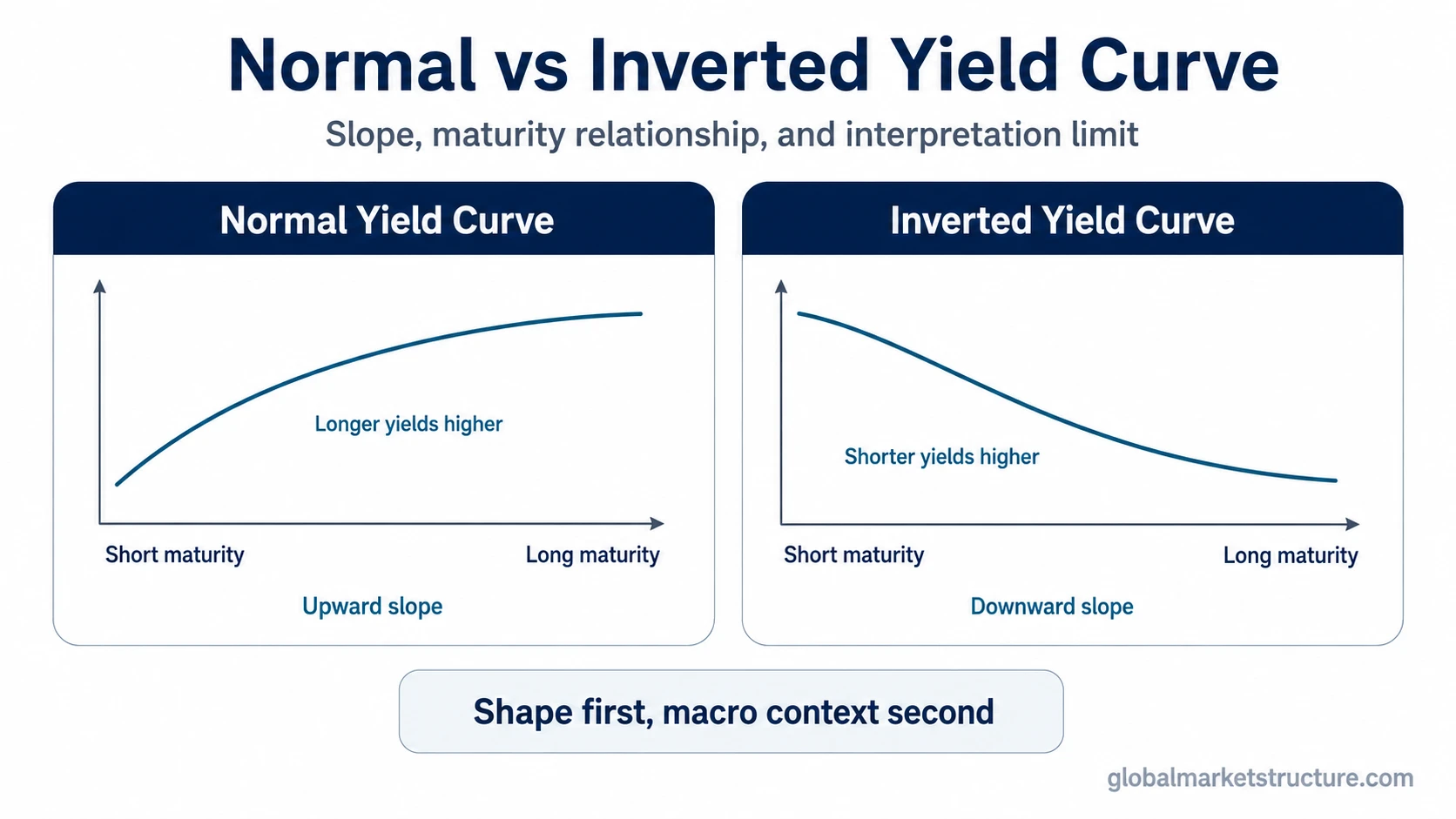
A normal yield curve slopes upward because longer-term yields are above shorter-term yields. An inverted yield curve slopes downward because short-term yields are above longer-term yields. The difference is curve shape first, not a direct market-timing signal.
Normal curve: longer maturities usually yield more than shorter maturities.
Inverted curve: shorter maturities yield more than longer maturities.
Main interpretation limit: inversion can signal macro pressure, but curve shape alone does not prove a recession, define a trade, or describe the full market regime.
Key Points
- A normal yield curve is upward sloping: longer-term yields sit above shorter-term yields.
- An inverted yield curve is downward sloping: shorter-term yields sit above longer-term yields.
- The classification depends on the relationship between maturities, not on whether markets feel bullish or bearish.
- Inversion has historically been associated with recession risk, but it is not a mechanical recession forecast.
- Spread choice, term premium, central-bank policy, global bond demand, and other macro evidence can change the interpretation.
Normal vs Inverted Yield Curve Comparison
| Curve type | Shape | Short-rate vs long-rate relationship | Typical macro reading | Main limitation | Deeper concept |
|---|---|---|---|---|---|
| Normal yield curve | Upward sloping | Short-term yields are below longer-term yields. | Often consistent with a more typical term structure where investors require extra yield for longer maturity risk. | A normal curve does not automatically mean a strong economy, low risk, or rising asset prices. | normal yield curve |
| Inverted yield curve | Downward sloping | Short-term yields are above longer-term yields. | Can reflect expectations for future rate cuts, weaker growth, policy stress, or demand for longer-duration bonds. | An inversion is not a guaranteed recession signal, market-timing rule, or direct instruction to reduce risk. | yield curve inversion |
Why the Two Curves Mean Different Things
A yield curve compares yields across maturities. The normal and inverted forms are different because the market is assigning a different price to short-term money versus long-term money.
In a normal curve, longer maturities usually carry higher yields. That can reflect the extra compensation investors often require for lending money over a longer period, accepting duration risk, and dealing with uncertainty about inflation, policy, and future growth.
In an inverted curve, the short end rises above the long end. That can happen when policy rates are restrictive, when markets expect future rate cuts, or when demand for longer-term bonds pushes longer yields lower relative to short-term yields.
The broader yield curve matters because it links rates, policy expectations, growth expectations, and risk appetite. The normal-vs-inverted distinction should still stay anchored to the maturity relationship before any macro conclusion is drawn.
Same Scenario, Different Curve Reading
Scenario: short-term rates are elevated because monetary policy is tight, while longer-term yields are falling because investors expect slower growth and future rate cuts.
Normal reading: if longer-term yields still remain above short-term yields, the curve can remain normal even if the macro backdrop is becoming less comfortable. The curve shape alone does not prove that risk conditions are healthy.
Inverted reading: if short-term yields rise above longer-term yields, the curve becomes inverted. That can point to a tighter policy and growth-expectation mix, but it still needs confirmation from credit, liquidity, labor, inflation, and market-breadth evidence.
What Inversion Can Suggest
Possible signal: an inverted curve can suggest that markets expect future policy easing, slower growth, or tighter financial conditions. It can also reflect demand for longer-term bonds, changing term premium, or global capital flows.
What it does not prove: inversion does not prove that a recession has already started, that one will begin on a precise schedule, or that any specific asset should be bought or sold.
The signal becomes more useful when it is read with other macro evidence. Credit spreads, labor-market deterioration, liquidity stress, inflation pressure, and market breadth can either reinforce or weaken the message from the curve.
Why a Normal Curve Is Not Automatically Positive
A normal curve is often treated as the default or healthier curve shape because longer yields are above short yields. That reading can be too simple.
A curve can look normal because long yields are rising for inflation-risk reasons, because the term premium is moving higher, or because bond investors require more compensation for uncertainty. In those cases, an upward slope does not automatically mean easier financial conditions or stronger risk appetite.
The normal curve label describes relative maturities. It does not replace the broader macro question: why are yields moving, which part of the curve is leading, and whether other markets confirm the same message.
Why Spread Choice Matters
| Question | Why it matters |
|---|---|
| Which maturities are being compared? | Different curve spreads can invert or normalize at different times, so the selected maturity pair changes the reading. |
| Is the short end rising or the long end falling? | An inversion caused by restrictive short rates can carry a different message than one driven mainly by strong demand for long-duration bonds. |
| What is happening in credit and liquidity? | Curve shape is more informative when it is confirmed or challenged by credit spreads, funding pressure, and broader liquidity conditions. |
| Is inflation pressure changing? | Inflation expectations and term premium can alter what a normal or inverted curve appears to signal. |
How to Read the Difference Safely
Step 1: identify the maturity pair being compared.
Step 2: classify the slope as upward, flat, or inverted.
Step 3: ask whether the short end, long end, or both are driving the change.
Step 4: compare the curve message with credit, liquidity, inflation, labor, and market-breadth evidence.
Step 5: treat the result as macro context, not as a direct trading instruction.
Interpretation Limits
A yield curve can help frame macro pressure, but it is not a complete market-regime model.
Interpretation depends on the spread being measured. A 2-year versus 10-year spread, a 3-month versus 10-year spread, and other maturity pairs can tell related but not identical stories. The same curve label can also carry different implications when inflation expectations, central-bank policy, term premium, and global bond demand are changing at the same time.
Common Mistakes
Mistake 1: Treating normal as bullish and inverted as bearish. A normal curve can appear in weak or uncertain environments, and an inverted curve can persist before markets fully react. Curve shape is a condition, not a market direction command.
Mistake 2: Treating inversion as a precise recession clock. Inversion can raise macro caution, but exact timing depends on broader economic and financial evidence.
Mistake 3: Ignoring which spread is being discussed. Different maturity pairs can invert or normalize at different times. The selected spread changes the reading.
Mistake 4: Reading the curve without context. Credit spreads, liquidity conditions, central-bank reaction function, inflation expectations, and market breadth can either reinforce or weaken the curve signal.
Related Curve Concepts
Normal yield curve analysis focuses on the upward-sloping structure where longer maturities usually yield more than shorter maturities.
Yield curve inversion analysis focuses on the downward-sloping structure and the macro caveats around short rates moving above long rates.
The broader yield curve framework connects curve level, slope, shape, and maturity structure across the rates market.