
Real yields are yields adjusted for inflation, so they show inflation-adjusted rate pressure rather than the quoted nominal yield alone. They matter in rates and market-structure analysis because they can change how tight or loose a nominal yield level feels after inflation expectations are considered.
A nominal yield tells you the quoted rate. A real yield asks what that rate means after inflation or expected inflation is accounted for. That distinction matters because the same nominal yield can create very different pressure depending on whether inflation expectations are high, low, rising, or falling.
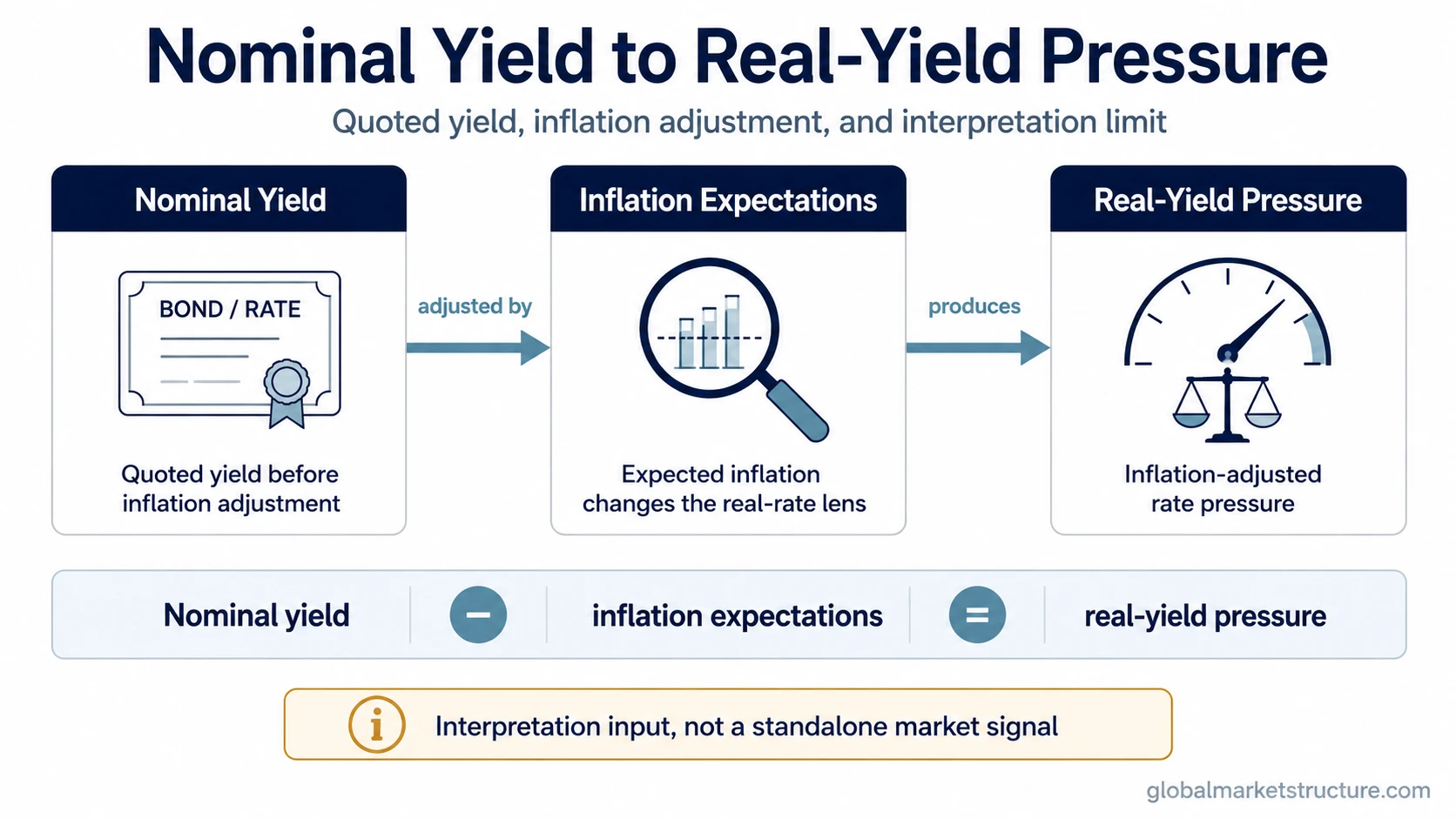
Definition: Real yields are inflation-adjusted yields. A simplified way to express the relationship is: real yield is approximately nominal yield minus inflation or expected inflation.
Market-structure role: Real yields are one input for interpreting discount-rate pressure, liquidity conditions, and duration-sensitive assets. They are not a standalone forecast for stocks, gold, recessions, or risk assets.
What Real Yields Mean
Real yields convert a quoted yield into an inflation-adjusted lens. If inflation expectations rise while the nominal yield stays unchanged, the inflation-adjusted pressure can fall. If inflation expectations fall while the nominal yield stays unchanged, the inflation-adjusted pressure can rise.
The simplified formula is useful for intuition, but it should not be treated as a complete measurement rule. Real-yield data can vary by maturity, instrument, inflation input, model, and country. A short-term real interest rate, a 10-year TIPS yield, and a model-based real-rate estimate can answer related but different questions.
Real yields help clarify four questions:
- whether a quoted yield remains high or low after inflation adjustment;
- whether inflation expectations are changing the meaning of nominal rates;
- whether discount-rate pressure is rising or falling in real terms;
- whether a rates signal needs to be checked against liquidity, growth, credit, and risk appetite.
Real Yields vs Nominal Yields
Nominal yields are the quoted rates investors see on bonds or rate series. Real yields adjust that quoted rate for inflation pressure. The difference matters because nominal rates can move for reasons that do not create the same real-rate pressure.
| Yield lens | What it shows | What changes the interpretation | Main limitation |
|---|---|---|---|
| Nominal yield | The quoted yield before inflation adjustment. | Policy expectations, growth expectations, inflation expectations, term premium, and demand for bonds. | It does not show how much yield remains after inflation pressure is considered. |
| Real yield | The inflation-adjusted yield lens. | Nominal yield level, inflation or expected inflation, maturity, instrument, and source methodology. | It does not predict asset direction by itself. |
The deeper distinction is covered in real yields versus nominal yields, where the quoted-yield baseline and inflation-adjusted lens are separated directly.
How Real Yields Are Observed
In the United States, TIPS yields are a common observable reference for real yields because Treasury Inflation-Protected Securities are linked to inflation adjustment. Treasury real yield curve data and FRED data series are better places to check current or historical values than an evergreen educational article when the reader needs a dated number.
Measurement note: TIPS yields are a common U.S. observable reference, not the only possible real-rate measure. Other sources may use model-based estimates, different maturities, country-level real interest rates, or inflation inputs that do not match a specific TIPS series.
This is why current real-yield values need a dated data source. Without the date, maturity, and method, a real-yield number can look more precise than it actually is.
Why Real Yields Matter in Market Structure
Real yields can influence discount-rate pressure because they affect how investors compare future cash flows, inflation protection, and safer yield alternatives. When real-rate pressure rises, duration-sensitive assets can face more valuation pressure, especially if growth expectations are not improving at the same time.
The interpretation still depends on context. Rising real yields can mean different things if they come with stronger growth, falling inflation expectations, tighter liquidity, widening credit spreads, or weaker risk appetite. A real-yield move becomes more useful when it is checked against the broader yield curve, credit conditions, liquidity, earnings expectations, and cross-asset behavior.
Useful interpretation sequence:
- Start with the nominal yield level.
- Check what inflation expectations are doing.
- Compare the resulting real-yield pressure with growth and liquidity conditions.
- Check whether credit, breadth, currency, and risk-asset behavior support the same message.
Practical Scenario: Same Nominal Yield, Different Real-Yield Pressure
Scenario A: A 10-year nominal yield is 4%, and expected inflation is 3%. The simplified real-yield pressure is roughly 1%.
Scenario B: The same 10-year nominal yield is 4%, but expected inflation falls to 2%. The simplified real-yield pressure is now roughly 2%.
The quoted nominal yield did not change, but the inflation-adjusted pressure became higher in the second scenario. That is why nominal yield levels can be misleading when inflation expectations are moving.
This scenario is illustrative, not a historical case. It shows the mechanism without implying that a specific asset, market, or policy episode must respond in one fixed way.
Common Misreadings
- Real yields do not predict stocks by themselves. Equity reaction depends on earnings expectations, liquidity, risk appetite, growth, positioning, and valuation context.
- Real yields do not predict gold by themselves. Gold can interact with real-rate pressure, the dollar, inflation risk, central-bank behavior, crisis demand, and positioning.
- TIPS yields are not the only possible real-yield measure. They are an important U.S. observable reference, but not a universal definition for every country, maturity, or model.
- Higher real yields do not always mean the same regime. The same move can reflect tighter policy pressure, stronger growth expectations, lower inflation expectations, or a mix of forces.
- Current values require current sources. Evergreen interpretation should not freeze a changing market number into permanent copy.
Real Yields and the Yield Curve Are Different Signals
Real yields describe inflation-adjusted yield pressure at a given maturity or across a real-rate curve. The yield curve describes the relationship between yields across maturities. Those are related, but they do not answer the same question.
A curve inversion is a shape signal, while real-yield pressure is an inflation-adjusted rate lens. The distinction matters because yield curve inversion can occur for reasons that are not identical to a rise or fall in real yields.
Related Concepts
Related rates lenses:
- Nominal yields: the quoted-yield baseline before inflation adjustment.
- Nominal vs real yields: the direct distinction between quoted rates and inflation-adjusted rates.
- Yield curve: the maturity structure of rates.
- Yield curve inversion: a curve-shape condition, not the same thing as real-yield pressure.
- Real yields and gold: a related cross-asset interpretation lens, not the center of the real-yields definition.
Real yields are most useful when they are treated as one part of a broader market-structure reading. Their message becomes clearer when nominal rates, inflation expectations, curve shape, liquidity, credit, and risk appetite are interpreted together.