
Housing sensitivity to rates appears through construction activity, permit pipelines, affordability pressure, and broader housing indicators. Rates shape financing conditions, but they do not explain the housing cycle alone. Use housing starts for current building activity, building permits for future supply intent, housing affordability for payment stress, and housing market indicators for broader macro confirmation.
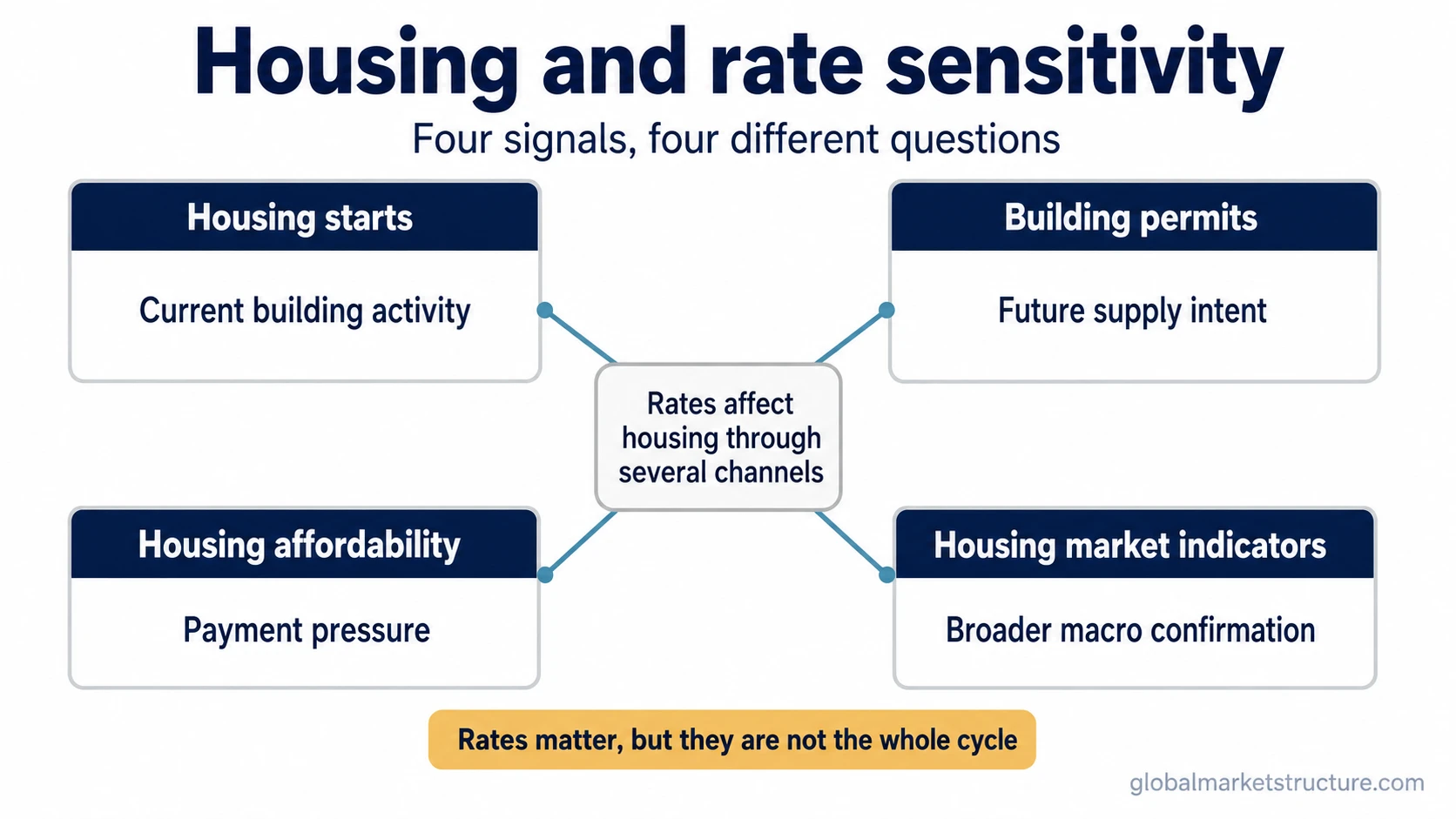
Choose the right housing-rate signal
Housing data becomes easier to interpret when each signal answers a separate question. Starts, permits, affordability, and broader indicators can all react to rates, but they do not measure the same part of the housing cycle.
| If the question is about… | Use this signal | Why it matters | What not to infer from it alone |
|---|---|---|---|
| Whether actual construction activity is expanding or contracting | housing starts | Starts track the movement from planned building into active construction. | Starts alone do not prove the full housing cycle is improving or weakening. |
| Whether future construction supply is being planned | building permits | Permits show the forward construction pipeline before every project becomes active. | Permits alone do not guarantee future starts, completions, or macro strength. |
| Whether households can absorb payment pressure | housing affordability | Affordability connects rates, home prices, income, and monthly payment stress. | Affordability alone does not explain builder behavior, supply limits, or regional differences. |
| Whether housing is confirming a broader macro condition | housing market indicators | Indicator groups combine several housing signals into a broader macro read. | A dashboard does not turn housing data into a direct forecast or trading signal. |
What belongs in housing and rate sensitivity
Housing rate sensitivity connects borrowing costs with construction incentives, household payment capacity, and the timing of housing activity. The core signals belong in four groups: actual building activity, future permit pipelines, affordability pressure, and broader housing indicator confirmation.
The boundary matters because the same rate move can affect each group differently. Lower yields may ease financing pressure, while weak income growth, wide mortgage spreads, limited supply, or cautious builder behavior can still keep activity restrained.
Why rates alone do not explain housing activity
Interest rates influence housing through financing costs, discount rates, mortgage availability, and payment affordability. That influence is important, but it is incomplete without the surrounding conditions.
Curve shape, real versus nominal yield pressure, mortgage spreads, household income, construction costs, inventory, supply constraints, and regional sensitivity can all change the meaning of a rate move. A lower policy-rate path may reduce one pressure point while other constraints keep starts, permits, or affordability weak.
How the neighboring housing signals differ
Housing starts: best for actual construction activity. The signal is closer to what builders are already doing, not only what they might do later.
Building permits: best for planned future construction. The signal can lead starts, but approved projects can still be delayed, canceled, or reshaped by financing and demand conditions.
Housing affordability: best for household pressure. The signal connects rates with income and home prices, but it does not fully capture supply, builder incentives, or regional market structure.
Housing market indicators: best for a broader dashboard view. The signal group is useful when housing needs to be compared with other macro evidence, but it should not replace the specific job of each underlying indicator.
A simple interpretation example
A lower Treasury-yield environment can make a housing rebound look tempting at first glance. The read is incomplete until the related housing signals confirm which part of the chain is responding.
If permits improve before starts, the shift may be appearing first in the planning pipeline. If affordability remains weak, household demand may still be constrained. If starts rise while broader indicators stay mixed, construction activity may be improving without confirming a full macro turn.
Signal sequence for housing-rate analysis
Start with the signal that matches the question. Use starts for present construction, permits for future supply intent, affordability for household pressure, and broader indicators when housing needs to be compared with the wider macro environment. Rate sensitivity becomes more useful when the signal is matched to the part of the housing cycle it actually measures.