
Housing starts measure new residential construction that has begun, generally when excavation starts for the foundation. They sit after permits and before completions, making them useful for judging whether planned housing activity is turning into real construction. Starts matter for housing-cycle and rate-sensitivity analysis, but one monthly report is noisy and should not be treated as a standalone forecast, recession signal, or financial-market signal.
Definition: Housing starts are new privately owned residential housing units where construction has begun. In U.S. macro data, housing starts are reported within New Residential Construction data from the Census Bureau, with Survey of Construction support funded partly by the Department of Housing and Urban Development.
Key Points
- Housing starts count residential construction that has moved beyond authorization and into actual building activity.
- A start is generally counted when excavation begins for the footings or foundation.
- Starts sit between permits and completions in the construction cycle.
- Single-family and multifamily starts can send different signals.
- Monthly starts data can be volatile, revised, and misleading when read in isolation.
What housing starts measure
Housing starts focus on construction activity, not home sales, mortgage approvals, or household qualification. The indicator counts new privately owned residential units after construction has begun.
The practical start point is the excavation or foundation stage. A project is not counted as a start simply because a buyer wants a home, a builder plans a project, or a permit has been authorized. The start requires construction activity, not only intent or authorization.
For multifamily buildings, the counting rule matters. When excavation begins for a multifamily structure, all units in that building are counted as started, not only one unit. That can make multifamily-heavy months look larger than the underlying number of separate projects might suggest.
Housing starts are reported monthly and are often shown as a seasonally adjusted annual rate. SAAR describes the annualized pace implied by the month after seasonal adjustment. It is not a forecast of how many homes will actually be started over the next year.
Measurement caution: Recent housing-starts estimates can be revised. The first release is useful for direction and context, but trend interpretation usually needs confirmation from later releases, permits, completions, and composition.
Where housing starts sit in the construction cycle
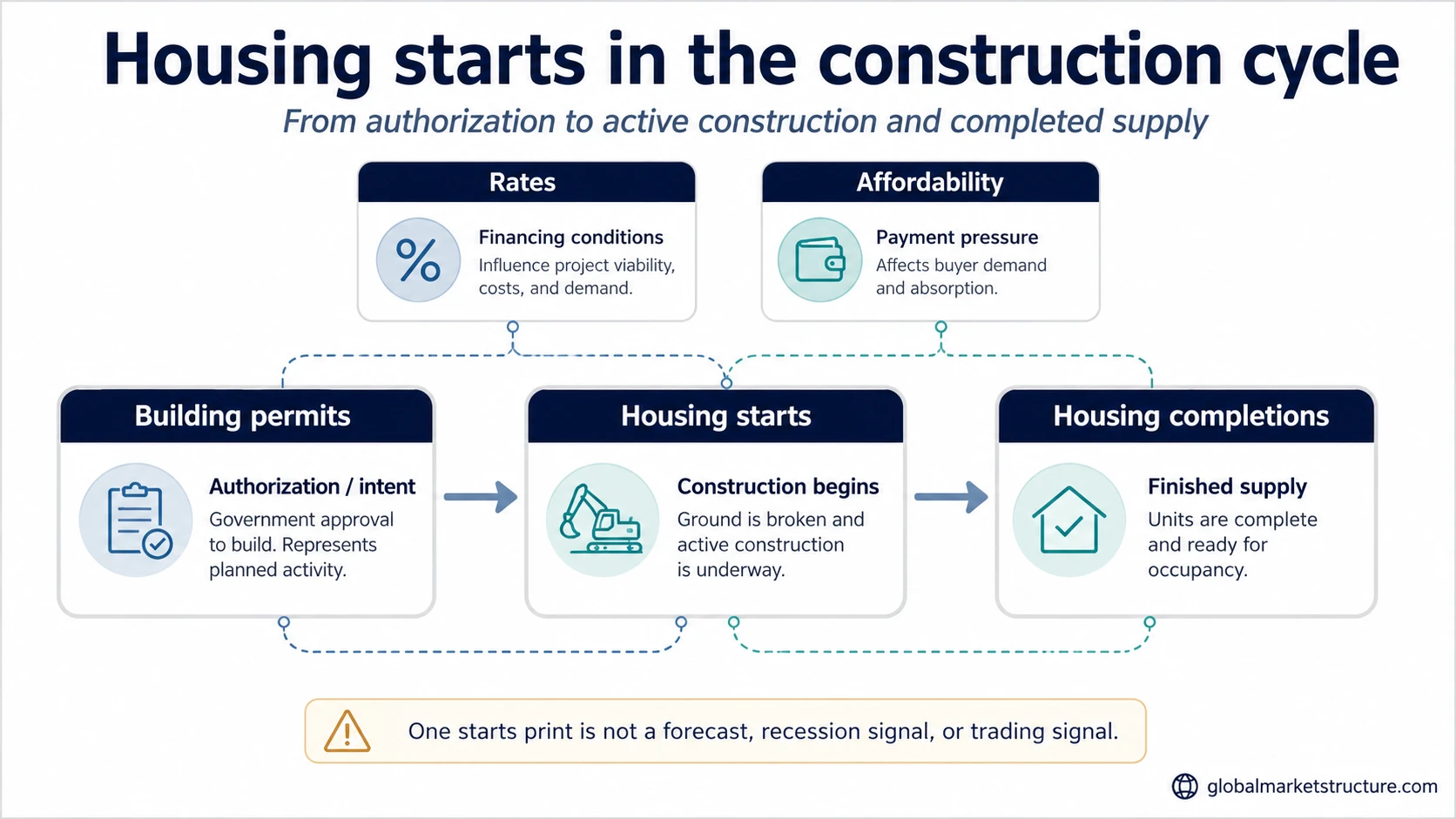
The construction cycle moves through three broad stages: authorization, construction start, and completion. Housing starts are the middle stage.
- Permits: local authorization or approval for future construction.
- Starts: construction has begun, usually at the excavation or foundation stage.
- Completions: the housing unit has reached the finished supply stage.
Building permits can soften before starts when financing costs rise, demand weakens, or builders become more cautious. Starts can lag that shift because some previously authorized projects still move forward. Completions can remain high even later because earlier projects are still being finished.
That timing gap is why the three stages should not be treated as interchangeable. Permits are closer to intent. Starts are closer to active construction. Completions are closer to delivered supply.
Housing starts vs permits vs completions
| Indicator | Construction-cycle stage | What it means | What it does not prove |
|---|---|---|---|
| Building permits | Before construction begins | Authorization or intent to build | That construction will begin immediately or at all |
| Housing starts | Construction has begun | Planned construction is turning into active building activity | That the project is complete, sold, profitable, or immune to later slowdown |
| Housing completions | After construction is finished | New supply is moving closer to the usable housing stock | That current builder demand is strong, because completions can reflect older projects |
Why housing starts matter for macro and rate sensitivity
Housing starts matter because residential construction connects interest rates, financing conditions, household demand, builder incentives, materials demand, labor activity, and future housing supply.
When rates rise or credit conditions tighten, monthly payments often become harder to absorb. That can weaken demand, reduce builder confidence, delay new projects, or shift activity toward segments where financing and inventory conditions are more favorable. Housing affordability adds the demand-pressure lens because income, prices, mortgage rates, and financing terms all affect how much housing activity can be supported.
The indicator is not only a demand measure. It also reflects builder decisions, project backlogs, land availability, regional conditions, labor capacity, materials costs, and the mix between single-family and multifamily construction.
Single-family starts can be more directly tied to owner-occupied demand and mortgage-rate sensitivity. Multifamily starts can be shaped by rental demand, financing availability, developer pipelines, and larger project timing. A headline increase can therefore mean different things depending on which segment drives the move.
Mechanism: Financing conditions and affordability pressure can affect buyer demand and builder incentives. Those changes often appear first in permits, then in starts, and later in completions, but the sequence is not mechanical or guaranteed.
How to read housing starts without overreading them
A useful housing-starts reading separates level, direction, composition, and confirmation.
- Level: the current pace of construction activity.
- Direction: whether starts are rising, falling, or stabilizing over several reports.
- Composition: whether single-family or multifamily units are driving the change.
- Confirmation: whether permits, completions, affordability, credit conditions, and broader activity data support the same interpretation.
Month-to-month changes can be noisy because housing starts are affected by weather, regional shifts, multifamily timing, survey variation, and revisions. A single strong or weak print can start a question, but it should not end the analysis.
SAAR boundary: A seasonally adjusted annual rate is an annualized description of the adjusted monthly pace. It should not be read as a promise, projection, or full-year forecast.
Common false readings
Housing starts are not a standalone recession signal. Weak starts can add evidence of housing-cycle softness, but recession interpretation needs broader confirmation from income, labor markets, credit, production, consumption, and financial conditions.
Housing starts are not a housing crash signal by themselves. A decline can reflect cooling construction momentum, affordability pressure, weather, regional shifts, or project timing. Crash language requires stronger evidence across prices, credit, defaults, demand, and inventory.
Housing starts are not a USD or trading signal. Economic calendars may frame housing data as market-moving, but a starts print does not provide a direct buy, sell, bullish, or bearish instruction.
Housing starts are not a personal affordability metric. They describe construction activity, not whether a household qualifies for a mortgage or can afford a specific property.
A practical housing-cycle scenario
A common scenario is that permits weaken first as higher financing costs or softer demand make builders more cautious. Starts may follow later because fewer authorized projects break ground. Completions can stay elevated for a while because older projects are still being finished.
That pattern can point to a cooling construction pipeline without proving a recession, housing crash, or market direction by itself. The useful signal is the timing difference between authorization, active construction, and delivered supply.
Related concepts
Building permits: useful for the earlier authorization and intent stage before construction begins.
Housing affordability: useful for the income, price, and financing-cost pressure that can influence demand and builder incentives.
FAQ
What are housing starts?
Housing starts are new privately owned residential units where construction has begun, generally at the excavation or foundation stage.
Are housing starts the same as building permits?
No. Building permits indicate authorization before construction begins. Housing starts indicate that construction has actually begun.
Are housing starts a leading indicator?
Housing starts can help read future construction activity, but they are not a clean standalone leading indicator. Interpretation depends on permits, completions, composition, affordability, credit, and broader macro data.
Why can housing starts be volatile?
Housing starts can move around because of weather, regional effects, multifamily project timing, revisions, and seasonal adjustment. One monthly print should be read with caution.
Do housing starts predict recessions?
No. Housing starts can contribute to macro interpretation, but they do not predict recessions by themselves. Broader labor, credit, income, production, and consumption data are needed for recession analysis.