
Building permits are a housing and rate-sensitivity indicator that tracks authorized new residential construction before construction begins. They can help frame whether the residential construction pipeline is expanding or cooling, but they are not completed homes, guaranteed housing starts, a recession forecast, or a standalone market signal.
Building permits: authorizations for new residential construction.
Housing starts: units where construction has begun.
Completions: finished units that have moved through the construction process.
Macro use: a conditional upstream signal for housing-cycle momentum, rate sensitivity, and construction pipeline pressure.
Key Points
- Building permits measure authorization, not finished construction.
- Permits sit upstream of housing starts, but not every permitted unit becomes an active project immediately.
- The indicator can help frame housing-cycle momentum when read with starts, affordability, financing conditions, and builder demand.
- Permit data can weaken or strengthen before construction activity fully appears in later housing measures.
- Permits should not be treated as a direct recession call, asset-price forecast, or market-timing signal.
What Building Permits Measure
Building permits measure authorized new residential construction. In macro analysis, the useful point is not the local paperwork process. The useful point is that authorization can appear before construction activity shows up in starts, units under construction, or completed housing supply.
That makes permits an upstream housing indicator. A rise in permits can suggest that builders are receiving authorization for more future construction. A decline can suggest that the future pipeline is cooling. The interpretation remains conditional because authorization can be delayed, cancelled, revised, or weakened by financing, affordability, demand, labor, material costs, or builder confidence.
Where Building Permits Sit in the Housing Construction Pipeline
The housing construction pipeline usually moves from authorization to activity and then to supply. Building permits belong near the beginning of that sequence.
Typical sequence: permit authorization → possible housing start → construction activity → completed unit → supply impact.
The sequence can break. A permit can be issued before construction begins, but tighter financing, weaker buyer demand, high mortgage rates, affordability pressure, or changing builder expectations can reduce the chance that authorization quickly turns into real construction activity.
Permits are useful but not self-sufficient. They can provide an early view of construction intent, while later housing data show whether that intent is becoming actual activity.
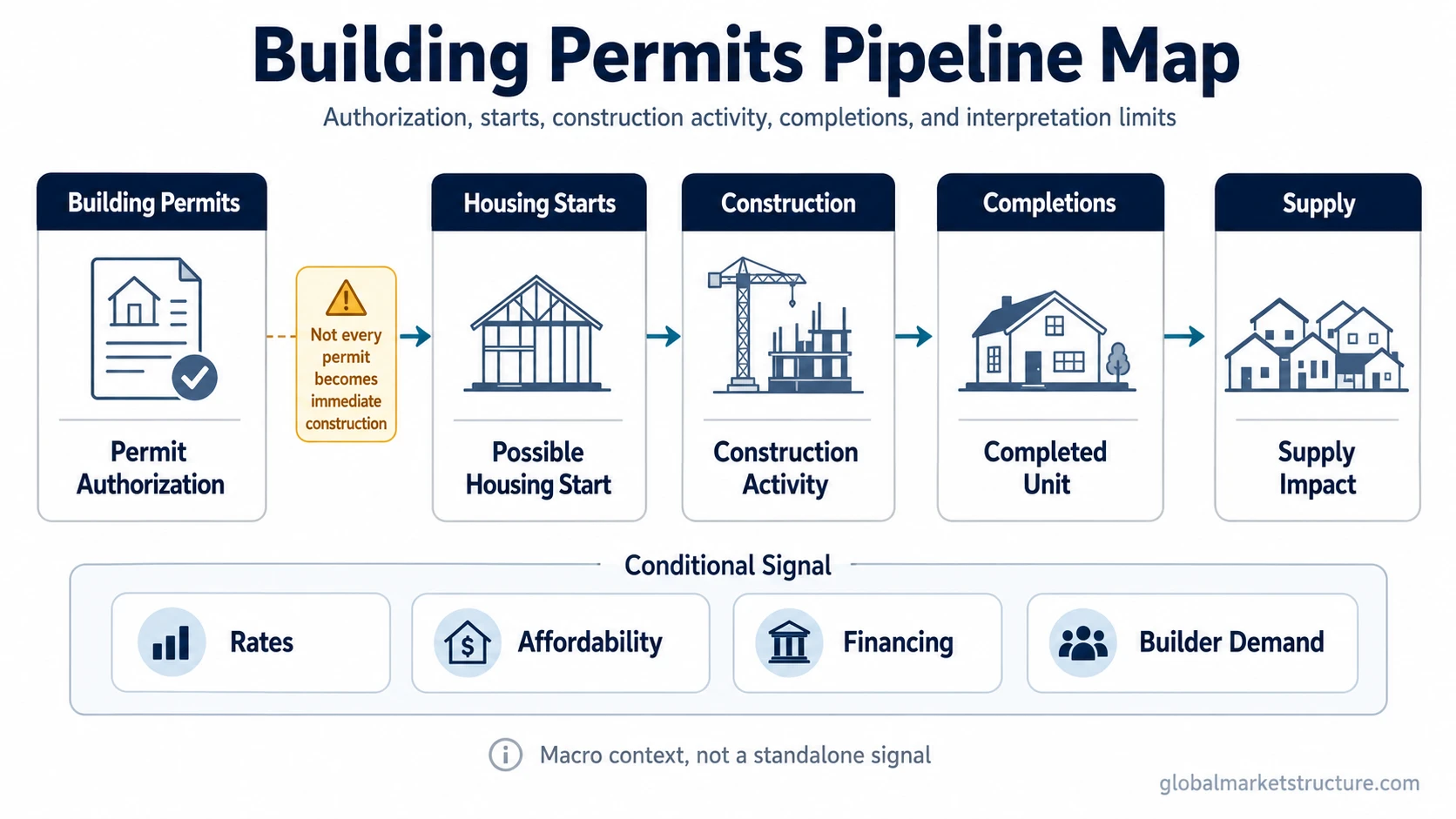
Building Permits vs Housing Starts vs Completions
The main confusion comes from treating permits, starts, units under construction, and completions as if they measure the same stage. They do not. Each sits at a different point in the residential construction process.
| Measure | What it captures | Where it sits in the pipeline | Main interpretation limit |
|---|---|---|---|
| Building permits | Authorized new residential construction | Before construction begins | Authorization may not convert into immediate construction |
| Housing starts | Residential units where construction has begun | After authorization and at the start of physical activity | Starts can lag permits and may still change with financing or demand |
| Units under construction | Projects currently moving through the construction process | During the active build phase | Shows activity already underway, not necessarily new forward intent |
| Housing completions | Finished residential units | At the end of the construction pipeline | Reflects supply delivery after earlier decisions were made |
Permits are the earliest of these stages, so they can be more forward-looking than completions. They are also less final than starts or completed units, so they require more caution.
Why Building Permits Matter for Macro Interpretation
Residential construction is sensitive to interest rates, financing conditions, affordability, household demand, and builder expectations. Building permits can therefore help show how the housing pipeline is responding before all of the activity appears in later construction data.
The indicator is most useful when it is read as part of a wider housing and rate-sensitivity picture. Rising permits can point to stronger construction intent if demand, affordability, financing, and starts confirm the signal. Falling permits can point to caution if later activity weakens as well. The reading becomes less useful when it is isolated from the broader housing environment.
Housing affordability is especially important because authorization does not guarantee that buyers can absorb future supply or that builders will move forward under tighter rate or credit conditions.
What Building Permits Can and Cannot Tell You
| Building permits can help indicate | Building permits cannot prove by themselves |
|---|---|
| Whether the authorized construction pipeline is expanding or cooling | That construction will definitely start |
| Whether housing activity may be changing before completions appear | That completed housing supply will rise or fall by the same amount |
| Whether builders may be responding to rate, demand, or affordability pressure | That a recession or recovery is confirmed |
| Whether housing-cycle momentum deserves closer attention | That equities, rates, credit, or risk assets should move in one direction |
Limitation: Building permits are not a complete housing-cycle model. They are one early-stage input. The interpretation becomes stronger when permits, starts, affordability, financing conditions, builder sentiment, credit conditions, and broader growth data point in the same direction.
How Building Permits Can Be Misleading
Building permits can be misleading when authorization is mistaken for real activity. A permit may exist before a project starts, and the project may still be delayed if financing becomes more expensive, buyers pull back, margins compress, or builders reassess demand.
A second mistake is treating one permit release as a market signal. A single change in permits does not define the macro regime. It can raise or lower attention on the housing pipeline, but the signal needs confirmation from related data before it can support a broader interpretation.
Illustrative scenario: Permits may weaken before starts clearly fall. That can suggest upstream caution, but the interpretation becomes stronger only if starts, affordability, financing conditions, and builder confidence also point toward a slowdown. If starts remain resilient and affordability improves, the permit weakness may be less decisive.
How to Read Building Permits with Other Housing Indicators
Building permits are most useful when they are compared with later-stage housing data. If permits rise while starts also improve, the signal may suggest a more active construction pipeline. If permits rise but starts do not follow, the authorization signal may be weaker than it first appears.
Affordability also matters. A permit cycle can look constructive on paper while mortgage rates, financing costs, or buyer affordability reduce the chance of smooth conversion into construction and sales activity. That is why permits should be read as an upstream input, not as a complete housing-market conclusion.
For broader context, the next layer is the full set of housing market indicators, where permits, starts, sales, affordability, supply, and rate sensitivity can be separated by role.
Official Data Source Note
Exact current values, release dates, revisions, and series metadata should be checked at the primary data source before publication or citation. Census New Residential Construction and FRED are source endpoints to verify directly when the page needs live values or technical series details.
The stable interpretation is narrower than the live data task: building permits show authorization before construction begins, and their macro value depends on whether later housing indicators confirm that authorization is becoming real activity.
Common Mistakes
| Mistake | Better interpretation |
|---|---|
| Treating permits as completed homes | Permits are authorizations near the start of the pipeline, not finished supply. |
| Assuming permits guarantee starts | Starts confirm that construction has begun; permits only show authorization. |
| Using permits as a recession signal by themselves | Permits can contribute to housing-cycle analysis, but broader labor, credit, income, inflation, and growth evidence is needed. |
| Reading permits as market timing | Permit data can influence macro interpretation, but it does not create buy or sell instructions. |
| Confusing macro permit data with local application guidance | The macro indicator concerns authorized residential construction data, not municipal permit procedures. |
FAQ
Are building permits a leading indicator?
Building permits can be treated as an upstream housing indicator because authorization comes before starts and completions. The signal is conditional because a permit does not guarantee that construction will begin or finish.
Are building permits the same as housing starts?
No. Building permits are authorizations for future construction. Housing starts count units where construction has begun. The difference matters because authorization can exist before physical activity appears.
Do building permits predict recessions?
Building permits alone do not predict recessions. They can contribute to housing-cycle analysis, but recession risk requires broader evidence from labor, credit, income, production, inflation, and financial conditions.
Why can building permits be misleading?
They can be misleading when authorization is confused with actual construction. Financing conditions, affordability, demand, builder confidence, and project delays can prevent permits from turning into immediate starts or completed units.