
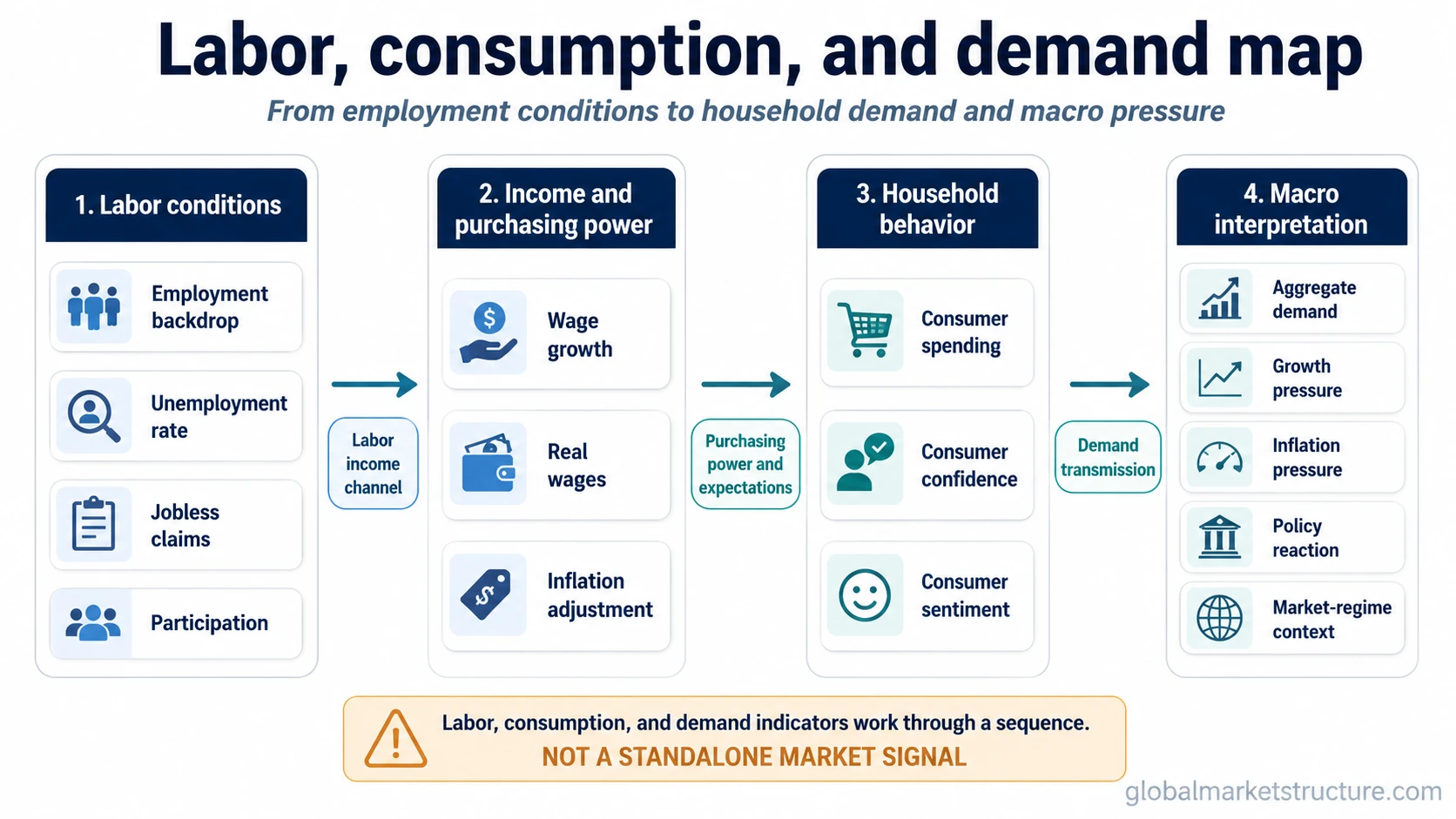
Labor, consumption, and demand indicators connect employment conditions, wage income, household spending, confidence, and broad demand inside the macro cycle. They belong together because labor conditions shape income, income affects purchasing power, purchasing power influences spending, and spending feeds into aggregate demand.
These signals should not be read as one clean market message. A firm labor market can support household demand, but the interpretation changes when wage pressure, real wages, jobless claims, participation, confidence, and spending data point in different directions.
Use this cluster to separate the question you are asking. Labor-market concepts describe employment capacity and slack. Wage concepts describe income and cost pressure. Consumption concepts describe household demand. Confidence and sentiment concepts describe expectations before they fully appear in spending behavior.
Key Points
- Labor indicators show employment capacity, slack, and income pressure.
- Consumption indicators show how households convert income, purchasing power, and confidence into spending.
- Demand indicators connect household behavior to broader macro pressure.
- The cluster is most useful when the signals are compared together, not treated as standalone market calls.
How labor, consumption, and demand connect
The basic chain runs from labor conditions to wage income, then to real purchasing power, consumption behavior, aggregate demand, inflation or growth pressure, policy reaction, and market-regime interpretation.
Cluster boundary: this area includes labor-market conditions, unemployment, claims, participation, wage growth, real wages, consumer spending, consumer confidence, consumer sentiment, and aggregate demand. Each indicator keeps a narrower analytical job, so the cluster works best as a way to separate the question before choosing the specific concept.
The chain can weaken at several points. Wage growth may not translate into stronger household demand if inflation erodes real income. Low unemployment may not carry the same meaning if participation is changing. Strong employment can also coexist with weaker sentiment if households feel pressure from prices, rates, or job security concerns.
Choose the right labor, consumption, or demand concept
The cleanest way to use this cluster is to start with the question you need answered, then move to the concept that owns that job.
| If you want to understand… | Route to… | Why it matters |
|---|---|---|
| Employment conditions and labor-market slack | labor market | Shows the broad employment backdrop behind income, slack, and hiring conditions. |
| The jobless rate as a cycle indicator | unemployment rate | Helps classify labor-cycle pressure, often as a lagging or confirming labor-market measure. |
| Early signs of labor-market cooling | initial jobless claims | Can give a higher-frequency view of labor stress before slower labor indicators fully adjust. |
| Wage income and cost pressure | wage growth | Connects household income support with labor-cost and inflation-pressure channels. |
| Purchasing power after inflation | real wages | Separates nominal wage gains from the income households can actually spend after price changes. |
| Household spending demand | consumer spending | Shows the direct consumption channel from income and confidence into economic activity. |
| Broad demand across the economy | aggregate demand | Frames economy-wide demand pressure beyond household consumption alone. |
| Survey-based consumer outlook | consumer confidence | Tracks expectations and willingness to spend before those views fully show up in behavior. |
| Household mood and inflation sensitivity | consumer sentiment index | Captures household mood, perceived financial pressure, and sensitivity to prices and income conditions. |
| Working-age participation and labor supply | labor force participation rate | Adds labor-supply and capacity context to unemployment, wages, and slack. |
A common interpretation mistake
Do not read one datapoint alone. A low unemployment rate, rising wages, weak real wages, falling sentiment, and slower spending can all exist in the same macro environment. The useful interpretation comes from the sequence across the cluster, not from forcing one indicator to carry the full message.
A firm labor report can appear alongside weaker consumer sentiment and pressure on real wages. That combination does not create a clean market signal by itself. It separates employment strength from purchasing-power pressure, then points toward consumer spending and aggregate demand for confirmation.
Where to go next
Labor conditions: start with labor market context, then compare the unemployment rate with initial jobless claims for slower versus higher-frequency labor stress context.
Wage and income pressure: use wage growth to understand income and cost pressure, then use real wages to adjust that income view for price changes.
Household demand and confidence: move from consumer spending to consumer confidence and the consumer sentiment index to separate actual spending behavior from survey-based expectations.
Broad demand: use aggregate demand when the question moves beyond households into economy-wide demand pressure, then add the labor force participation rate when labor supply and capacity matter to the interpretation.