
Initial jobless claims are weekly first-time filings for unemployment insurance. They are a timely labor-market flow indicator because they show new claims for unemployment benefits, but they are not the unemployment rate, not continued claims, not consumer confidence, not the consumer sentiment index, and not a standalone market signal.
Current release values belong with official data sources and government releases. Initial jobless claims are more useful in macro interpretation when the data is separated from nearby labor and survey indicators and when one weekly print is treated cautiously inside a broader labor, income, and demand sequence.
Source boundary: Latest values, revisions, and release tables belong with official unemployment insurance data sources. The interpretation layer is about what the series can and cannot say inside a broader macro sequence.
What initial jobless claims measure
Initial jobless claims measure first-time applications for unemployment insurance during a weekly reporting period. The series is watched because it can show new labor-market stress earlier than slower-moving indicators.
The key word is initial. These claims capture new filings, not the full number of unemployed people and not the number of people who remain on unemployment insurance after an earlier claim. Because the series is based on unemployment insurance filings, it does not capture every form of joblessness or every person outside work.
| What initial jobless claims are | What they are not |
|---|---|
| Weekly first-time unemployment insurance filings | The unemployment rate |
| A timely labor-market flow indicator | Continued claims |
| A possible sign of new labor-market stress if the move is sustained | Consumer confidence or sentiment |
| One input in labor, income, and demand interpretation | A standalone recession or market signal |
What initial jobless claims do not measure
Initial claims do not measure the unemployment rate. The unemployment rate is a broader labor-market statistic based on the share of the labor force that is unemployed and actively looking for work. Initial claims only capture new unemployment insurance filings.
Initial claims are also different from continued claims. Continued claims focus on people who are still receiving unemployment insurance after filing earlier. Initial claims are more about new job-loss pressure, while continued claims are more about whether unemployment is persisting.
Initial jobless claims are not survey-based confidence data. Confidence and sentiment indicators describe how households say they feel about finances, jobs, or the economy. Jobless claims are hard labor-market filings, so they belong in a different part of the labor and demand evidence stack.
Initial claims vs continued claims vs unemployment rate
The same labor market can look different depending on which measure is being used. Initial claims can turn before broader labor data, continued claims can show persistence, and the unemployment rate gives a wider but less weekly view of labor-market conditions.
| Indicator | What it shows | Why it differs |
|---|---|---|
| Initial claims | New first-time unemployment insurance filings | Timely flow indicator for new labor-market stress |
| Continued claims | People continuing to receive unemployment insurance | Shows whether unemployment is persisting after the initial filing |
| Unemployment rate | Share of the labor force unemployed and actively looking for work | Broader labor-market measure, but not a weekly first-filing indicator |
This distinction matters because a single claims release can be timely without being complete. A clean interpretation usually asks whether initial claims are moving in the same direction as continued claims, payrolls, wages, participation, and household demand data.
Why initial jobless claims matter in macro interpretation
Initial claims matter because they can show when labor demand is starting to weaken at the margin. If more people are filing for unemployment insurance for the first time, the data may indicate that job separation pressure is rising.
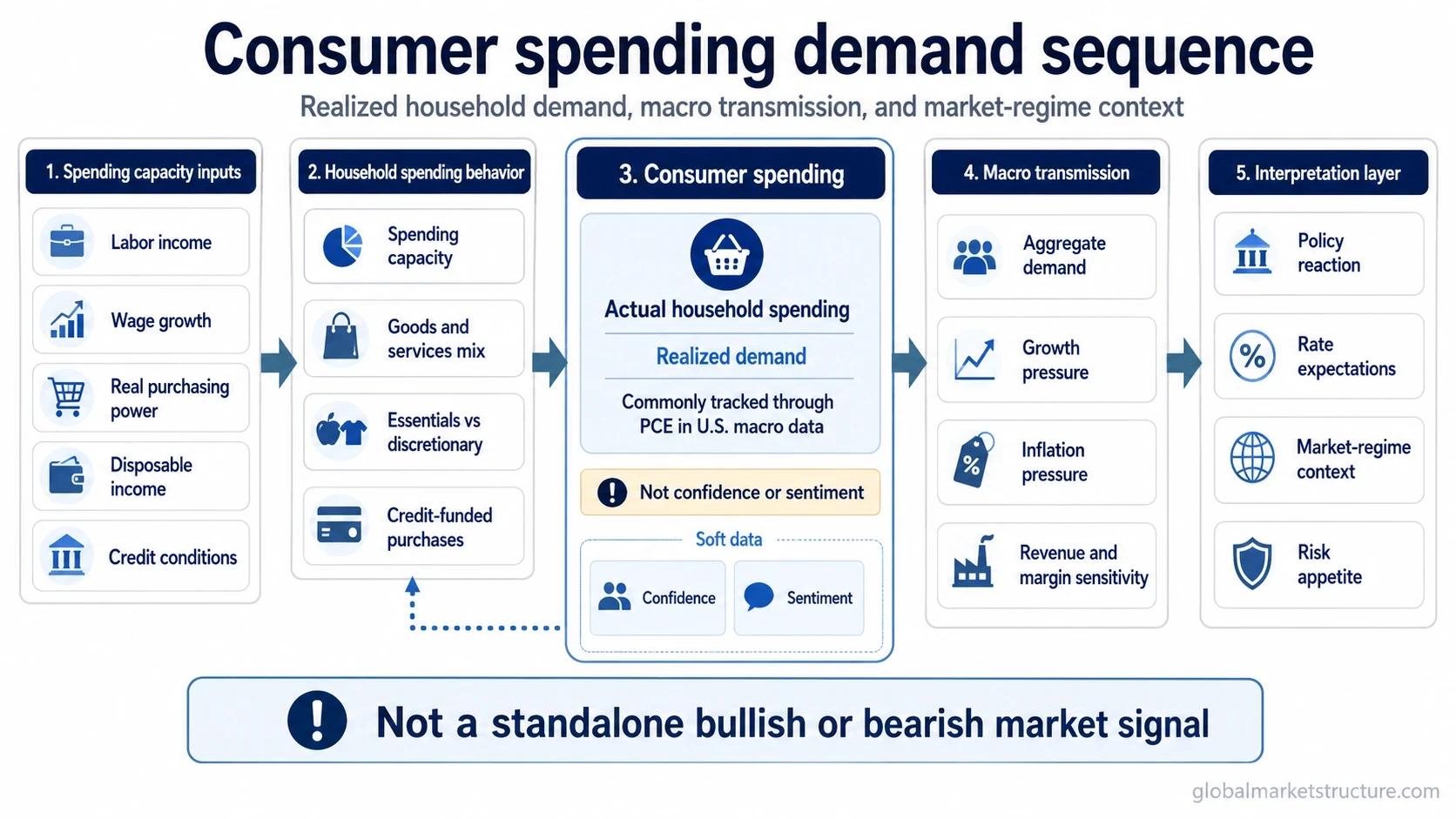
The macro link is conditional. Rising initial claims can point to labor cooling, labor cooling can pressure household income, weaker income can affect consumption, and softer consumption can feed into aggregate demand. That sequence is not automatic, but it is the reason claims are watched inside broader macro analysis.
For market-regime interpretation, initial claims are best treated as one part of a confirmation stack. They can matter more when they move with weaker payroll growth, softer wage pressure, higher continued claims, weaker confidence or sentiment, and slower spending data.
Why weekly claims data can be noisy
Initial claims are useful partly because they are timely. The same timeliness also makes the data easier to overread. Weekly releases can be affected by revisions, seasonal adjustment, holidays, reporting timing, and temporary disruptions, so a single observation should not carry the full interpretation.
Limitation: One weekly claims print is not enough. Claims data can be noisy, revised, and affected by calendar effects or temporary disruptions. The signal becomes more useful when sustained direction appears in the 4-week average and is confirmed by related labor, income, confidence, and spending data.
The 4-week average helps smooth some of that week-to-week noise. It does not remove every limitation, but it can make the direction of the data easier to interpret than a single release.
How to interpret claims without overreading them
A stronger interpretation starts with direction and persistence. A one-week increase can be noise. A sustained rise, especially if it appears in the 4-week average, can become more meaningful.
The next step is confirmation. Initial claims become more useful when they are checked against continued claims, the unemployment rate, labor force participation, payroll growth, wage data, household confidence, sentiment, and actual spending behavior.
A practical scenario is a sustained rise in initial claims alongside rising continued claims, weaker confidence, and softer spending data. That combination does not prove a downturn by itself, but it can indicate that the labor-to-demand sequence is weakening across more than one measure.
Common mistakes when reading initial jobless claims
A common mistake is treating one weekly release as a complete labor-market diagnosis. Initial claims are timely, but timeliness is not the same as completeness.
Another mistake is reading claims as if they were the unemployment rate. Initial claims measure new filings. The unemployment rate measures a broader labor-force condition. They can move together in some environments, but they are not the same indicator.
A third mistake is turning claims into a direct market signal. A higher or lower claims print is not automatically bullish or bearish. The market interpretation depends on the broader regime, inflation context, policy expectations, income conditions, and confirmation from other data.
Related indicators to watch with initial claims
Initial claims are most useful when they are read beside other labor and demand indicators. Continued claims can show whether unemployment is persisting. Payrolls and wages help show whether labor income is still supporting household demand. Participation can change how unemployment data should be interpreted.
Survey-based indicators can add a different angle. If hard labor data weakens while confidence and sentiment also deteriorate, the household demand picture may become more concerning. If claims are noisy but confidence and spending remain stable, the interpretation may be less severe.
The cleanest reading usually separates the data types: claims show labor-market filings, confidence and sentiment show household attitudes, and spending data shows realized demand.
FAQ
Are initial jobless claims the same as the unemployment rate?
No. Initial jobless claims are weekly first-time unemployment insurance filings. The unemployment rate is a broader measure of the share of the labor force that is unemployed and actively looking for work.
What is the difference between initial claims and continued claims?
Initial claims measure new first-time filings for unemployment insurance. Continued claims measure people who remain on unemployment insurance after an earlier claim.
Can one jobless claims report signal a recession?
One report should not be treated as a recession signal by itself. Claims are more useful when a sustained trend appears and is confirmed by broader labor, income, confidence, and spending data.