
Aggregate demand means the total planned demand for final goods and services in an economy. It is a demand-side macro concept built from consumption, investment, government spending, and net exports. For market interpretation, aggregate demand helps frame growth pressure, inflation pressure, and policy context, but it does not forecast market direction by itself.
Key Points
- Aggregate demand describes total spending demand across the economy.
- The common expenditure formula is AD = C + I + G + (X – M).
- It is related to GDP measurement, but it should not be treated as identical to GDP in every analytical context.
- Its market meaning changes when supply capacity, inflation pressure, policy reaction, liquidity, and risk appetite change.
Aggregate Demand Formula and Components
The common aggregate demand formula is:
AD = C + I + G + (X – M)
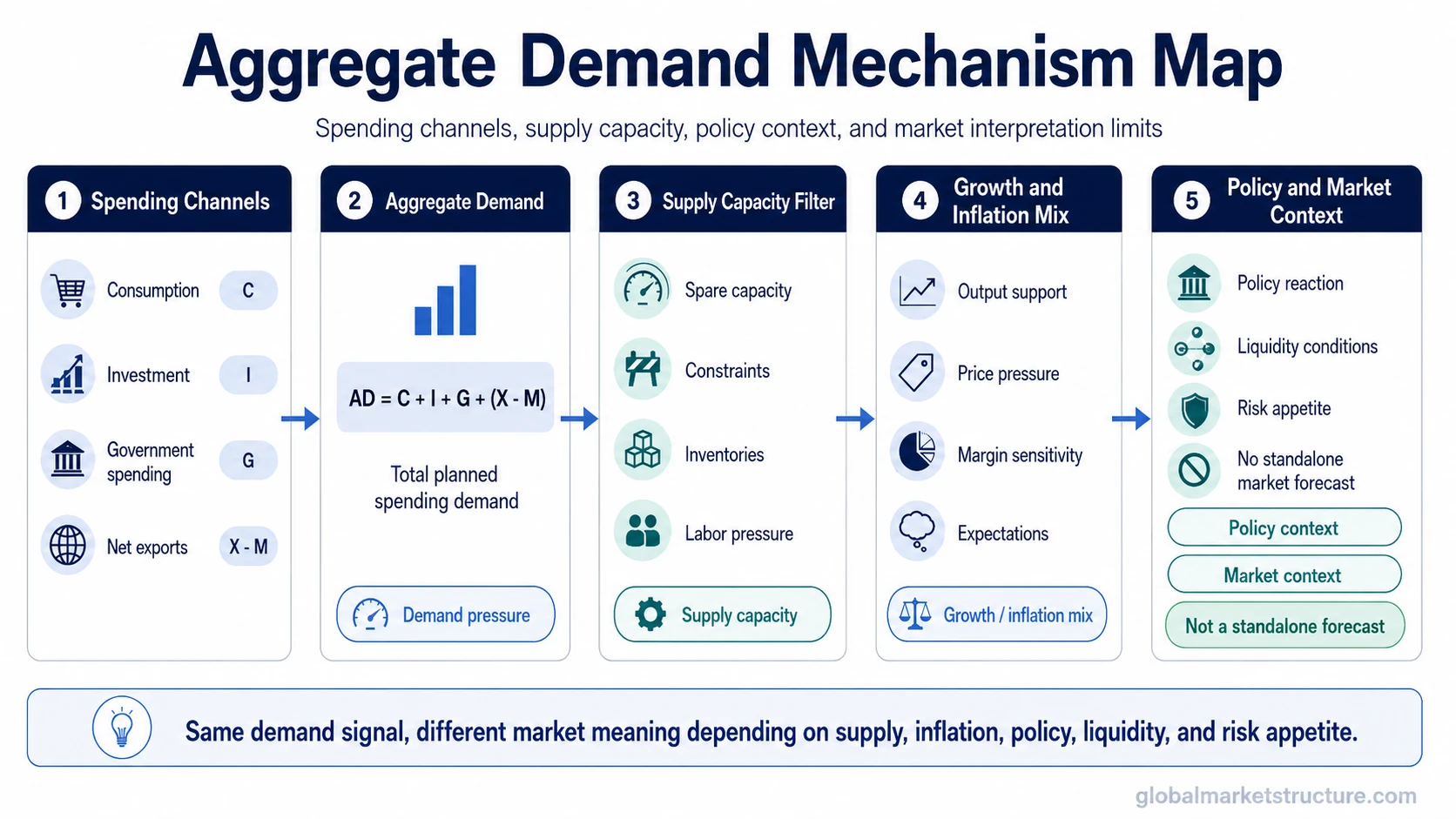
Each part represents one spending channel. The formula separates household demand, business demand, public-sector demand, and foreign demand instead of treating demand as one vague force.
| Formula part | Component | What it captures | Interpretation boundary |
|---|---|---|---|
| C | Consumption | Household purchases of final goods and services, often the largest demand channel in many economies. | Consumer spending is a component of aggregate demand, not the whole concept. |
| I | Investment | Business spending on equipment, structures, inventories, and productive capacity. | Investment can be sensitive to financing conditions, expected demand, margins, and uncertainty. |
| G | Government spending | Public-sector purchases of final goods and services. | Government spending can support demand, but it does not automatically determine growth, inflation, or market direction. |
| X – M | Net exports | Exports minus imports, capturing foreign demand for domestic output after subtracting domestic spending on imported goods. | Net exports can shift with exchange rates, external demand, trade exposure, and import intensity. |
The aggregate demand curve frames total planned spending at different price levels. A full curve analysis belongs to broader AD-AS theory. The core interpretation is narrower: total demand can shift because spending channels, price-level relationships, expectations, or financial conditions change.
How Aggregate Demand Works as a Macro Pressure Input
Aggregate demand begins with spending sources. Household income and real wages affect consumption. Business confidence, financing costs, and expected sales affect investment. Fiscal settings affect public-sector demand. Exchange rates and foreign growth affect net exports.
The next step is the supply-capacity interaction. Stronger demand can support output when spare capacity exists. The same demand pressure can become more inflation-sensitive when supply is constrained, inventories are tight, labor markets are stretched, or import costs are rising.
Mechanism sequence: demand source, spending channel, supply-capacity interaction, growth and inflation mix, policy reaction, and market interpretation boundary.
That sequence is the main reason aggregate demand matters for market-structure interpretation. Demand does not move markets in isolation. Its meaning depends on whether the economy can absorb demand through real output, whether inflation pressure rises, whether policy becomes more restrictive, and whether liquidity conditions support or weaken risk appetite.
Aggregate Demand, GDP, and Aggregate Supply
Aggregate demand is closely related to GDP through the expenditure approach, because GDP can be measured through consumption, investment, government spending, and net exports. The relationship is useful, but the concepts should not be flattened into one meaning in every context.
GDP is a measurement of output or income in an economy over a period. Aggregate demand is the demand-side spending structure that helps explain pressure on that output. In equilibrium models, demand and supply can meet at a level of output and prices, but the demand side is only one part of the full macro picture.
Aggregate supply is the production-side counterpart. It reflects the economy’s capacity to produce goods and services at different price levels. When aggregate demand rises against flexible supply, the growth effect can be different from a demand rise against constrained supply. That distinction is central to interpreting inflation pressure.
Consumer spending: one household demand channel inside aggregate demand.
Aggregate demand: the full demand-side spending structure across households, firms, government, and net exports.
Aggregate supply: the production-capacity side that determines how much demand becomes real output versus price pressure.
GDP: a broad output measurement connected to the expenditure identity, not a synonym for every use of aggregate demand.
What Shifts Aggregate Demand
Aggregate demand can shift when the willingness or ability to spend changes across one or more components. Household demand can move with income growth, employment conditions, real wages, credit availability, wealth effects, and confidence. Business investment can move with rates, expected sales, financing access, margins, and uncertainty.
Expectations matter because planned spending depends on what households and firms think future conditions may look like. A rise in consumer confidence can support spending willingness, while weaker confidence can restrain demand even before hard data fully deteriorates.
Fiscal policy can shift demand through government spending, taxation, transfers, and public investment. External demand can shift through foreign growth, exchange rates, commodity exposure, and import demand. None of these factors works in isolation; their effect depends on the wider macro setting.
What Aggregate Demand Can and Cannot Tell You
Aggregate demand is most useful as a pressure input. It can clarify whether demand-side forces are supporting activity, adding inflation pressure, weakening revenue conditions, or changing the likely policy backdrop. It becomes weaker when treated as a direct forecast for any single market.
| Aggregate demand can help interpret | Aggregate demand cannot determine by itself |
|---|---|
| Whether demand pressure is rising or fading across the economy. | Whether real growth will accelerate, because supply capacity and productivity also matter. |
| Whether spending pressure could add to inflation risk. | Whether inflation will rise, because supply shocks, margins, expectations, and policy also matter. |
| Whether policy makers may face a different growth-inflation mix. | The exact central bank reaction, timing, or policy path. |
| Whether revenue and margin sensitivity may change across sectors. | Equity, bond, currency, or credit-market direction. |
| Whether risk appetite may need to be judged against macro pressure. | A risk-on or risk-off outcome without liquidity, rates, credit, and breadth confirmation. |
False reading to avoid: stronger aggregate demand does not automatically mean stronger markets. If demand is rising while supply is tight, inflation pressure may increase. If policy then becomes more restrictive, the market interpretation can change even when the demand data looks firm.
Aggregate Demand Example in Context
A practical scenario is a period when household spending improves, business investment stabilizes, and exports stop weakening. That combination can point to firmer aggregate demand. The interpretation remains incomplete if supply capacity is limited, input costs are rising, or policy makers are already focused on inflation pressure. The same demand improvement can support growth in one setting and increase tightening risk in another.
The useful distinction is not whether aggregate demand is good or bad. The more important question is what kind of pressure it creates after supply capacity, inflation, policy reaction, liquidity, margins, and risk appetite are considered together.
Related Concepts
Consumer spending gives the household-demand lens inside aggregate demand. Consumer confidence gives the expectations and sentiment lens that can influence spending willingness. Aggregate supply, GDP, real wages, wage growth, and labor-market conditions add separate context, but they should not replace aggregate-demand analysis.