
Volatility risk premium is compensation associated with bearing volatility risk. It is commonly inferred by comparing option-implied volatility with expected or subsequently realized volatility over a matched horizon. The exact construction and sign convention can vary, so the measurement definition should be clear before a positive or negative reading is interpreted.
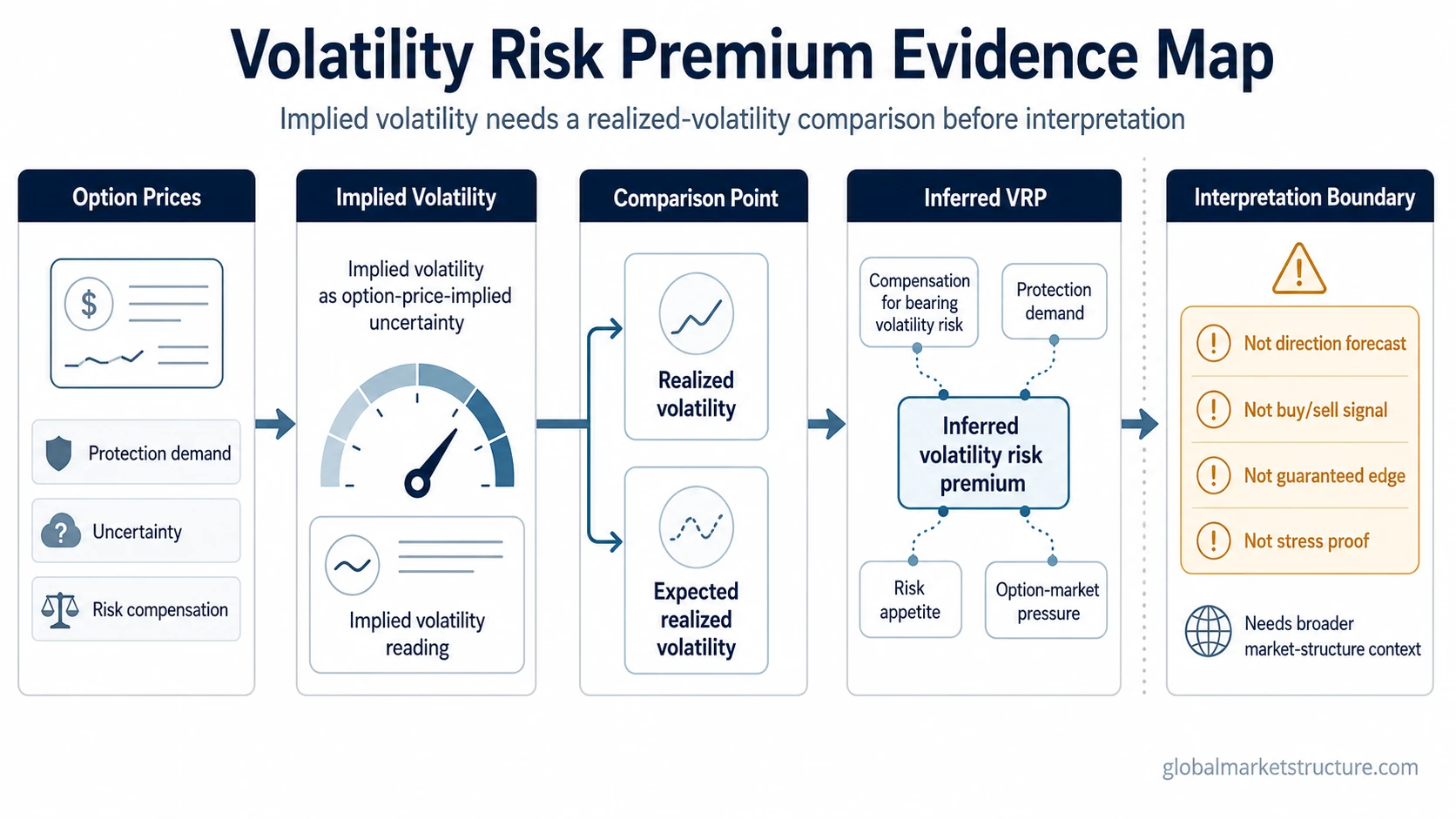
How Volatility Risk Premium Is Inferred
Option prices provide an implied-volatility measure that reflects expected future movement together with compensation for bearing volatility risk. A realized-volatility estimate or projection provides the comparison point. The difference can then be used as a proxy for the volatility risk premium when the underlying asset and measurement horizon are aligned.
Current option prices embed a market-implied measure of expected volatility.
The comparison should refer to the same underlying asset and a consistent horizon.
The result is an inferred premium rather than a directly observed market price.
BIS describes volatility risk premium using the difference between implied volatility and projected realized volatility. A New York Fed analysis uses the reverse subtraction, realized volatility minus option-implied volatility. The economic idea is closely related, but the sign changes with the convention. State the convention before interpreting a positive or negative value. Source: BIS. Source: New York Fed.
Volatility Risk Premium and Nearby Concepts
| Concept | Main meaning | Relationship to VRP |
|---|---|---|
| Implied volatility | A volatility measure derived from option prices. | It provides the option-market side of the comparison used to infer VRP. |
| Realized volatility | Observed price variability over a measured period. | Realized or expected realized volatility can provide the benchmark for the comparison. |
| Volatility risk premium | Compensation associated with bearing volatility risk. | It is inferred from a comparison between option-implied and realized or expected realized volatility. |
| Variance risk premium | A related risk premium expressed in variance terms. | It uses a closely related economic idea but a different measurement frame, so the two should not be assumed to be numerically interchangeable. |
Why the Premium Can Exist
Investors may be willing to pay for protection against unfavorable volatility shocks, while participants bearing that risk can require compensation. Option-implied volatility can therefore contain both an expectation about future movement and a risk-compensation component.
The size of the premium does not identify one unique cause. The same observed gap can reflect different combinations of expected volatility and compensation for bearing volatility uncertainty. Interpretation is more reliable when the measurement definition, horizon, and surrounding market conditions are kept explicit.
How VRP Fits the Volatility and Stress Framework
VRP adds a pricing layer to volatility analysis. volatility clustering describes persistence in movement intensity, while broader market stress asks whether strain is appearing across several market channels. VRP can exist with or without either condition.
The premium can compensate for real volatility and tail risk. Its presence alone does not establish future market direction, a profitable strategy, or a complete stress diagnosis. Comparisons are most useful when the underlying asset, horizon, volatility measure, and sign convention are consistent.