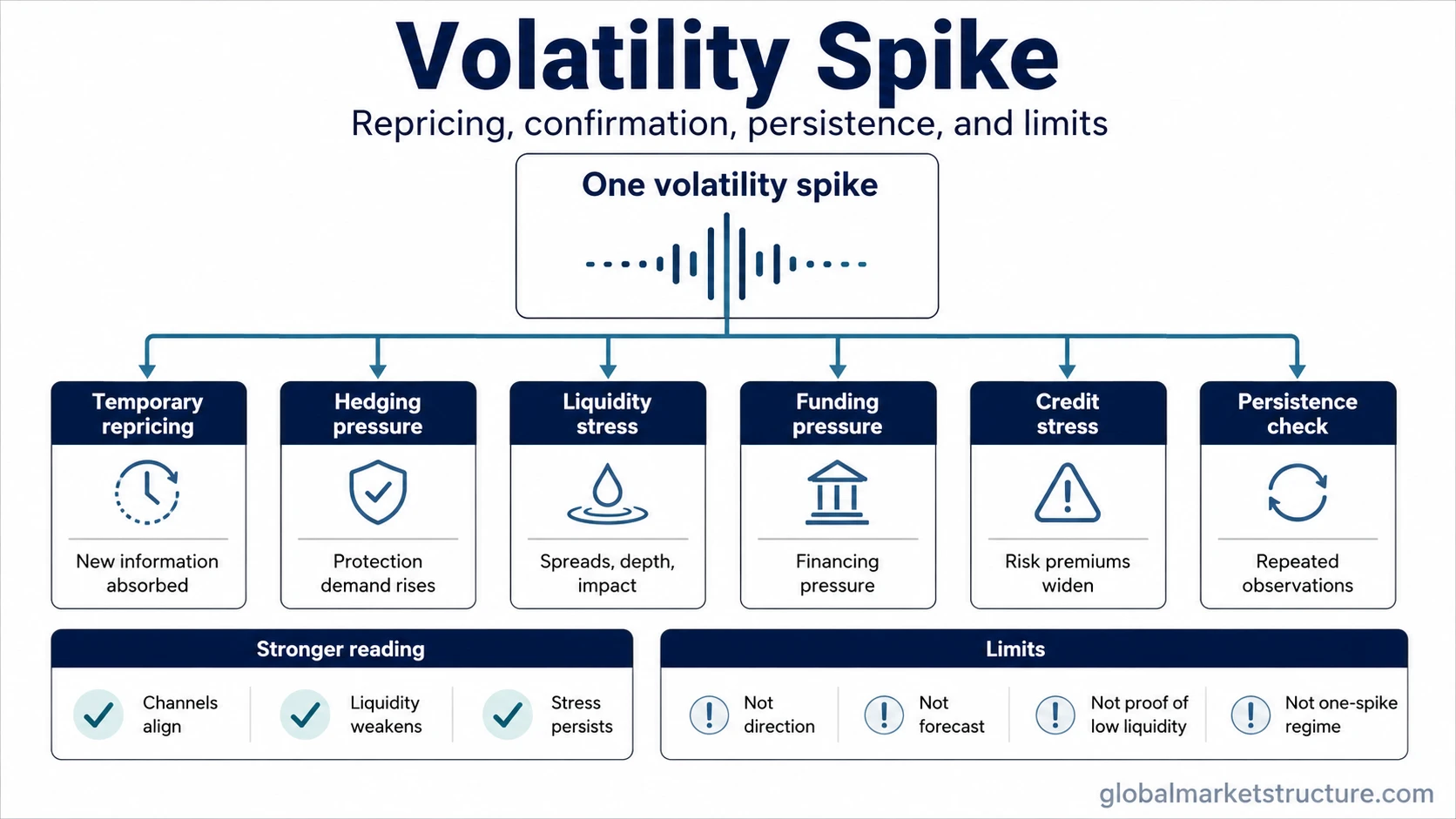
A volatility spike can signal sudden repricing, rising hedging demand, a shift in risk appetite, or early stress in the market environment. It does not prove market direction, a crisis, low liquidity, or a new volatility regime by itself. The reading becomes more useful when liquidity, credit, funding, breadth, and persistence confirm that the move is part of a broader stress pattern.
A single jump in movement is useful as a warning flag, not as a complete diagnosis. The interpretation depends on what changed around the spike: whether trading costs rose, market depth weakened, credit risk widened, funding pressure appeared, or the move faded once positioning pressure cleared.
Key Points
- A volatility spike is a sudden increase in expected or realized market movement.
- It can reflect repricing, hedging pressure, forced adjustment, uncertainty, or stress.
- It carries stronger stress evidence when liquidity, credit, funding, breadth, and persistence align.
- It is weaker evidence when the move is isolated, short-lived, asset-specific, or unsupported by broader market signals.
- One spike is not enough to define a sustained volatility regime.
What a volatility spike can signal
A volatility spike usually means the market has moved from a calmer pricing state into a sharper uncertainty state. The cause may be a policy surprise, inflation shock, earnings reset, leverage adjustment, geopolitical event, liquidity gap, or crowded-position unwind.
The spike itself only says that movement expectations or realized movement have increased quickly. It does not say whether the next move must be up or down. A sharp rally after a panic low, a disorderly selloff, and an event-driven repricing can all produce higher volatility, but they do not carry the same market meaning.
The useful question is whether the spike is being confirmed by surrounding evidence. A temporary shock with stable liquidity and contained credit risk has a different meaning from a volatility spike that appears alongside wider spreads, weaker depth, funding pressure, and broad risk-off participation.
What counts as a volatility spike
A volatility spike is a sudden jump in the size or expected size of price movement. It may appear in realized price behavior, in options-implied pricing, or in market volatility indexes tied to a specific asset class.
The term should stay narrower than general volatility. Volatility describes the degree of movement or uncertainty. A spike describes an abrupt change in that condition.
That distinction matters because a spike can be brief. Markets can reprice quickly around a policy surprise, earnings shock, inflation release, liquidity gap, or positioning unwind, then return to a calmer state. A persistent environment requires repeated evidence, not one abrupt observation.
Stronger vs weaker evidence
The same volatility spike can mean different things depending on confirmation. Stronger readings come from alignment across market channels. Weaker readings come from isolated movement without supporting stress evidence.
| Reading | Stronger evidence | Weaker evidence | Why it matters |
|---|---|---|---|
| Temporary repricing | The move follows a clear event and stabilizes after the market absorbs new information. | The spike keeps extending without a clear information anchor or stabilization pattern. | A temporary repricing can be sharp without becoming a broader stress condition. |
| Hedging pressure | Options demand rises, downside protection becomes more expensive, and risk appetite weakens. | Options pricing moves briefly while broader market participation remains stable. | Hedging pressure can lift expected movement without proving a lasting regime shift. |
| Liquidity stress | Bid-ask spreads widen, depth falls, market impact rises, and prices move more per unit of flow. | Volatility rises while trading remains orderly and transaction conditions stay stable. | Volatility becomes more serious when the market absorbs flow poorly. |
| Funding pressure | Leveraged participants reduce exposure, collateral pressure rises, and financing conditions tighten. | The spike appears without visible pressure in financing or forced positioning channels. | Funding pressure can turn a price move into a broader deleveraging process. |
| Credit stress | Credit spreads widen, risk premiums rise, and lower-quality credit weakens relative to safer assets. | Equity or options volatility rises while credit markets remain contained. | Credit confirmation helps separate market noise from deeper risk repricing. |
| Volatility regime change | Elevated volatility persists across repeated observations and appears across related markets. | The spike fades quickly and the surrounding environment returns to its prior range. | A regime is a sustained state, not a single jump. |
Temporary repricing vs broader stress evidence
A temporary volatility spike can happen when markets quickly absorb new information. A policy surprise, inflation surprise, earnings shock, or crowded-position unwind can force prices to move faster while the market recalibrates. If liquidity remains functional and credit stress does not spread, the spike may be more about repricing than systemic pressure.
Broader stress evidence appears when the spike is not isolated. The reading becomes more serious when market depth thins, transaction costs rise, funding conditions tighten, credit spreads widen, safe-haven behavior strengthens, and market breadth deteriorates at the same time.
This is why a volatility spike should be treated as part of an evidence stack. It can start the investigation, but it should not finish it. The surrounding channels decide whether the spike is a short-lived adjustment, a liquidity warning, a funding stress signal, or part of a more persistent market regime.
When liquidity changes the interpretation
Liquidity changes the meaning of a volatility spike when the market becomes less able to absorb trading without large price impact. High movement alone does not prove low liquidity. The stronger warning appears when high movement coincides with wider spreads, thinner order books, weaker resiliency, higher market impact, or rising cost to trade.
This distinction prevents a common error. Volatility describes movement or uncertainty. Liquidity describes the market’s ability to absorb flow. They can interact, but they are not the same condition.
A volatility spike with stable liquidity may reflect fast repricing. A volatility spike with deteriorating liquidity can reflect stress in the market’s absorption capacity. The second case is more important for risk-environment interpretation because price changes may become self-reinforcing when participants cannot transact without pushing prices further.
Why one spike is not a volatility regime
A volatility regime is a sustained environment of low, moderate, or high volatility. One spike does not establish that environment. It only shows that volatility changed sharply at one point in time.
Regime interpretation requires persistence. Elevated movement should remain visible across repeated observations, related assets, or multiple risk channels before it becomes reasonable to describe the environment as a higher-volatility regime.
The distinction is especially important after event shocks. A market can experience a sharp volatility burst, absorb the event, and return to prior conditions. Calling that a regime change too early can overstate the evidence and turn a short-term observation into a broader claim the data has not yet confirmed.
Common false readings
Crisis proof: A volatility spike can appear during crisis conditions, but it does not prove a crisis by itself. Confirmation needs broader stress evidence.
Direction forecast: Higher volatility means larger or less certain movement, not a guaranteed next direction.
Liquidity proof: Volatility can rise while liquidity remains functional. Liquidity stress needs evidence from spreads, depth, market impact, and resiliency.
Market-bottom signal: A spike can appear near turning points, but it is not a market-bottom label without separate evidence.
Regime label: A single jump is not a durable volatility regime. Persistence matters.
Illustrative scenario
A market reacts sharply to a policy surprise and volatility jumps for one session. If bid-ask spreads remain stable, credit spreads stay contained, and the move fades after the information is absorbed, the spike may be a temporary repricing event.
The same observation carries a different message if it is followed by wider spreads, weaker depth, rising market impact, pressure in credit, and repeated high-volatility sessions. Then the spike is no longer just a movement event. It becomes part of a broader stress evidence stack.
How to read the signal without turning it into a forecast
The cleanest reading starts with classification. Ask whether the spike is expected, realized, or both. Implied volatility reflects expected movement priced through options markets, while realized volatility reflects what has already occurred in price behavior.
Then check confirmation channels. Liquidity conditions, credit spreads, funding pressure, breadth, safe-haven behavior, and persistence help separate a narrow shock from a broader risk-environment shift.
Finally, keep the conclusion conditional. A volatility spike can raise attention. It can strengthen a stress interpretation when other evidence aligns. It should not be converted into a standalone prediction, buy/sell signal, crisis label, or regime call.
Related concepts
Use the broader volatility concept when the question is about movement or uncertainty in general. Use implied volatility when the question is about expected movement priced through options. Use realized volatility when the question is about movement already observed in prices.
Use volatility regime when the question is no longer about one spike, but about whether the market has moved into a sustained low, moderate, or high-volatility state.
FAQ
Does a volatility spike mean the market will fall?
No. A volatility spike means movement or expected movement has increased sharply. It does not define the next direction by itself.
Can a volatility spike signal market stress?
Yes, but only conditionally. The stress reading becomes stronger when liquidity, credit, funding, breadth, and persistence confirm the spike.
Does a volatility spike prove low liquidity?
No. Low liquidity needs separate evidence, such as wider spreads, lower depth, weaker resiliency, higher transaction costs, or greater market impact.
Is one volatility spike enough to confirm a volatility regime?
No. A volatility regime requires persistence across repeated observations, not one isolated jump.