
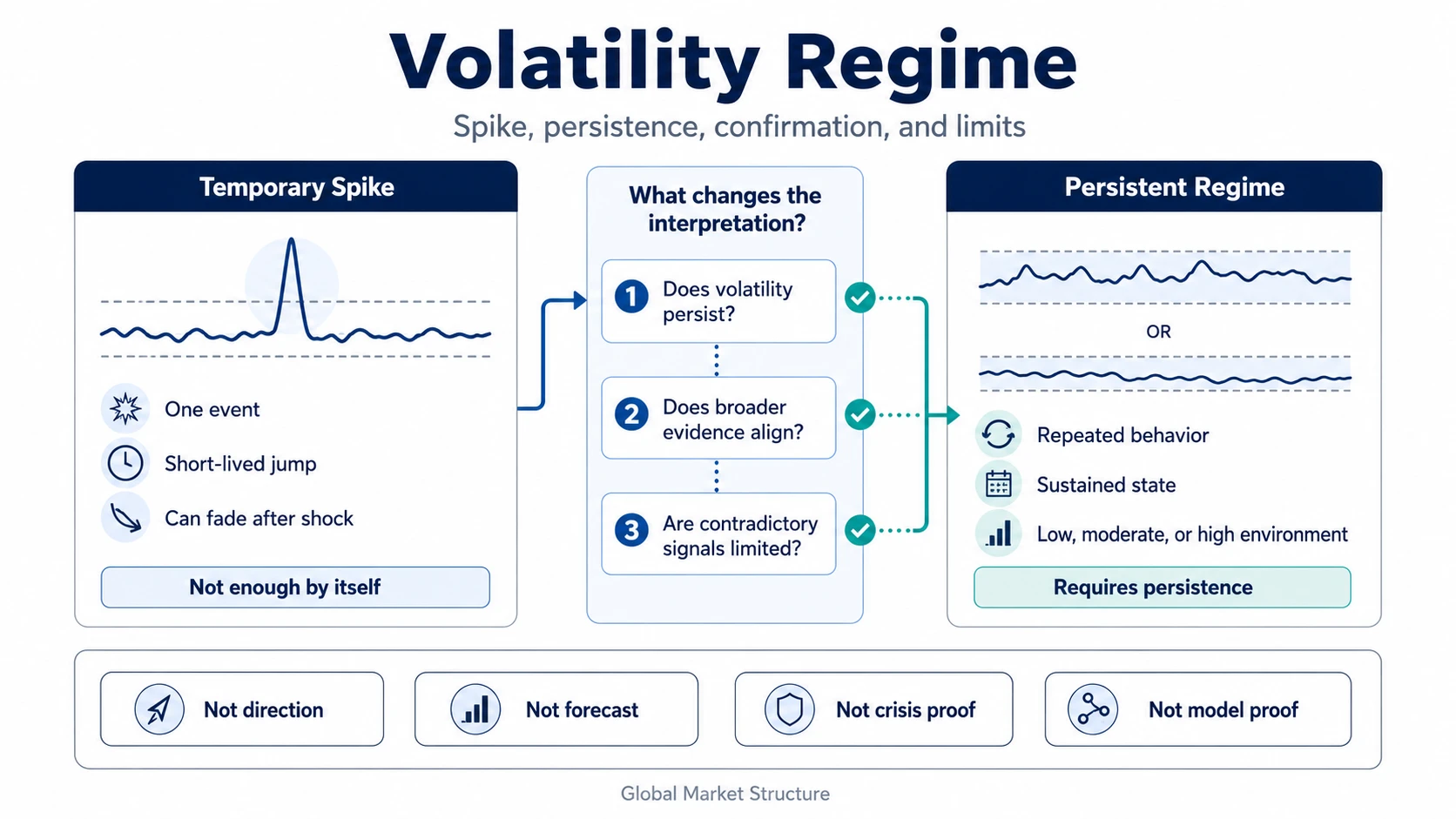
A volatility regime is a persistent market environment in which volatility remains relatively low, moderate, or high for a period. The defining feature is persistence rather than the size of one isolated move. A short-lived volatility spike can occur without changing the prevailing regime.
Low, Moderate, and High Volatility Regimes
There is no universal threshold that separates every market into the same regime categories. Classification depends on the asset, timeframe, volatility measure, estimation window, and comparison baseline.
| Regime | Typical condition | What supports the label | Boundary |
|---|---|---|---|
| Low volatility | Price variability remains subdued relative to the chosen baseline. | Quiet conditions persist across repeated observations rather than one short period. | The label describes volatility, not whether the broader market is safe. |
| Moderate volatility | Movement remains between unusually calm and unusually turbulent conditions. | The market stays within a relatively stable middle range. | Transition periods can make the middle state difficult to classify cleanly. |
| High volatility | Larger and less stable movements occur more frequently. | Elevated volatility persists after the initial shock and remains high relative to the relevant baseline. | The label does not establish market direction, illiquidity, or a financial crisis. |
realized volatility can provide one measurement input, but any regime label still depends on how the baseline and observation window are defined.
Research using regime-switching volatility models identifies distinct high and lower-volatility states, but the estimated states and switching behavior depend on the model and sampling frequency. Recent work also compares multiple regime-switching methods rather than treating one classification as uniquely correct. Source: Journal of Empirical Finance. Source: International Review of Economics & Finance.
Persistence Separates a Regime From a Spike
A large volatility move can be temporary. The regime interpretation becomes stronger when elevated or subdued volatility continues after the original catalyst has passed. If volatility quickly returns toward its previous range, the evidence for a durable regime change weakens.
Persistence also connects the concept to volatility clustering. Clustering describes the tendency for large changes to be followed by large changes and small changes by small changes. A volatility regime is the broader state classification. The two can overlap without being identical.
Volatility Regime and Nearby Concepts
| Concept | Main job | Boundary relative to volatility regime |
|---|---|---|
| Realized volatility | Measures observed price variability over a selected period. | It is an input or observation. A regime classifies whether volatility behavior looks persistent. |
| Volatility clustering | Describes statistical persistence in the magnitude of market movements. | Clustering is a behavior pattern. A volatility regime is a state label. |
| Volatility spike | Describes a sudden jump in volatility. | A spike can remain temporary and never become a new regime. |
| Market regime | Classifies the broader macro and market environment. | A market regime can include growth, inflation, policy, liquidity, credit, breadth, and risk appetite. A volatility regime focuses only on the volatility state. |
Using Models to Estimate Volatility Regimes
Rolling volatility measures, statistical thresholds, Markov-switching models, and other classification methods can all be used to estimate volatility states. Different methods can assign different boundaries or transition points because they use different assumptions, data frequencies, and estimation windows.
Regime classification should remain tied to the chosen method and baseline. A statistical model can help identify persistent behavior, but its output does not establish future direction or guarantee that the classified state will continue.