
A headline index can rise while participation narrows beneath it. Concentration shows how dependent the move is on a smaller leadership group, breadth shows how widely underlying components are participating, and participation shows whether that support is broadening, narrowing, or rotating.
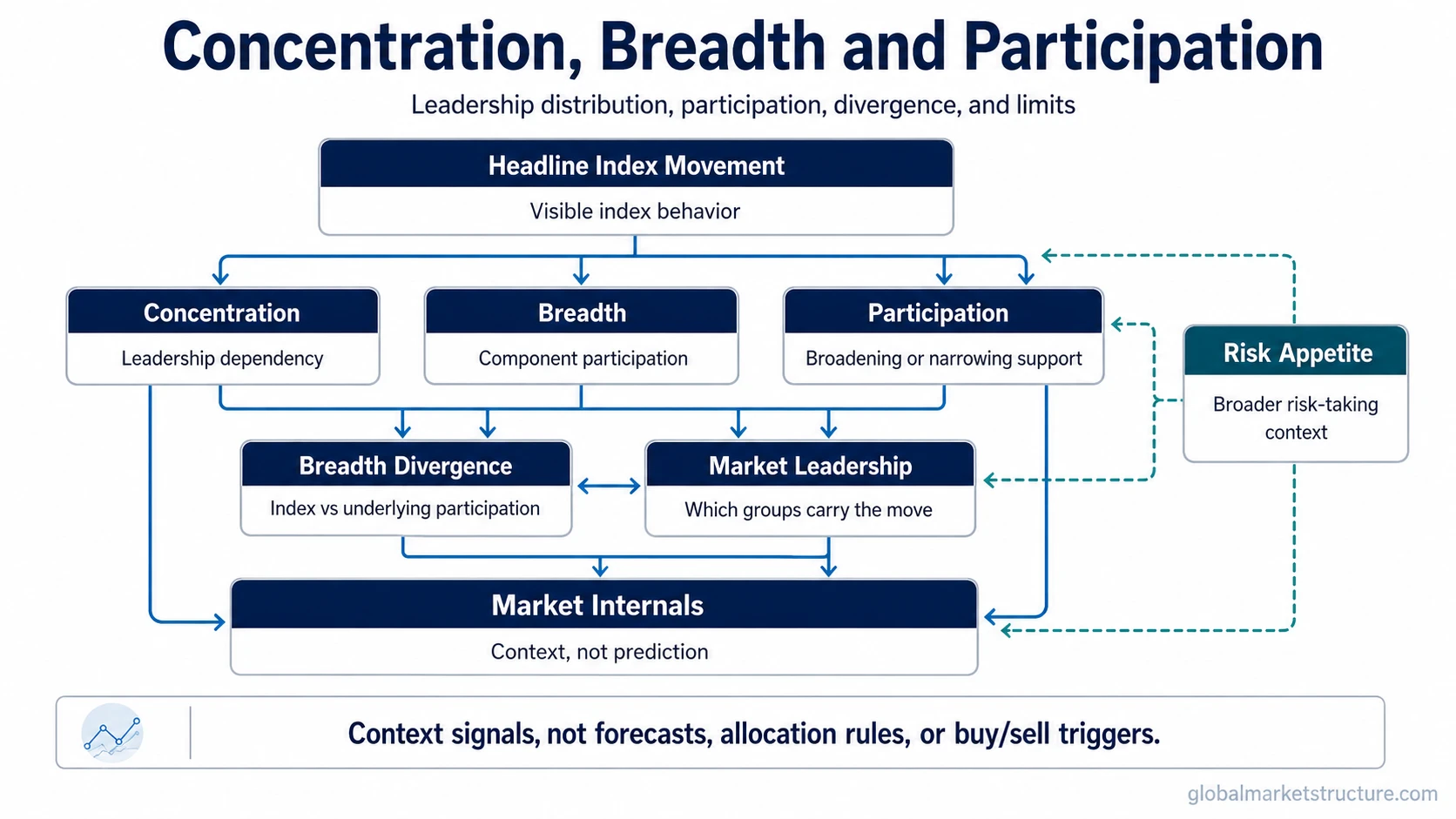
Three Lenses for Reading Market Internals
Shows how dependent market or index performance is on a smaller group of securities, sectors, or regions.
Shows how widely underlying components are participating in the move.
Shows whether support is spreading across more areas, narrowing into fewer areas, or rotating between them.
Choose the Right Market-Internals Route
The same index move can raise different analytical questions. The relevant route depends on whether the problem is structural concentration, participation breadth, measurement, divergence, leadership, or index dependency.
| Question | Route | Main job |
|---|---|---|
| How dependent is the market on a smaller group of large constituents or leaders? | Market concentration | Structural concentration and top-heavy index dependency. |
| How widely are stocks or other underlying components participating? | Market breadth | Broad participation beneath headline index movement. |
| Which tools can be used to measure participation? | Market Breadth Indicators | The broader toolkit of market-wide participation measures. |
| Has participation repaired rapidly after a weak or narrow phase? | Breadth Thrust Indicator | Rapid participation improvement and breadth-thrust methodology. |
| Is headline index behavior disagreeing with underlying participation? | Breadth divergence | Non-confirmation between price or index direction and breadth. |
| How can advancing and declining issues be tracked cumulatively? | Advance Decline Line | Cumulative advancing-versus-declining participation. |
| Which securities, sectors, styles, or regions are carrying performance? | Market leadership | Where performance leadership is concentrated or rotating. |
| How does concentration affect the representativeness and dependency of an index? | Concentration and Index Risk | The interpretation and index-risk consequences of concentrated weights. |
For the broader cross-asset question of whether markets are rewarding or avoiding risk exposure, continue with Risk appetite.
Where Market Internals Reach Their Limit
Broad participation can strengthen internal confirmation, while narrow leadership can persist without producing an immediate reversal. Liquidity, credit, rates, volatility, and other risk-environment evidence remain separate analytical layers.