Market Concentration

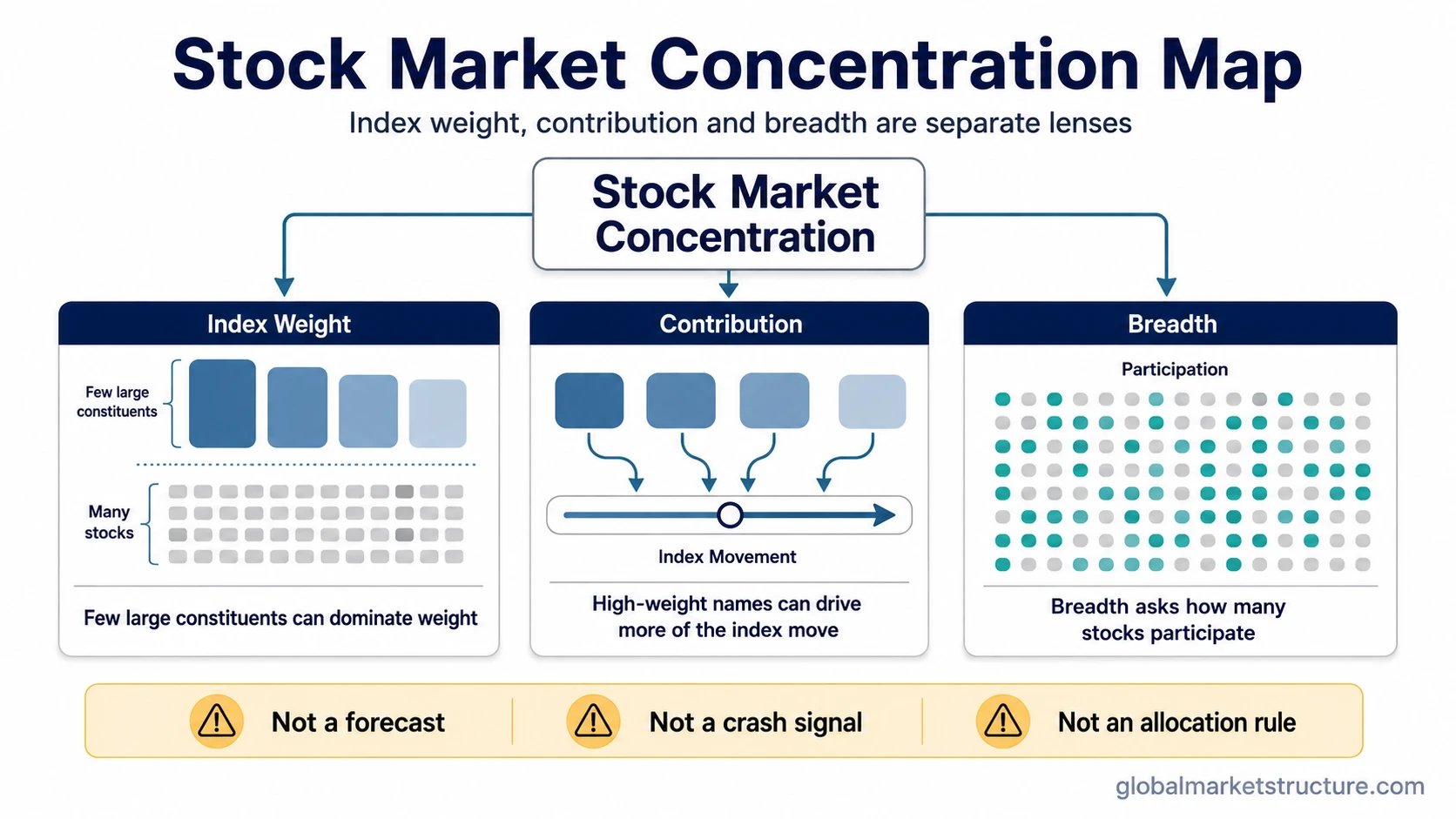
Market concentration is an equity-market condition in which a relatively small group of constituents holds a disproportionately large share of benchmark influence. It describes how unevenly market impact is distributed across the market and how much aggregate index behavior depends on a narrow leadership tier. It is not a directional label for whether prices are rising or falling. It is a structural description of who is carrying the market and how dominant that influence has become.

Within concentration, breadth and participation, the concept helps separate headline index performance from the underlying distribution of influence inside the market.

What market concentration means

A market is concentrated when index direction, return contribution, or market tone is driven mainly by a limited set of stocks, sectors, or themes. In that structure, headline benchmark performance can be shaped by only a small part of the market even while many other constituents remain active but less influential in the aggregate result.

That makes market concentration a distributional condition inside the market rather than a forecast or sentiment label. It does not automatically mean strength, weakness, or instability. It identifies an uneven internal balance of influence.

Structure and forms of market concentration

Market concentration can appear in several related forms. Weight concentration exists when a small group of constituents occupies an unusually large share of a capitalization-weighted benchmark. Influence concentration exists when those same constituents exert outsized control over index movement because their size gives each price change more aggregate impact. Return concentration exists when a narrow group accounts for most of the index’s gains or losses. Leadership concentration exists when the same limited set of names repeatedly determines market tone and benchmark direction.

These forms often overlap, but they are not identical. A market can still show active day-to-day trading across many constituents while remaining concentrated if decisive index influence sits with only a few dominant leaders. Read alongside market breadth, the concept helps clarify whether headline performance reflects broad participation or a narrower source of influence.

Cap-weight and benchmark influence

In capitalization-weighted indexes, concentration is closely tied to how benchmark construction translates company size into market influence. As a constituent’s market value grows, its index weight usually grows with it, which means a given price move in that name affects the aggregate benchmark more than an equivalent move in a smaller constituent. That is why market concentration is not only about counting how many names are leading. It is also about how much benchmark influence those leaders command once size and weighting are taken into account.

For that reason, a market can look busy on the surface while still being highly concentrated in practical terms. Many stocks may trade, rise, or fall, but the benchmark can remain structurally dependent on a small cap-weighted leadership core.

How market concentration is typically assessed

In practice, market concentration is usually read through three basic questions: how much benchmark weight sits in the largest constituents, how much of recent index performance comes from that same group, and whether leadership persistence is widening or staying narrow over time. Those dimensions do not require a single official threshold. They help distinguish a market that is merely led by strong winners from one in which benchmark behavior has become structurally dependent on a small leadership tier.

How narrow leadership mechanics work

Market concentration usually develops when leadership persists long enough for outperforming constituents to become more important to the benchmark itself. In capitalization-weighted indexes, sustained outperformance tends to increase index weight, which gives leading names even more influence over future index moves. That creates a reinforcing mechanism in which strong leaders lift the benchmark, larger benchmark weight amplifies their influence, and the market’s aggregate tone becomes increasingly tied to that same narrow group.

Not every brief period of narrow leadership counts as meaningful concentration in a structural sense. Markets often rotate through temporary pockets of outperformance without changing the broader distribution of influence. Concentration becomes more significant when the same leadership base continues to dominate returns, index weighting, and market attention over a longer stretch.

How concentration is read in market structure

Market concentration is most useful when it is read with participation signals that show how widely a move is shared. Measures such as the advance-decline line help show whether underlying participation is broad or narrow, while leadership breadth helps show whether leadership is spreading across more names or compressing into fewer leaders. Concentration matters when those signals indicate that benchmark influence is becoming increasingly dependent on a limited group.

Why uneven participation matters

Uneven participation matters because headline index strength and underlying market participation are not always the same thing. A broad move reflects support from many constituents. A concentrated move can still be real and persistent, but it rests on a smaller support base, so benchmark performance reveals less about how the average stock is behaving. This is also why the concept is useful when thinking about concentration and index risk and the degree to which benchmark resilience depends on a limited set of dominant components.

When participation remains uneven, aggregate performance can mask important internal divergence. A strong index may coexist with narrower leadership, weaker average participation, or a market in which many constituents contribute little to the headline move. Market concentration therefore helps separate broad market confirmation from benchmark strength that is being carried by a much smaller group.

What market concentration does not mean

Market concentration does not mean corporate market-share concentration, ownership concentration, or an automatic signal of imminent reversal. It is a descriptive concept about internal equity-market structure: who is carrying the market, how much benchmark influence they hold, and how concentrated that influence has become.

Used properly, market concentration helps separate broad participation from narrow leadership and gives a clearer reading of what aggregate market performance is actually reflecting at a given moment.

FAQ

Can a market rise while concentration is increasing?

Yes. A market can rise while concentration is increasing if a small number of influential leaders account for a large share of the gains. In that case, the index advances, but the support behind that move is narrower than the headline suggests.

Is market concentration always a bearish sign?

No. Concentration is not a bearish label by itself. It does not tell you that a reversal must follow. It only shows that market influence is unevenly distributed and that aggregate performance depends more heavily on a narrow leadership group.

How is market concentration different from weak participation?

Weak participation refers to limited involvement across the market. Concentration refers to unequal influence within the market. They often appear together, but they are not the same because many stocks can still be active while only a small group truly drives benchmark behavior.

Why can concentration last longer than expected?

Concentration can last because strong leaders often attract more capital, more attention, and more benchmark weight at the same time. In capitalization-weighted indexes, sustained outperformance can increase the influence of the leading names, which allows narrow leadership to persist until participation broadens or leadership rotates.