
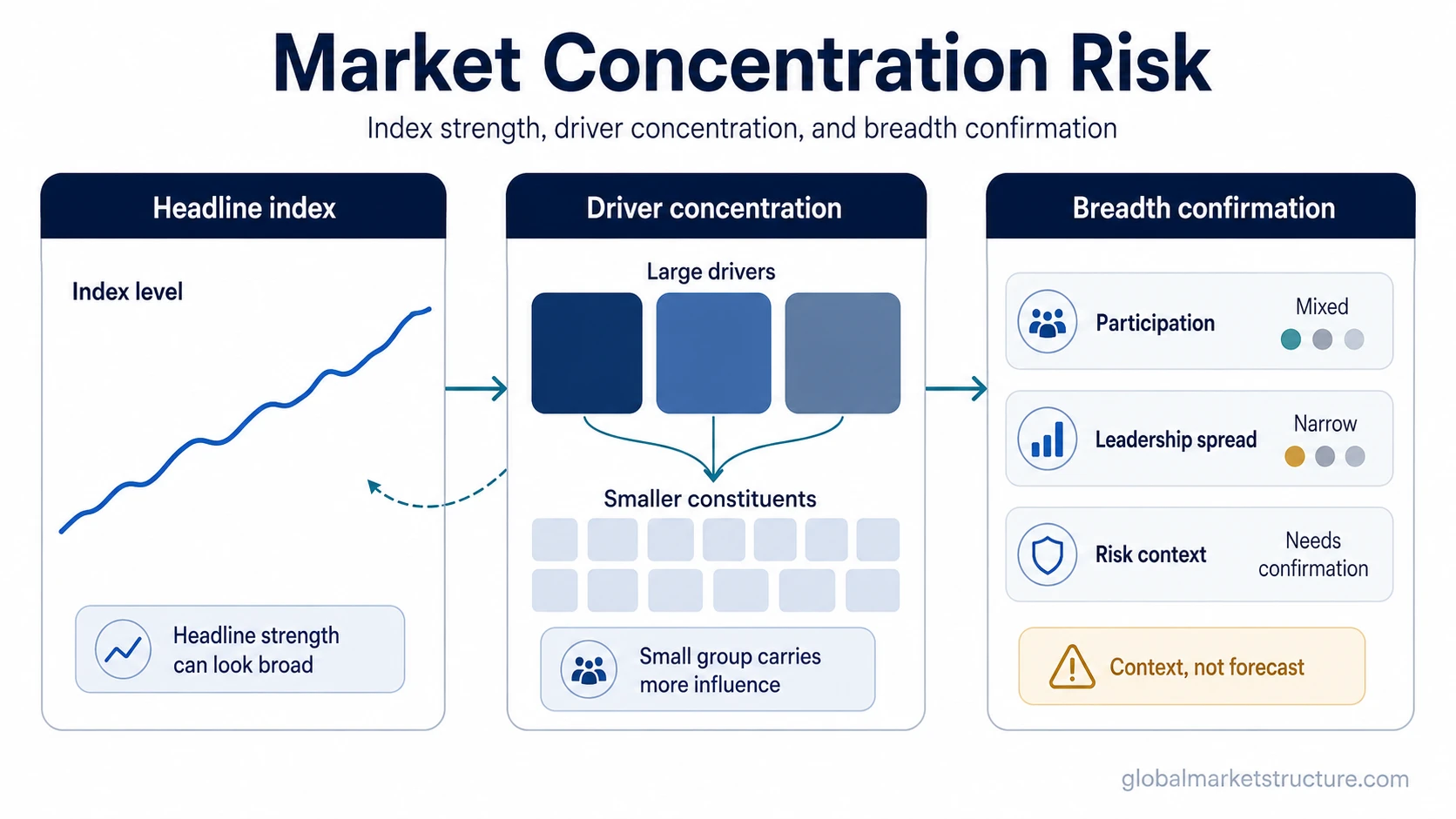
Market concentration risk means a headline index or broad market measure can become too dependent on a small group of large constituents, sectors, themes, or correlated exposures. In a cap-weighted index, that can make index strength look broader than the underlying participation picture. The risk is contextual: concentration alone does not prove a market top, drawdown, future underperformance, or timing signal. It becomes more useful when checked against breadth, leadership distribution, volatility, credit, risk appetite, correlation, and dispersion.
The narrow issue is not only that a few names are large. The issue is that their influence can make the index less representative of the broader market. A concentrated index can rise while many smaller constituents are flat, weak, or lagging. It can also look stable because a small group absorbs most of the positive pressure.
Key Points
- Market concentration risk is an index interpretation problem when a small group carries too much influence over headline performance.
- The main risk is signal quality: index movement may not reflect broad participation.
- Concentration is not the same as a crash warning, sell signal, or market-top forecast.
- The concern carries more weight when weak breadth, narrow leadership, rising volatility, wider credit spreads, or weaker risk appetite confirm the same message.
What Market Concentration Risk Means in Index Context
In index context, market concentration risk appears when a small number of large constituents, sectors, or themes carry a disproportionate share of index influence. This is the narrower index-risk angle of market concentration, not a full personal portfolio planning topic.
The distinction matters because a broad index can look healthier than the average constituent underneath it. If the largest constituents keep advancing while the rest of the market is mixed, the index may show strength without broad confirmation. That does not make the strength false, but it changes what the strength represents.
Personal portfolio concentration risk asks whether one investor has too much exposure to one asset, company, sector, or factor. Market concentration risk asks a different question: is the market measure itself becoming too dependent on a small set of drivers to represent the broader risk environment cleanly?
Why Concentration Can Distort Index Interpretation
Cap-weighted indexes give larger constituents more influence. When the largest constituents become very large relative to the rest of the index, their movement can dominate the headline result. A strong index print can therefore reflect the strength of a small group more than broad participation across the full constituent base.
This does not mean cap-weighted indexes are broken. They are designed to reflect market value. The interpretation problem begins when the index is treated as a clean proxy for broad participation. In a concentrated environment, the index may still be accurate as an index, but less useful as a simple reading of how widely risk appetite is spreading.
A concentrated index can create three interpretation problems. First, headline strength may overstate broad participation. Second, headline weakness may be driven by pressure in only a few dominant constituents. Third, diversification inside the index may be weaker than it appears if many exposures depend on the same sector, theme, funding condition, or risk factor.
Concentration, Breadth, and Narrow Leadership
Concentration is about how much index influence sits in a small group. Narrow market leadership is about which parts of the market are actually leading. The two often overlap, but they are not identical. A market can be concentrated because a few large constituents dominate index weight, while leadership can be narrow because only a limited group is advancing.
Breadth answers a different question: how many stocks, sectors, or groups are participating in the move. If a concentrated index rises while participation stays weak, the signal is less broad than the headline move suggests. If participation broadens, the concentration concern can weaken because more of the market is confirming the index direction.
This is why market breadth is a confirmation layer rather than a synonym for concentration. Concentration describes dependency. Breadth describes participation. Leadership describes where performance is coming from.
| Concept | Main question | What it helps interpret |
|---|---|---|
| Market concentration risk | Is index influence too dependent on a small group? | Index representativeness and dependency risk |
| Market breadth | How widely is the move being confirmed? | Participation beneath the headline index |
| Narrow leadership | Which limited group is driving performance? | Leadership quality and rotation risk |
How to Read Concentration Without Turning It Into a Forecast
Concentration is most useful when it is read as a pressure point in the market structure, not as a standalone prediction. The same concentration condition can have different meanings depending on breadth, volatility, credit, correlation, dispersion, and leadership rotation.
| Concentration condition | What it can imply | What it does not prove | What to check next |
|---|---|---|---|
| A few large constituents drive most index movement | Headline index strength may be less representative | It does not prove a market top | Breadth and leadership distribution |
| Sector or theme exposure dominates index returns | Index risk may depend more on one leadership group | It does not prove an immediate reversal | Volatility, credit, and risk appetite |
| Correlated exposures rise together | Diversification may be weaker than it appears | It does not prove future underperformance | Correlation, dispersion, and breadth confirmation |
The most useful reading is conditional. Concentration becomes more concerning when the index is strong but breadth is weak, leadership is narrow, volatility is rising, credit spreads are widening, and risk appetite is deteriorating. The same concentration reading becomes less concerning when participation broadens, leadership rotates across more groups, volatility stays contained, and credit conditions remain stable.
Market Concentration Risk Example in Index Context
Illustrative scenario: A cap-weighted index can rise for several weeks while only a small group of dominant constituents continues to make new highs. At the same time, many smaller constituents fail to confirm the move, sector participation stays uneven, and leadership does not rotate into additional groups. The index trend is still real, but the participation underneath it is less convincing.
That condition does not prove that the index must reverse. It means the headline move needs confirmation from other layers. The concern carries more weight if volatility rises, credit spreads widen, risk appetite weakens, correlation increases, or dispersion shows that gains are still concentrated in a narrow group.
The practical mistake is treating a concentrated index move as either fully healthy or automatically dangerous. The better reading is narrower: concentration can reduce the quality of the index signal until participation and risk context either confirm or weaken the concern.
When the Risk Reading Carries More or Less Weight
A concentration concern carries more weight when several independent signals point in the same direction. Weak breadth suggests limited participation. Narrow leadership suggests that performance is coming from a small group. Rising volatility may show that risk pricing is becoming less stable. Wider credit spreads can indicate stress outside the equity headline. Higher correlation can show that diversification is weakening when many exposures start moving together.
The concentration concern loses force when participation broadens and leadership rotates into more groups. If more sectors, industries, or constituents begin confirming the index direction, concentration may still exist, but the index signal becomes more representative. Contained volatility and stable credit conditions can also reduce the urgency of the concentration concern.
Dispersion matters as well. If only a few large constituents are responsible for most of the index behavior, the market may be more fragile than the headline suggests. If performance becomes more evenly distributed, concentration risk can remain present but less dominant in interpretation.
What Market Concentration Risk Does Not Prove
Limitation: Market concentration risk is not a crash forecast, market-top signal, sell signal, or complete allocation framework. It does not prove that a concentrated market must perform poorly. It also does not prove that broad market strength is invalid.
The safer interpretation is that concentration changes the confidence level of headline index readings. A concentrated market requires more confirmation from participation, leadership quality, volatility, credit, risk appetite, correlation, and dispersion before the index move is treated as broad market evidence.
Concentration should also not be reduced to a single measurement. Metrics such as top-weight share, sector weight, HHI, Gini-style concentration, correlation, or risk contribution can be useful, but none of them alone explains the full market structure. The interpretation depends on what is concentrated, why it is concentrated, whether the leadership is durable, and whether the rest of the market is confirming.
FAQ
Is market concentration risk the same as portfolio concentration risk?
No. Portfolio concentration risk focuses on whether one investor has too much exposure to one asset, sector, or factor. Market concentration risk focuses on whether a broad index or market measure is too dependent on a small group of large constituents, sectors, themes, or correlated exposures.
Does market concentration risk mean the market is about to fall?
No. Concentration alone does not prove a market top, drawdown, reversal, or future underperformance. It shows that headline index movement may need stronger confirmation from breadth, leadership distribution, volatility, credit, risk appetite, correlation, and dispersion.
Why does market breadth matter when reading concentration risk?
Market breadth shows how widely an index move is being confirmed. If an index rises because a few large constituents are advancing while many others lag, the move may be less representative. If participation broadens, the concentration concern can weaken.