
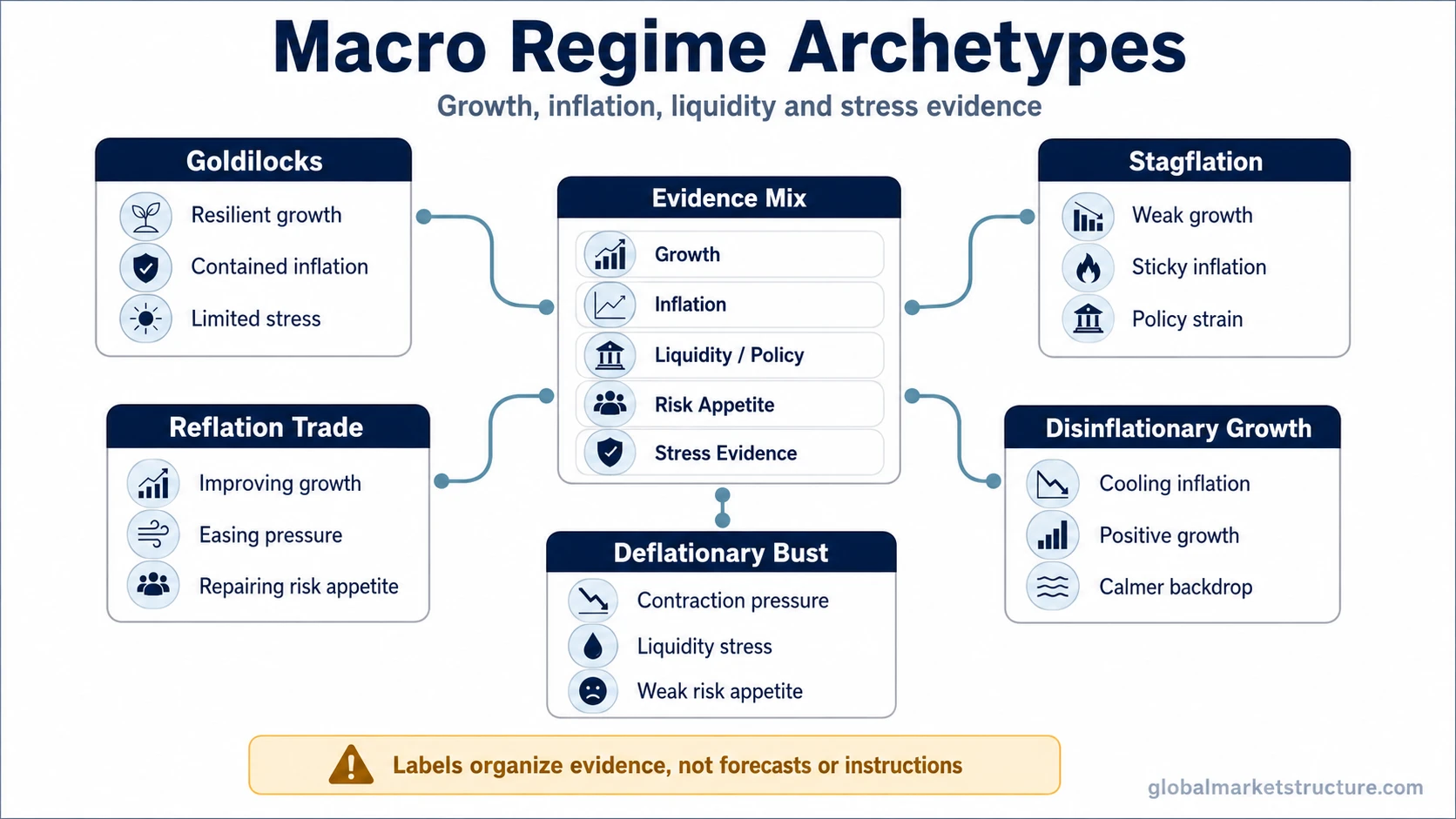
Macro regime archetypes classify broad market environments by the mix of growth, inflation, liquidity, policy pressure, risk appetite, and stress evidence. The core archetypes are Goldilocks, Stagflation, Reflation Trade, Disinflationary Growth, and Deflationary Bust. They organize macro evidence into categories, not forecasts, trading signals, or portfolio instructions.
Definition: A macro regime archetype is a broad environment category built from combined macro evidence. The label becomes more useful when growth, inflation, liquidity, policy pressure, credit conditions, breadth, and risk appetite point toward the same kind of backdrop.
Choose the Closest Macro Regime Archetype
The fastest way to separate regime archetypes is to identify the main pressure mix. A benign growth and inflation backdrop is different from a weak-growth inflation shock, and both are different from a liquidity-supported recovery or a deflationary stress environment.
| Archetype | Typical evidence mix | Relevant when the main question is |
|---|---|---|
| Goldilocks | Growth is resilient, inflation pressure is contained, liquidity is not restrictive, and stress signals remain limited. | Whether the market backdrop looks balanced rather than overheated, recessionary, or crisis-driven. |
| Stagflation | Growth weakens while inflation pressure stays high or sticky, leaving policy and risk appetite under strain. | Whether inflation stress is occurring alongside weaker real activity rather than ordinary inflation alone. |
| Reflation Trade | Growth expectations improve after slowdown risk, liquidity pressure eases, and risk appetite begins to repair. | Whether the backdrop is shifting from contraction fear toward recovery and renewed cyclical risk appetite. |
| Disinflationary Growth | Inflation cools while growth remains positive enough to avoid a clear contraction or stress regime. | Whether lower inflation is supporting the backdrop without requiring a recessionary interpretation. |
| Deflationary Bust | Growth, demand, liquidity, and risk appetite deteriorate together while stress evidence becomes more visible. | Whether the environment is moving from ordinary weakness into broader contraction and market-functioning stress. |
Why One Indicator Is Not Enough
A regime label becomes fragile when it is based on one data point. Inflation alone does not define stagflation. Falling inflation alone does not define disinflationary growth. Weak growth alone does not define a deflationary bust.
The evidence mix matters because different forces can offset or reinforce each other. Growth can slow while inflation remains sticky. Inflation can cool while growth stays resilient. Liquidity can improve before economic data turns. Stress can rise before headline indicators confirm a downturn.
Limit: A macro regime archetype is a classification tool. It does not forecast the next market move, identify a current regime by itself, or create a buy or sell signal.
How the Main Evidence Groups Differ
Each archetype depends on the relationship between several evidence groups. Growth describes real-activity pressure. Inflation describes price pressure. Liquidity and policy pressure describe the financial backdrop. Risk appetite describes market willingness to take exposure. Stress evidence describes whether the environment is becoming fragile.
| Evidence group | What it helps separate | Risk of over-reading it alone |
|---|---|---|
| Growth | Expansion, slowdown, contraction, and recovery pressure. | Weak growth can mean a soft patch, recession risk, or deeper stress depending on inflation, liquidity, and credit evidence. |
| Inflation | Contained inflation, sticky inflation, cooling inflation, or deflationary pressure. | Inflation direction alone does not show whether the backdrop is benign, restrictive, or demand-destructive. |
| Liquidity and policy pressure | Whether financial conditions are easing, neutral, or restrictive. | Liquidity relief can support risk appetite without proving that the economic cycle has fully repaired. |
| Risk appetite | Whether investors are willing to accept cyclical, credit, equity, and duration risk. | Risk appetite can rebound temporarily even when the macro evidence remains mixed. |
| Stress evidence | Whether weakness is becoming more systemic or market-functioning driven. | Volatility alone is not enough; stress becomes more meaningful when liquidity, credit, breadth, and forced-selling evidence also deteriorate. |
Related Macro Regime Distinctions
Some regime questions are better handled as direct comparisons. These distinctions are useful when two labels appear similar but describe different evidence mixes.
| Comparison | Use it when the confusion is |
|---|---|
| Stagflation vs Inflation | Whether high inflation is also paired with weak growth and policy strain. |
| Reflation vs Stagflation | Whether rising nominal pressure reflects recovery and improving risk appetite or weak growth with sticky inflation. |
| Stagflation vs Recession | Whether the weakness is mainly inflation-constrained or demand-contraction driven. |
When Regime Labels Become Unstable
Regime labels are least stable near transition points. Evidence can rotate gradually, and different evidence groups can disagree for a while. Inflation may cool before growth weakens, risk appetite may recover before liquidity fully improves, and stress indicators may appear before broad economic data confirms the shift.
That is why regime archetypes work best as classification tools. They help separate the kind of environment being observed, but they should not be treated as timing tools, market calls, or instructions for what to own.
Which Archetype Fits the Evidence Mix?
The clearest starting point is the evidence mix causing the confusion. Benign growth with contained inflation points toward Goldilocks. Sticky inflation with weak growth points toward Stagflation. Improving growth and liquidity point toward Reflation Trade. Cooling inflation with still-positive growth points toward Disinflationary Growth. Contraction with rising stress points toward Deflationary Bust.