
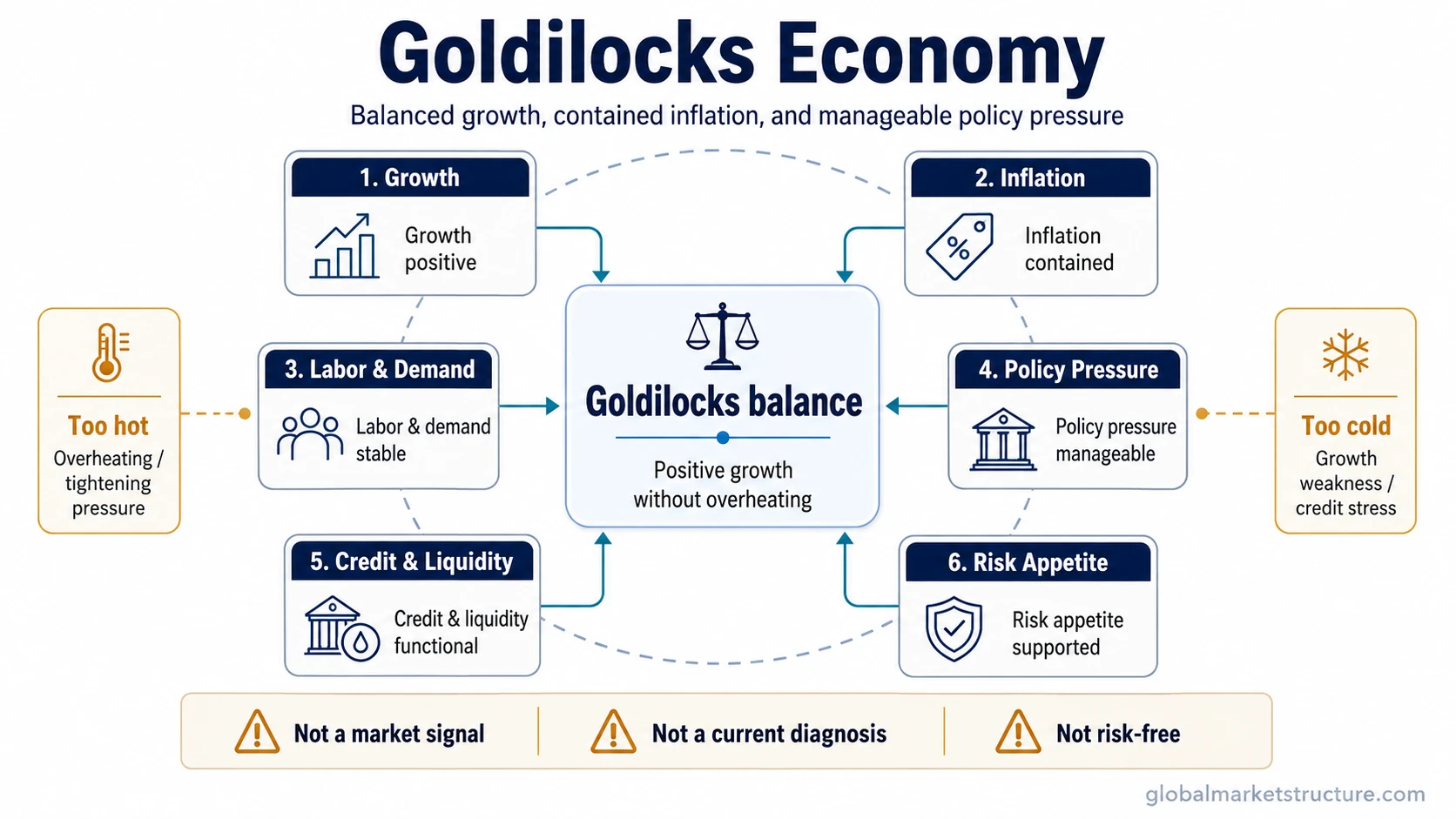
A Goldilocks economy is a macro-regime in which growth stays positive without overheating, inflation remains contained, labor and demand conditions stay stable, and policy pressure does not force aggressive tightening. It can support risk appetite, but it is not a standalone market signal, an asset-allocation rule, or proof that the current economy has no risk.
The useful idea is balance. Growth is strong enough to avoid recession pressure, but not so strong that it creates clear overheating. Inflation is low or moderating enough to reduce policy stress, but not because demand is collapsing. Credit and liquidity conditions remain functional enough for risk-taking, but the label becomes weaker if funding stress, balance-sheet strain, or aggressive tightening begins to dominate.
Key Points
- A Goldilocks economy is a macro-regime description, not a forecast.
- Growth, inflation, labor demand, policy pressure, credit conditions, and risk appetite must be read together.
- Low inflation alone does not prove Goldilocks conditions.
- Rising markets alone do not confirm the regime.
- Any current-market diagnosis requires updated macro, credit, policy, and liquidity data.
What Is a Goldilocks Economy?
A Goldilocks economy describes a macro environment that is neither too hot nor too cold. “Too hot” usually means growth and demand are strong enough to create inflation pressure, labor tightness, or policy tightening risk. “Too cold” usually means growth is weak enough to raise recession, deleveraging, or demand-collapse concerns.
The Goldilocks label sits between those extremes. It points to a regime where the economy has enough momentum to support confidence, but not enough overheating to force a severe policy response. That makes it different from a simple “good economy” label. The regime depends on several conditions remaining in balance at the same time.
| Classification | Goldilocks reading | Boundary |
|---|---|---|
| Macro-regime label | Balanced growth and contained inflation | Not a trade signal |
| Policy context | Less pressure for aggressive tightening | Not proof that policy risk is gone |
| Market interpretation | Can support risk appetite | Not a guarantee of asset returns |
| Evidence standard | Requires multiple confirming conditions | Not proven by one indicator |
The Condition Stack Behind Goldilocks
A Goldilocks economy is best read as a condition stack rather than a single data point. Growth, inflation, labor conditions, policy pressure, credit, liquidity, and risk appetite all matter because the regime depends on balance across the system.
| Condition | Goldilocks interpretation | What weakens the label |
|---|---|---|
| Growth | Positive and steady enough to avoid contraction pressure | Growth acceleration that looks inflationary, or growth weakness that looks recessionary |
| Inflation | Contained, moderating, or stable enough to reduce policy stress | Renewed inflation pressure or disinflation caused by demand damage |
| Labor and demand | Stable enough to support income, spending, and confidence | Sharp labor weakening, demand deterioration, or overheating wage pressure |
| Policy pressure | Central banks are not forced into abrupt tightening by overheating | Inflation or financial instability forces a more restrictive policy path |
| Credit and liquidity | Financing conditions remain functional enough for risk-taking | Credit tightening, funding stress, or declining market liquidity |
| Risk appetite | Investors may become more willing to hold risk assets | Risk appetite rises without macro confirmation, or stress appears beneath the surface |
The condition stack matters because a Goldilocks reading can look convincing on the surface while one part of the regime is already weakening. For example, contained inflation may look supportive, but the interpretation changes if credit is tightening and labor demand is deteriorating at the same time.
Why Goldilocks Conditions Can Support Risk Appetite
Goldilocks conditions can support risk appetite because they reduce two common macro fears at the same time. The first fear is overheating, where inflation and policy tightening pressure become dominant. The second fear is contraction, where demand weakness, credit stress, or recession risk becomes dominant.
When growth is positive and inflation pressure is contained, investors may see a wider path for earnings stability, easier financial conditions, and lower policy shock risk. That can make risk assets more attractive relative to a regime dominated by inflation stress or growth collapse.
The limitation is important. Goldilocks conditions can support risk appetite, but they do not mechanically determine market returns. Valuation, positioning, earnings expectations, liquidity, credit spreads, policy communication, and market structure can still change the outcome. The label describes a macro backdrop. It does not replace market-specific evidence.
Practical scenario
A common Goldilocks-style reading appears when growth remains positive, inflation pressure cools, and policy fears ease without a clear collapse in labor demand. That setting may improve confidence, but the reading becomes weaker if credit conditions tighten or if market strength depends only on a narrow risk-appetite move without confirmation from the broader macro stack.
False Readings: What Goldilocks Does Not Mean
The most common mistake is treating one supportive signal as proof of the whole regime. Goldilocks is a balance across conditions, not a label that can be assigned from inflation, stock prices, or a soft-landing narrative alone.
Goldilocks is not proven by one indicator
- Low inflation is not enough if demand is weakening sharply.
- Strong equity prices are not enough if credit conditions are deteriorating.
- Low unemployment is not enough if wage pressure forces renewed policy tightening.
- Moderate growth is not enough if liquidity stress appears beneath the surface.
- A soft-landing narrative is not enough without supporting evidence across growth, inflation, labor, policy, credit, and liquidity.
A Goldilocks reading also should not be used as a current-market claim without updated evidence. Current GDP, inflation, labor-market data, policy guidance, credit spreads, and liquidity conditions would need to be checked before diagnosing any live economy as Goldilocks.
What Can End a Goldilocks Economy?
Goldilocks conditions are fragile because the regime depends on balance. It can end from the hot side if growth, demand, or inflation pressure becomes strong enough to force tighter policy. It can end from the cold side if growth slows, labor weakens, credit tightens, or balance-sheet pressure begins to dominate.
| Pressure point | How it can end the Goldilocks reading |
|---|---|
| Inflation acceleration | Raises the risk that policy becomes more restrictive. |
| Policy tightening | Can pressure valuations, borrowing costs, credit creation, and risk appetite. |
| Credit tightening | Can reduce financing availability and expose balance-sheet stress. |
| Growth slowdown | Can turn a balanced regime into a recession-risk regime. |
| Labor weakening | Can shift the interpretation from benign cooling to demand damage. |
| Liquidity stress | Can make asset prices vulnerable even if headline macro data still looks stable. |
The transition can be gradual or abrupt. A regime can look balanced until one condition starts forcing a different interpretation. That is why stress confirmation matters. A Goldilocks label is stronger when credit, liquidity, labor, inflation, and policy signals broadly agree. It is weaker when surface-level optimism conflicts with hidden tightening or demand deterioration.
Goldilocks vs Adjacent Macro Regimes
Goldilocks is often confused with other macro regimes because several regimes can share one visible feature. Inflation may cool in both Goldilocks and demand weakness. Growth may improve in both Goldilocks and reflation. Risk appetite may rise even when the underlying regime is not stable. The difference comes from the full condition mix.
| Regime | Main condition mix | How it differs from Goldilocks |
|---|---|---|
| Goldilocks economy | Positive growth, contained inflation, stable demand, manageable policy pressure | Balance is the defining feature. |
| Stagflation | Weak or slowing growth with persistent inflation pressure | Inflation remains a problem even as growth conditions weaken. |
| Deflationary bust | Demand weakness, credit tightening, deleveraging pressure, and balance-sheet strain | Cooling is not benign; it reflects stress and contraction pressure. |
| Reflation | Improving growth and rising inflation expectations from a weaker base | The regime may be moving hotter, while Goldilocks depends on contained inflation pressure. |
| Disinflationary growth | Growth remains positive while inflation pressure eases | It can overlap with Goldilocks, but still needs credit, labor, policy, and liquidity confirmation. |
How to Use the Goldilocks Label Safely
The safest use of the Goldilocks label is descriptive. It helps classify a macro backdrop when growth, inflation, labor, policy, credit, liquidity, and risk appetite are broadly aligned. It becomes less useful when it is reduced to a bullish market slogan.
A disciplined reading starts with the condition stack. If growth is steady, inflation is contained, labor demand is stable, policy pressure is manageable, and credit conditions are not deteriorating, the Goldilocks label may be reasonable as a macro description. If those conditions conflict, the label should be treated with caution.
The label also has a boundary. It does not tell the reader which asset to own, when to enter a position, or whether a market has already priced the regime. Market expression requires separate evidence. Goldilocks describes the macro environment; it does not convert that environment into a trade, allocation, or forecast.
Related Macro Regime Concepts
Goldilocks sits inside a wider macro-regime map. It becomes clearer when compared with regimes where the balance breaks in different ways. Stagflation breaks the balance through weak growth and persistent inflation pressure. A deflationary bust breaks it through demand weakness, credit tightening, and balance-sheet stress.
The most important distinction is that Goldilocks is a condition stack, not a single label for optimism. When the stack holds together, the regime can feel supportive. When one side of the stack breaks, the macro interpretation changes.