
A deflationary bust is a macro-regime stress condition where falling price pressure appears together with weakening demand, deleveraging, credit stress, asset-price pressure, and balance-sheet strain. It is narrower than ordinary deflation because the problem is not lower prices alone. The stress comes from the feedback loop between weaker spending, tighter credit, falling collateral values, and forced adjustment across the economy and markets.
A deflationary bust is best understood as a regime label, not as a market forecast. The term describes a cluster of conditions that can make deflationary pressure damaging. It does not, by itself, prove that a market crash is inevitable, that a recession has started, or that any specific asset must rise or fall.
Why a Deflationary Bust Is Narrower Than Ordinary Deflation
Ordinary deflation means a broad decline in the general price level. That decline can come from different sources. Some price declines may reflect productivity gains, cheaper supply, falling input costs, or normal cyclical cooling. Those cases do not automatically create a deflationary bust.
A deflationary bust requires a more damaging mix. Demand weakens, borrowers and leveraged participants reduce exposure, credit becomes harder to obtain, collateral values fall, and balance sheets become more fragile. The deflationary pressure matters because it interacts with debt, income, asset prices, and financing conditions.
| Concept | Core meaning | Why it matters |
|---|---|---|
| Ordinary deflation | General price levels decline. | The meaning depends on whether the cause is supply improvement, weak demand, or financial stress. |
| Deflationary bust | Deflation pressure combines with demand contraction, deleveraging, credit stress, and balance-sheet pressure. | The issue is the reinforcing stress mechanism, not just the lower price level. |
| False reading | Lower prices are treated as automatically good or automatically catastrophic. | The correct reading depends on income, credit, debt, collateral, liquidity, and demand conditions. |
What a Deflationary Bust Is and Is Not
The useful distinction is between a price-level observation and a broader stress regime. A falling price index is an observation. A deflationary bust interpretation requires evidence that lower price pressure is connected to weakening demand, tighter credit, forced deleveraging, falling asset values, or balance-sheet stress.
| It is | It is not |
|---|---|
| A macro-regime label involving deflation pressure and economic stress. | A label for every period of falling inflation or lower prices. |
| A way to describe interaction between demand, debt, credit, collateral, and balance sheets. | A standalone crash forecast. |
| A condition that becomes more credible when several stress signals align. | A conclusion that can be confirmed by one indicator. |
| A framework for separating harmful deflationary pressure from benign price declines. | A trading signal, asset-allocation rule, or guaranteed policy outcome. |
The Mechanism Behind a Deflationary Bust
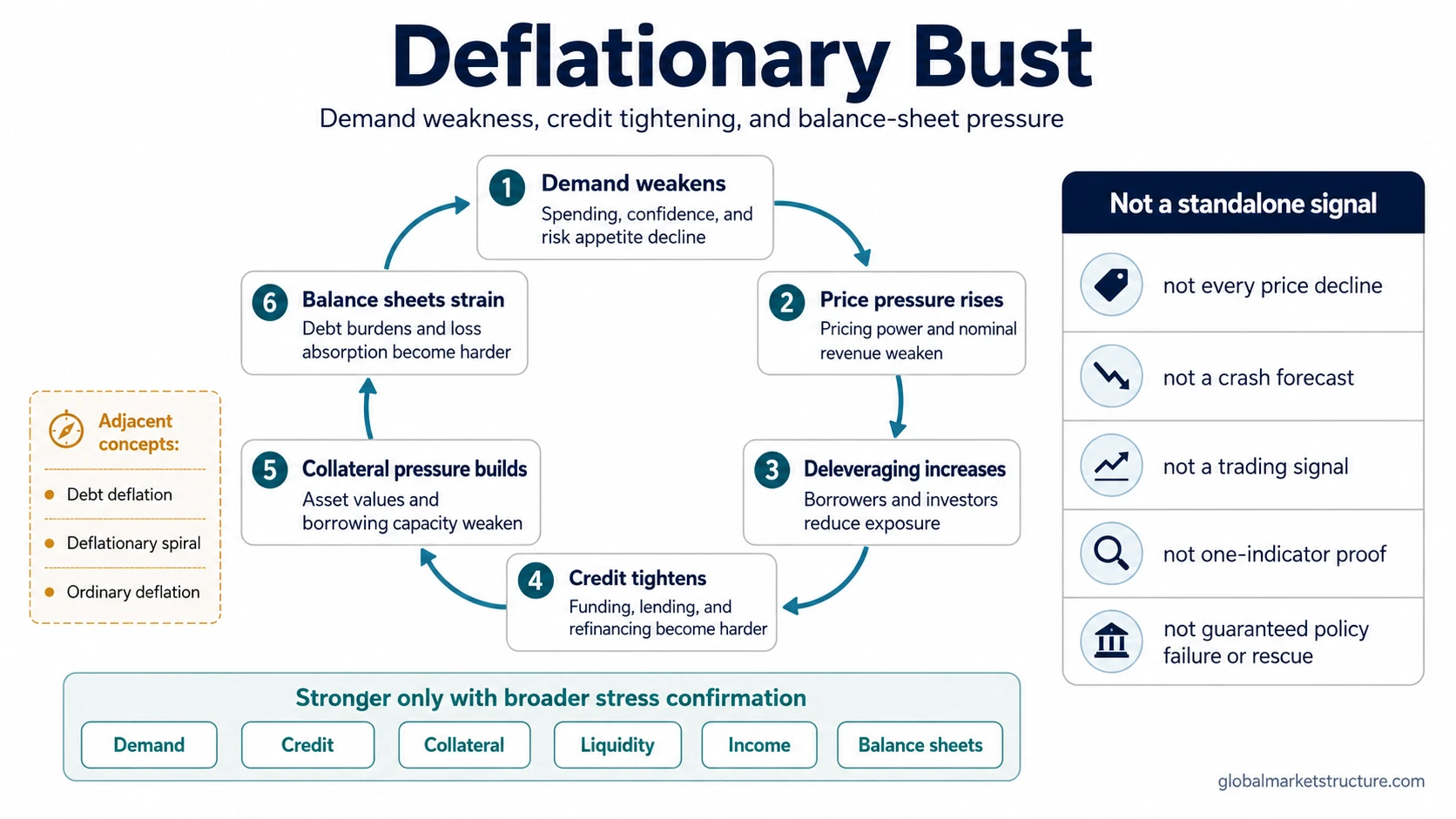
The mechanism usually starts with weakening demand or a sharp loss of confidence. Lower spending pressure reduces pricing power, revenue expectations, and cash-flow confidence. As income and asset values weaken, borrowers and investors may reduce leverage, lenders may tighten standards, and collateral values may become less reliable.
That sequence can make the regime self-reinforcing. Lower demand pressures prices. Lower prices and weaker income can make debt burdens harder to manage in real terms. Falling asset prices can reduce collateral values. Tighter credit can force more spending cuts or asset sales. The result is a contractionary loop rather than a simple decline in consumer prices.
- Demand weakens: households, firms, or investors reduce spending and risk-taking.
- Pricing pressure rises: firms lose pricing power, and nominal revenue becomes harder to maintain.
- Deleveraging begins: borrowers, investors, or institutions try to reduce debt, exposure, or balance-sheet risk.
- Credit tightens: lending standards, funding access, or collateral terms become less forgiving.
- Asset pressure spreads: falling prices can weaken collateral, confidence, and balance-sheet capacity.
- The regime becomes more fragile: weaker income, tighter credit, and lower asset values reinforce each other.
Why Debt, Credit, and Balance Sheets Matter
Debt changes the meaning of falling prices. When prices, wages, revenues, or asset values fall while nominal debt remains fixed, the real burden of that debt can rise. This is why debt deflation is closely related to a deflationary bust, even though the two terms should not be treated as identical.
Credit conditions also matter because they control the ability to refinance, roll funding, maintain collateral, and absorb losses. A deflationary bust reading becomes stronger when falling price pressure appears alongside credit tightening, weaker nominal income, broader deleveraging, and visible balance-sheet stress.
The reading becomes weaker when price declines are mainly supply-driven, growth remains stable, credit remains available, collateral values are not under broad pressure, and nominal income is not contracting. In that case, the environment may look closer to benign disinflation or disinflationary growth than to a deflationary bust.
Related Concept Boundaries
Deflationary bust sits near several macro-regime and deflation concepts. The terms can appear in the same discussion, but they answer different questions. The contrast is especially useful when comparing contractionary stress with Goldilocks conditions, stagflation, debt deflation, and deflationary spiral dynamics.
| Related concept | How it differs from a deflationary bust |
|---|---|
| Deflation | Deflation is the price-level condition. A deflationary bust is the stress regime that can develop when falling price pressure combines with weaker demand, tighter credit, and balance-sheet strain. |
| Deflationary spiral | A deflationary spiral is a self-reinforcing mechanism of falling prices, weaker spending, and further price pressure. A deflationary bust can include spiral dynamics, but it is a broader regime label. |
| Debt deflation | Debt deflation focuses on the real burden of debt rising as prices and incomes fall. A deflationary bust may include this mechanism, but also includes credit, asset-price, and balance-sheet stress. |
| Goldilocks | A goldilocks regime usually implies stable growth and contained inflation pressure. A deflationary bust implies contractionary stress and weaker balance-sheet resilience. |
| Stagflation | Stagflation combines weak growth with inflation pressure. A deflationary bust combines weak demand with deflation pressure and credit or balance-sheet stress. |
Practical Limitation Scenario
A common scenario is that prices begin to soften while growth indicators also weaken. That alone does not confirm a deflationary bust. The interpretation becomes more credible only if softer prices are joined by weaker demand, tighter credit, falling collateral values, deleveraging pressure, and visible balance-sheet stress.
The opposite can also happen. Prices may decline because supply improves, energy costs fall, inventory normalizes, or productivity improves. If income remains stable, credit remains available, and asset stress is contained, the deflationary-bust label may overstate the risk. The cause of the price decline matters as much as the price decline itself.
Interpretation Boundaries
A deflationary bust is not a timing tool. It should not be used as proof that a crash is coming, that one asset class must outperform another, or that a policy response will succeed or fail. The concept is useful only when it helps classify a broader macro environment with enough confirming evidence.
The strongest interpretation comes from a cluster, not a single signal. Falling price pressure, weak demand, tighter credit, declining collateral values, balance-sheet strain, and deleveraging pressure need to be read together. Without that cluster, the phrase can become too broad, too alarmist, or too detached from the actual macro regime.