
Drawdowns, contagion, systemic risk, and fire-sale dynamics answer different questions about market stress. A drawdown describes the decline path. Financial contagion describes transmission. Systemic risk concerns broader financial-system fragility. Fire-sale dynamics describe forced-selling feedback. A separate comparison is needed when the question is systemic risk versus systematic market risk.
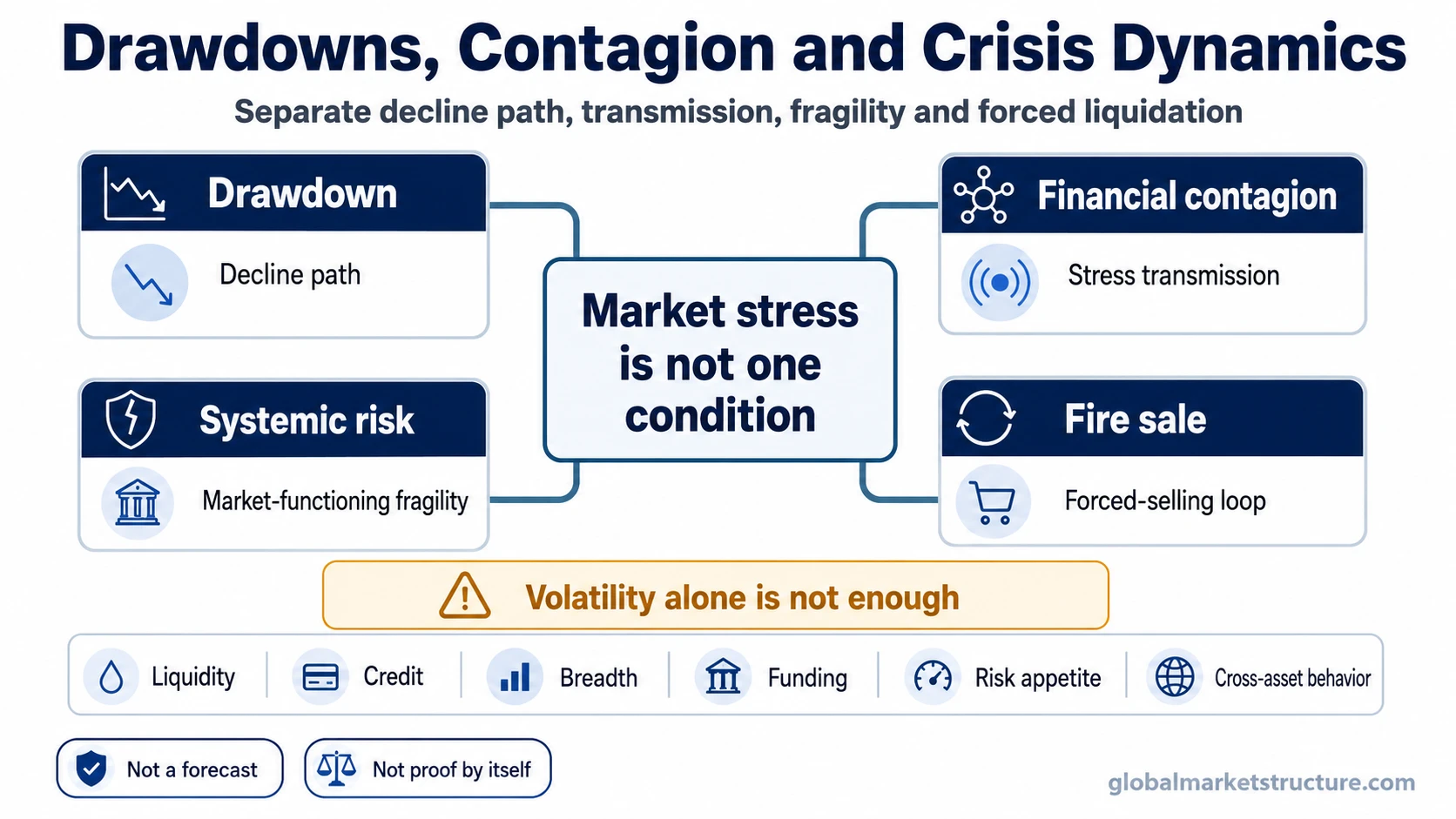
Choose the Right Stress Concept
| Question | Route | Main job |
|---|---|---|
| How large is the decline, how long has it lasted, and what does the recovery path look like? | Drawdown | Measure the depth, duration, and path of a decline from a prior high. |
| Is stress spreading across markets, institutions, regions, or balance sheets? | Financial contagion | Identify transmission from the original source of stress into connected areas. |
| Can the stress impair broader financial-system functioning? | Systemic risk | Assess system-level fragility and the risk of wider financial impairment. |
| Is forced liquidation interacting with leverage, collateral pressure, or weak liquidity? | Fire sale | Examine forced-selling feedback and price pressure under constrained liquidity. |
| Are two similar-sounding risk concepts being confused? | Systemic Risk vs Systematic Risk | Separate financial-system fragility from broad market risk that diversification cannot remove. |
How the Concepts Can Overlap
A market decline can remain a drawdown without spreading further. Stress can also move across connected institutions or markets, which brings contagion into the analysis. Forced selling may add another feedback mechanism when leverage, collateral pressure, or poor liquidity affect the ability of participants to absorb sales. The systemic-risk question becomes relevant when the effects extend far enough to threaten broader financial-system functioning.
A drawdown can remain contained. Contagion can occur without becoming systemic. Fire-sale pressure can stay localized. The labels are most useful when they identify the mechanism that is actually visible rather than being treated as mandatory stages of one sequence.