
Systemic risk in finance is the risk that impairment in the financial system disrupts the provision of financial services and can cause serious negative effects in the real economy. Stress can begin in one institution, asset, funding channel, or market segment and become systemic when it spreads and amplifies through funding, liquidity, collateral, counterparty, confidence, or balance-sheet channels.
Market volatility or a drawdown can be severe without reaching that threshold. The systemic question is whether the shock begins to impair the system’s ability to fund, price, clear, transfer risk, or provide credit and other financial services.
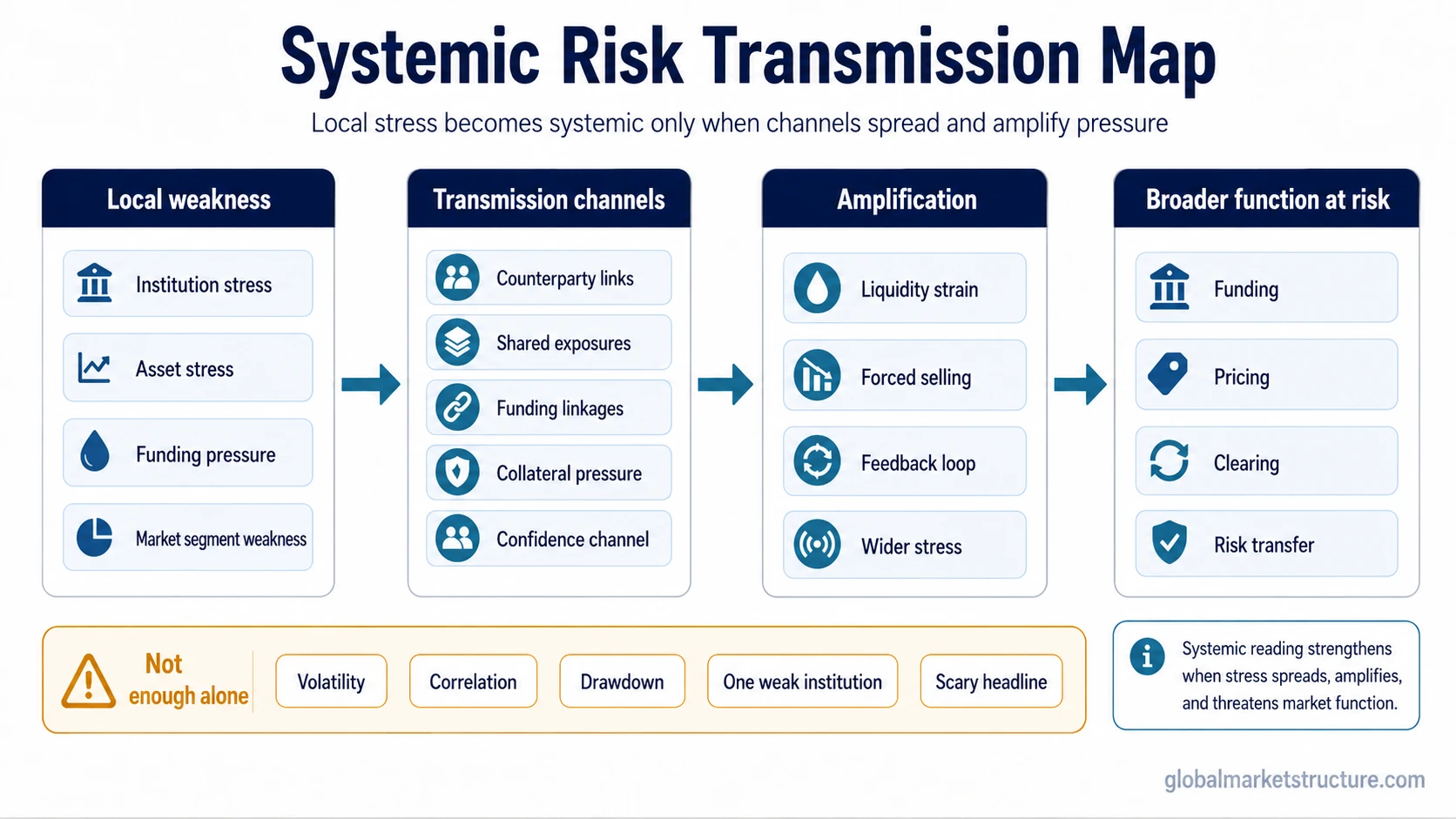
How Local Stress Becomes Systemic
A weakness begins in one institution, market segment, asset class, or funding channel.
Counterparties, lenders, investors, or related markets become exposed through direct links, shared positions, or confidence effects.
Borrowing, refinancing, market depth, or collateral capacity becomes more difficult for additional participants.
Forced selling, collateral calls, balance-sheet contraction, or confidence loss can feed the stress back into prices and funding conditions.
The systemic reading strengthens when the shock starts to disrupt financial services or broader market functions beyond the original source of stress.
This transmission process overlaps with financial contagion, which focuses on how stress spreads across institutions or markets. Systemic risk is broader because the concern is impairment of financial-system function and consequences beyond the originating shock.
IMF surveillance guidance defines systemic risk around disruption in the provision of financial services caused by impairment of the financial system, with serious negative effects for the real economy. BIS uses the same IMF-FSB-BIS framework. That boundary is stricter than treating volatility, a drawdown, or one institution’s failure as systemic by itself. Source: IMF. Source: BIS.
When Market Stress Becomes Systemically Relevant
| Observed condition | What raises systemic relevance | What can keep the stress contained |
|---|---|---|
| Higher volatility | Losses begin to interact with leverage, funding, collateral, or liquidity constraints across participants. | Markets continue to function and financing remains available despite repricing. |
| Rising correlations | Shared exposures or simultaneous losses create pressure across several balance sheets or funding channels. | The co-movement reflects ordinary risk-off behavior without broader impairment. |
| A drawdown | Falling prices weaken collateral, market depth, funding capacity, or other balance sheets. | The decline remains a price adjustment that the financial system absorbs. |
| One institution under stress | Counterparty, payment, funding, or confidence channels transmit the problem outward. | Losses are absorbed without disrupting wider financial services. |
| Forced selling or a fire sale | Price pressure feeds into marks, collateral, leverage, or funding conditions for other participants. | The selling remains localized and does not create broader feedback. |
Systematic risk is a different concept. It refers to broad market-wide exposure that diversification cannot easily remove. The difference between systemic and systematic risk matters because similar wording hides two different risk problems.
A Contained Shock Can Still Be Severe
Consider a funding-dependent institution that loses lender confidence. The initial problem can be serious even if it remains concentrated in one balance sheet. The systemic reading strengthens if counterparties reduce exposure, short-term funding tightens, collateral requirements rise, and other participants begin selling assets to meet obligations.
One institution or market segment comes under heavy funding, liquidity, or balance-sheet pressure.
Funding lines remain available, counterparties absorb losses, market depth holds, and collateral stress does not spread.
The event remains a contained financial stress episode unless broader transmission and system-function impairment emerge.
What Strengthens the Systemic-Risk Reading
A stronger reading usually combines evidence across interconnections, shared exposures, leverage, short-term funding dependence, collateral sensitivity, market depth, and confidence. No single input is decisive. The interpretation becomes more serious when several channels deteriorate together and the effects begin to impair financial services or broader financial-system function.
The label does not determine market direction, forecast a crash, or prescribe a portfolio action. It is most useful for judging whether stress is contained or is beginning to spread and impair the financial system.