
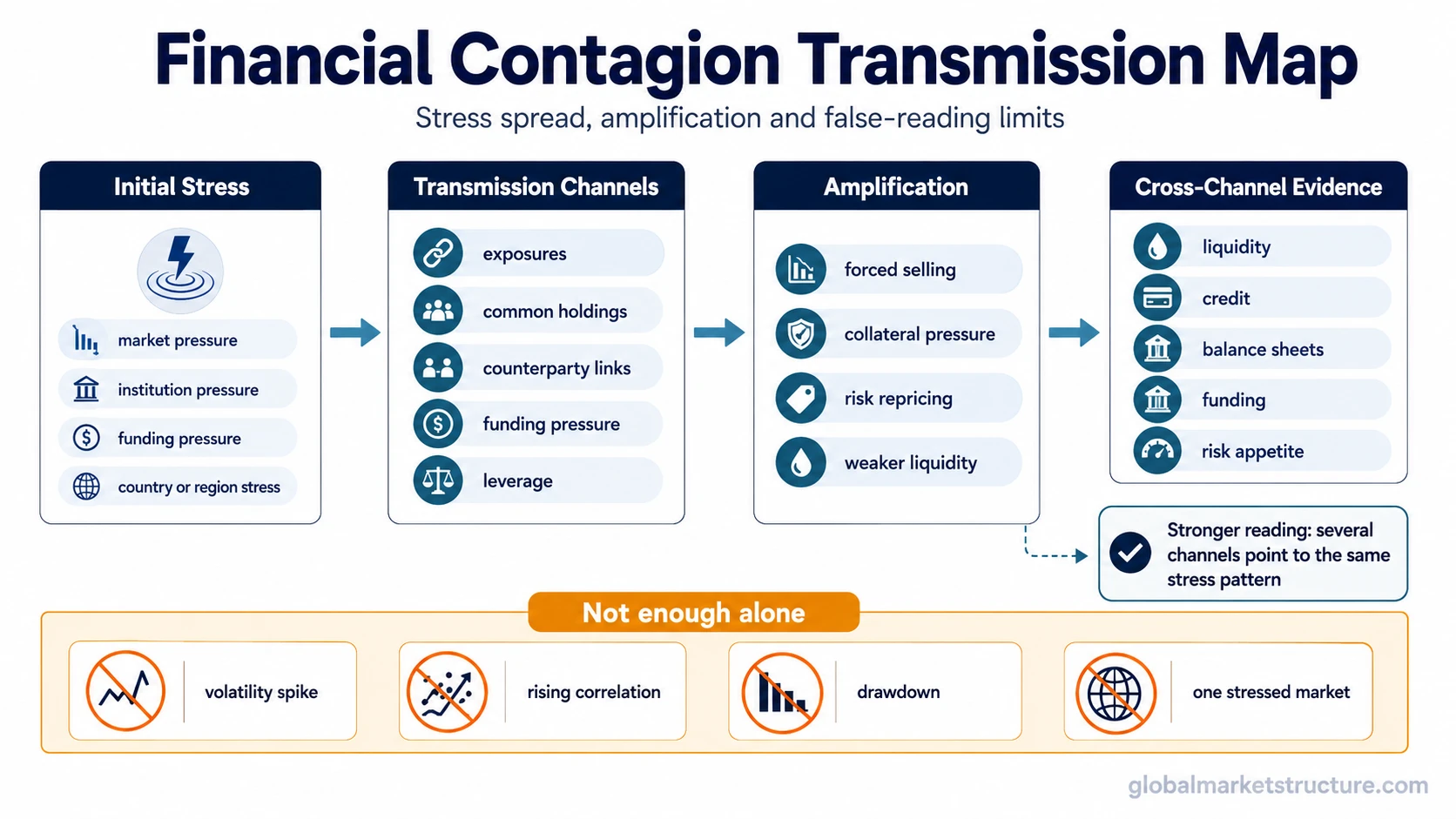
Financial contagion is the transmission of financial stress from an initial source to other markets, institutions, or funding channels. Direct exposures, shared asset holdings, funding constraints, and information spillovers can carry the pressure beyond the original shock. As losses and liquidity needs affect additional participants, the initial disturbance can also be amplified.
Contagion versus normal market interdependence
Several markets can decline together after an interest-rate surprise or another common macroeconomic shock. That pattern may reflect their exposure to the same driver. A contagion interpretation requires evidence that pressure has been transmitted or amplified through financial connections, beyond the co-movement expected from the original shock.
Markets respond to a shared driver or move together through established relationships. Simultaneous losses do not identify a separate propagation mechanism.
Stress at an initial source creates secondary effects through exposures, funding needs, asset-price feedback, or information transmission. The assessment depends on evidence for those connections.
How financial stress can spread
The transmission channel determines which participants may be affected and what evidence is relevant. Several channels can operate together during the same episode.
| Channel | Possible transmission | Evidence to examine |
|---|---|---|
| Direct financial exposures | Losses at a borrower, lender, or counterparty affect another institution through loans, securities, derivatives, or other contractual claims. | Counterparty relationships, exposure sizes, loss absorption, and subsequent balance-sheet pressure. |
| Shared assets and price feedback | A stressed holder sells assets also owned by other participants. Lower prices can affect their valuations, collateral, or financing capacity. | Overlapping holdings, pressured sales, market depth, price impact, and second-round losses. |
| Funding and collateral | Tighter financing, margin calls, or collateral requirements force participants to raise liquidity or reduce positions, potentially affecting other markets. | Funding rates, availability of financing, margin pressure, collateral changes, and liquidity conditions. |
| Information and risk repricing | News about losses or uncertain exposures changes how investors assess connected institutions or markets. De-risking may extend beyond the initial source. | Timing of new information, actual or perceived exposures, repricing across affected assets, and alternative common drivers. |
Illustrative funding-stress scenario
A funding-sensitive institution comes under pressure and begins selling assets to meet liquidity needs. Other participants hold some of the same assets. If those sales depress market prices, their collateral values and measured losses may change as well. Some may then face tighter financing or additional sales pressure.
This would provide a possible route from an initial funding problem to stress at other institutions. The interpretation would be weaker if the original institution remained isolated, buyers continued to absorb sales, and connected participants showed no material funding or balance-sheet pressure. The scenario is illustrative; it does not establish that contagion has occurred in a particular market.
An IMF working paper on interconnectedness and contagion sets out approaches using interbank, cross-sector, and cross-border exposure and market data. It distinguishes ordinary financial linkages from the analysis of how shocks may propagate through them. Read the IMF research.
A BIS working paper models direct interbank exposures and indirect transmission through overlapping asset holdings and fire-sale dynamics using euro area banking data. Its findings depend on the model, data, and assumptions about price impact. The study does not establish a universal ranking of contagion channels for every crisis or market. Read the BIS research.
Financial contagion and related risk concepts
Transmission can coincide with market losses and wider financial instability, but the concepts describe different parts of the event.
| Concept | Separate analytical role |
|---|---|
| Drawdown | Measures the decline from a prior peak and its recovery path. The size of a loss does not identify how stress reached other participants. |
| Systemic risk | Concerns disruption of wider financial-system functioning and potential consequences for the real economy. A transmission episode may remain limited without reaching that scale. |
A volatility spike, higher correlation, or broad selloff can justify examining contagion, but each can also occur without a separate transmission process. Funding, exposure, liquidity, and balance-sheet evidence may be incomplete or unavailable. Where the mechanism cannot be distinguished from a common shock, the appropriate conclusion remains uncertain. A contagion label alone does not determine a future market path or a portfolio action.