
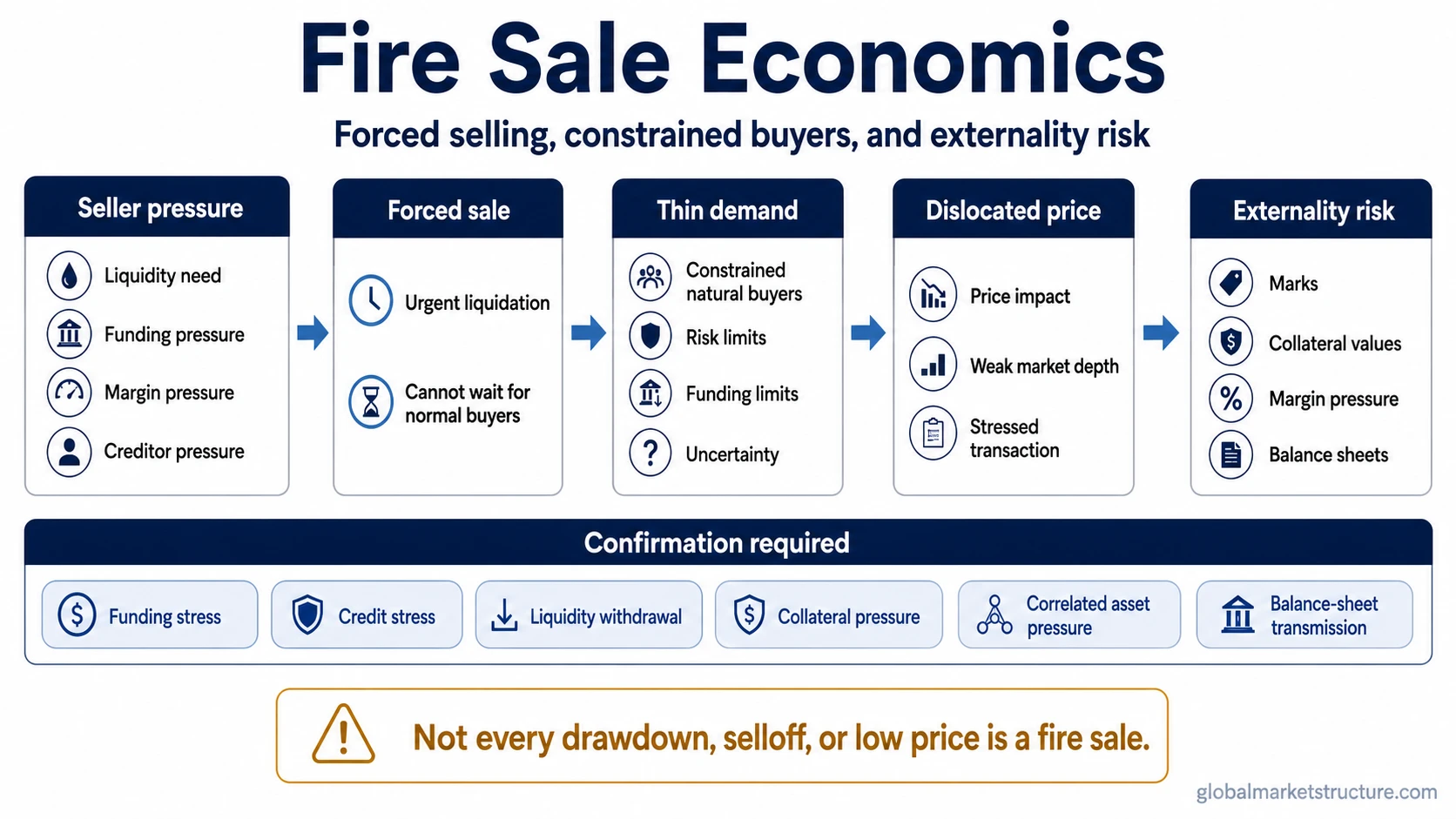
Fire sale economics describes forced or pressure-driven asset sales at dislocated prices. A seller needs liquidity or must reduce exposure, while the buyers who would normally absorb the asset may also face funding, balance-sheet, or risk limits. The resulting price pressure can extend beyond the original seller when it affects other holders’ valuations or collateral.
When a sale becomes a fire sale
A low transaction price can have several explanations. The seller may have accepted a discount voluntarily, the asset’s expected value may have changed, or financing pressure may have left the seller with little time to find buyers. Fire-sale economics focuses on the last mechanism when constrained demand contributes to price dislocation.
| Condition | What is happening | Additional evidence needed |
|---|---|---|
| Ordinary discount sale | A seller accepts a lower price without clear liquidation pressure. | A discount alone does not establish a fire sale. |
| Distressed sale | A seller needs cash, faces creditor pressure, or must reduce leverage. | Whether the sale occurs into constrained demand and affects the transaction price. |
| Asset fire sale | Urgent selling meets impaired natural buyers, contributing to a dislocated price. | Funding or margin pressure, limited buyer capacity, market depth, and price impact. |
| Fire-sale externality | The lower price affects other holders’ marks or collateral and can tighten their financing constraints. | Evidence of second-round pressure on other participants, beyond the original seller’s loss. |
| Wider financial stress | Forced sales and balance-sheet constraints reinforce one another across additional participants or markets. | Broader funding, credit, liquidity, and transmission evidence. |
How forced selling can affect other holders
A leveraged investor may need to sell assets after a margin call or a reduction in available financing. During normal conditions, buyers familiar with the asset might absorb the supply. If those buyers are also short of funding, reducing risk, or protecting their balance sheets, the urgent sale may have a larger price impact.
Other investors may hold the same or similar assets. Lower transaction prices can affect their reported values or the collateral available to support borrowing. If the tighter constraint forces them to sell as well, the initial transaction has created a channel for further pressure.
That second-round effect is the fire-sale externality. Its existence depends on the effect on other participants, rather than the discount suffered by the first seller.
What strengthens or weakens the interpretation
| Evidence | Supports a fire-sale reading | Weakens the reading |
|---|---|---|
| Seller pressure | Margin calls, creditor demands, funding withdrawals, or required deleveraging. | Orderly and voluntary selling without a binding liquidity need. |
| Buyer capacity | Thin market depth and natural buyers constrained by losses, risk limits, or financing. | Buyers continue absorbing supply without material deterioration in trading conditions. |
| Spillover | Price changes affect other holders’ collateral, financing, or balance-sheet capacity. | The transaction remains isolated, with no identified second-round pressure. |
Illustrative collateral-feedback scenario
Consider a leveraged holder of an illiquid security that must raise cash quickly. It sells into limited demand, moving the transaction price lower. Another holder uses a similar security as collateral for borrowing. The lower price may reduce its collateral value and lead the lender to demand additional protection.
If the second holder can meet the requirement without selling, the pressure may stop there. If it must liquidate holdings into the same constrained market, the original price effect has helped transmit stress. Determining whether this happened in a real episode requires evidence about actual sales, collateral terms, funding conditions, and the other holders affected.
Shleifer and Vishny describe financial fire sales in terms of forced asset liquidation, price dislocation, and constraints on the investors who would otherwise be natural buyers. Their 2011 review provides the economic basis for this mechanism. Read the Journal of Economic Perspectives research.
Federal Reserve Governor Jeremy Stein’s 2013 discussion distinguishes a distressed sale from a fire-sale externality that harms other participants through constraints such as collateral-dependent borrowing. A discounted sale by itself does not establish that wider effect. The discussion addresses financial-market mechanisms and policy considerations, not the valuation or future return of any particular asset. Read the Federal Reserve discussion.
Fire sales in the wider risk environment
A drawdown measures how far a price, index, or portfolio has declined from an earlier peak. It cannot identify whether the decline was caused by forced liquidation. Fire-sale analysis examines the selling and buyer constraints behind a possible price dislocation.
Forced-sale pressure may contribute to systemic risk when stress affects the functioning of the wider financial system. Financial contagion is the related transmission process: a fire sale can be one channel through which pressure reaches other participants. An isolated forced transaction need not develop into either outcome.
A low price, large drawdown, or volatility spike cannot establish forced selling from price data alone. Even an identified fire sale does not demonstrate that an asset is undervalued, that recovery is imminent, or that a wider financial crisis will follow. Those conclusions require separate valuation, liquidity, funding, and transmission evidence.