
Capital flows describe how money moves across countries, funds, asset classes, and risk environments. Broad capital movement, fund activity, defensive flows, short-term speculative flows, and stress-driven exits can reflect very different conditions.
In market-structure analysis, the value of flow data depends on what is moving, where it is moving, how persistent the movement is, and what is happening in liquidity, credit, currencies, positioning, and prices at the same time.
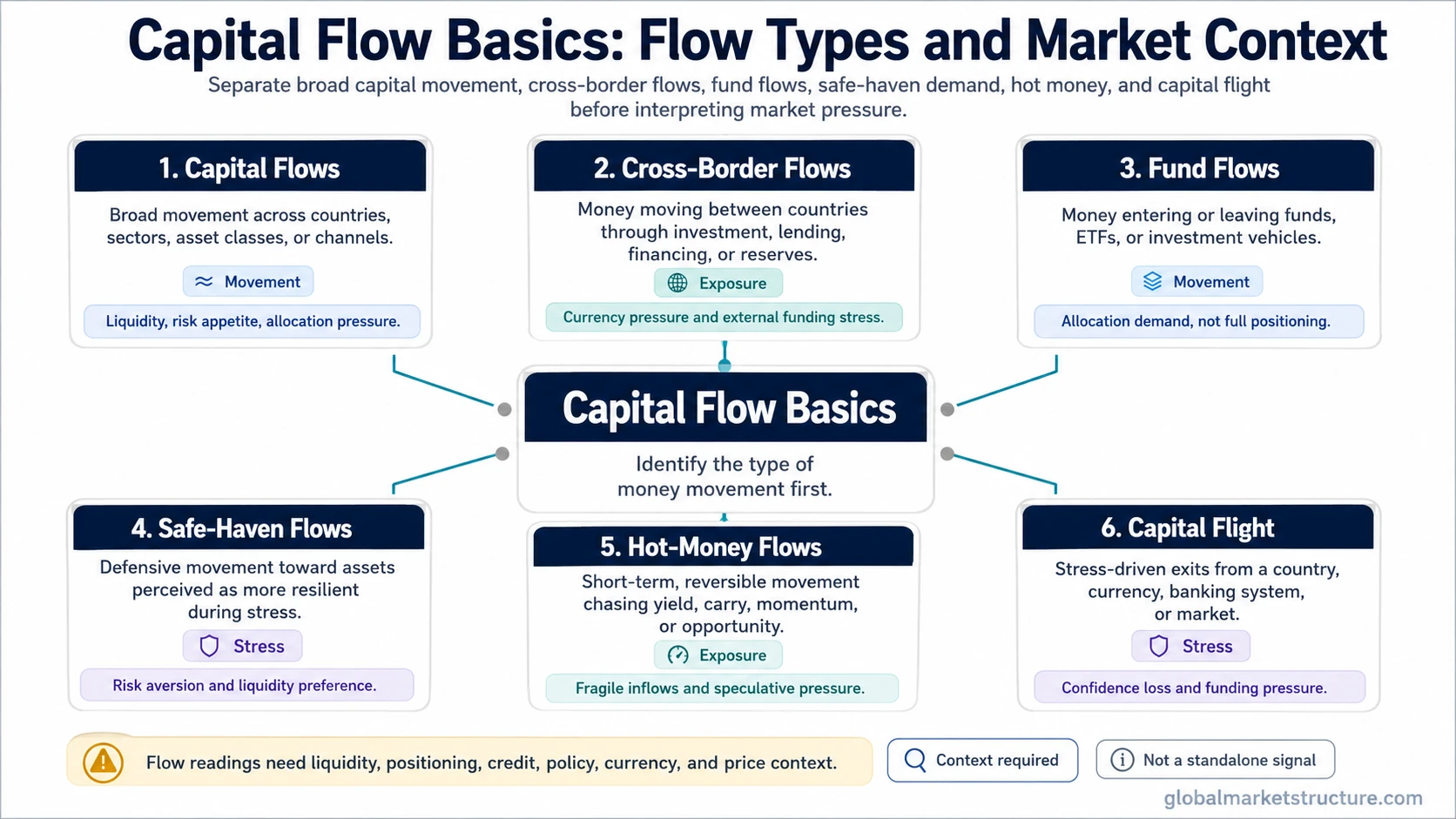
Main Types of Capital Flows
| Flow concept | What it describes | What it helps interpret | What it does not prove | Deeper concept path |
|---|---|---|---|---|
| Capital flows | Broad movement of money between countries, sectors, asset classes, or financial channels. | Liquidity direction, risk appetite, currency pressure, and broad allocation changes. | Precise market direction or timing. | Broad movement of money. |
| Cross-border flows | Money moving between countries through investment, lending, trade-related financing, or reserve activity. | Currency pressure, external funding stress, balance-of-payments strain, and dependence on foreign capital. | The cause of every move in a currency or equity market. | Country-level capital movement. |
| Fund flows | Money entering or leaving funds, ETFs, mutual funds, or other investment vehicles. | Investor allocation and changes in demand for an asset class. | The full positioning of hedge funds, dealers, or leveraged participants. | Fund or ETF inflow and outflow data. |
| Safe-haven flows | Defensive movement toward assets perceived as more resilient during stress. | Risk aversion, demand for liquidity, and defensive allocation shifts. | That all risk assets must continue falling. | Defensive movement of capital. |
| Hot money flows | Short-term capital movement sensitive to yield, momentum, carry, or perceived opportunity. | Fragile inflows, speculative pressure, and sensitivity to rate or currency changes. | Durable investment confidence. | Fast and reversible capital movement. |
| Capital flight | Stress-driven movement of money out of a country, currency, banking system, or market. | Loss of confidence, funding pressure, and policy credibility risk. | The exact cause of the exit without supporting evidence. | Stress-driven or fear-driven exits. |
Accounting, Exchange-Rate, and Stress Questions
Separates current-account activity from the narrower capital-account category.
Clarifies the distinction between the capital account and financial account in balance-of-payments classification.
Covers how cross-border financial assets and liabilities are recorded inside the balance of payments.
Examines how cross-border flow pressure can interact with currency markets and exchange rates.
Focuses on abrupt interruptions or reversals of external financing under stress.
Capital Flows, Fund Flows, and Positioning
Capital flows can describe movement across borders, asset classes, currencies, institutions, and funding channels. Fund flows are narrower because they measure movement into or out of investment vehicles. Positioning measures the exposure that market participants already hold.
Money entering, leaving, or shifting through a market or financial channel over a period.
Existing exposure, including how concentrated or vulnerable that exposure may be.
A market can receive fresh inflows while the underlying trade is already crowded. It can also experience outflows while leveraged exposure remains high. The effect depends partly on who is moving capital and how much liquidity is available to absorb the flow.
Reading Capital Flows in Market Structure
Determine whether the observation is broad, cross-border, fund-based, defensive, speculative, or stress-driven.
Separate a durable shift from a short-lived or easily reversible movement.
Compare the flow with liquidity, positioning, credit, policy conditions, currencies, and the wider risk environment.
Price behavior and cross-market evidence help distinguish a broader shift from an isolated allocation change.
When a Defensive Flow Becomes More Important
Money can move toward defensive assets before the wider market shows a durable change in risk conditions. The flow itself is evidence of movement, not proof that the entire risk environment has changed.
Capital begins leaving riskier assets while defensive assets attract demand.
Credit, liquidity, currencies, and market breadth remain relatively stable.
Credit spreads widen, liquidity deteriorates, currency stress increases, and market breadth weakens alongside the flow shift.
What Capital Flows Cannot Show Alone
An inflow can reflect fresh demand, short-term yield seeking, portfolio rebalancing, or movement that follows an earlier price change. An outflow can carry equally different meanings. Liquidity, positioning, credit conditions, policy context, currency behavior, and price confirmation determine how much weight the flow deserves.