
Volatility targeting is a portfolio-risk process that adjusts exposure so expected or realized volatility stays near a target level.
It matters for market structure because synchronized exposure scaling can influence institutional flow pressure during volatility shocks. The process can change risk exposure, but it does not forecast direction or prove the size of future flows.
Definition: Volatility targeting sets a volatility objective for a portfolio and then changes exposure when the estimated level of risk moves away from that objective. If measured or expected volatility rises, exposure may be reduced. If volatility falls, exposure may be increased, subject to mandates, leverage limits, liquidity and transaction costs.
Key Points
- Volatility targeting adjusts portfolio exposure toward a volatility objective, not a return target.
- The mechanism usually depends on realized or expected volatility estimates.
- Rising volatility can lead some portfolios to reduce exposure, but the market effect is conditional.
- The process creates pressure context, not a directional forecast.
- Liquidity, crowding, correlations, hedging and offsetting flows shape whether exposure changes become visible in markets.
What Volatility Targeting Means
Volatility targeting belongs to the institutional allocation and portfolio-risk family. The goal is to keep portfolio volatility near a chosen level by changing how much market exposure the portfolio carries.
The target is not a price forecast. It is a risk objective. A portfolio can reduce exposure after volatility rises even if the underlying manager has no directional view on the market. The exposure change comes from the risk model, not from a claim that prices must move in a specific direction.
The core distinction is simple: volatility targeting responds to estimated risk, while directional forecasting tries to predict price movement. Confusing those two ideas turns a risk-control mechanism into a false market signal.
How Volatility Targeting Changes Exposure
A volatility-targeting process usually begins with a volatility estimate. That estimate may be based on realized volatility, expected volatility, or a model that blends several inputs. The portfolio then compares the estimate with the target volatility level.
A simple way to understand the mechanism is the ratio between target volatility and estimated volatility. If the target is higher than the estimate, the model may allow more exposure. If the estimate rises above the target, the model may call for lower exposure.
Mechanism mini-map: volatility estimate → target volatility gap → exposure scale factor → portfolio exposure change → possible flow pressure → liquidity, size, crowding, correlation and offsetting-flow filters.
The scale factor is not the same as a market order. Mandate rules, rebalancing frequency, leverage caps, risk limits, hedges, transaction costs and internal netting can all change how much of the model adjustment becomes external market flow.
Model lag also matters. A volatility estimate can be based on a lookback window, so the portfolio may respond after risk has already changed rather than at the first sign of market stress.
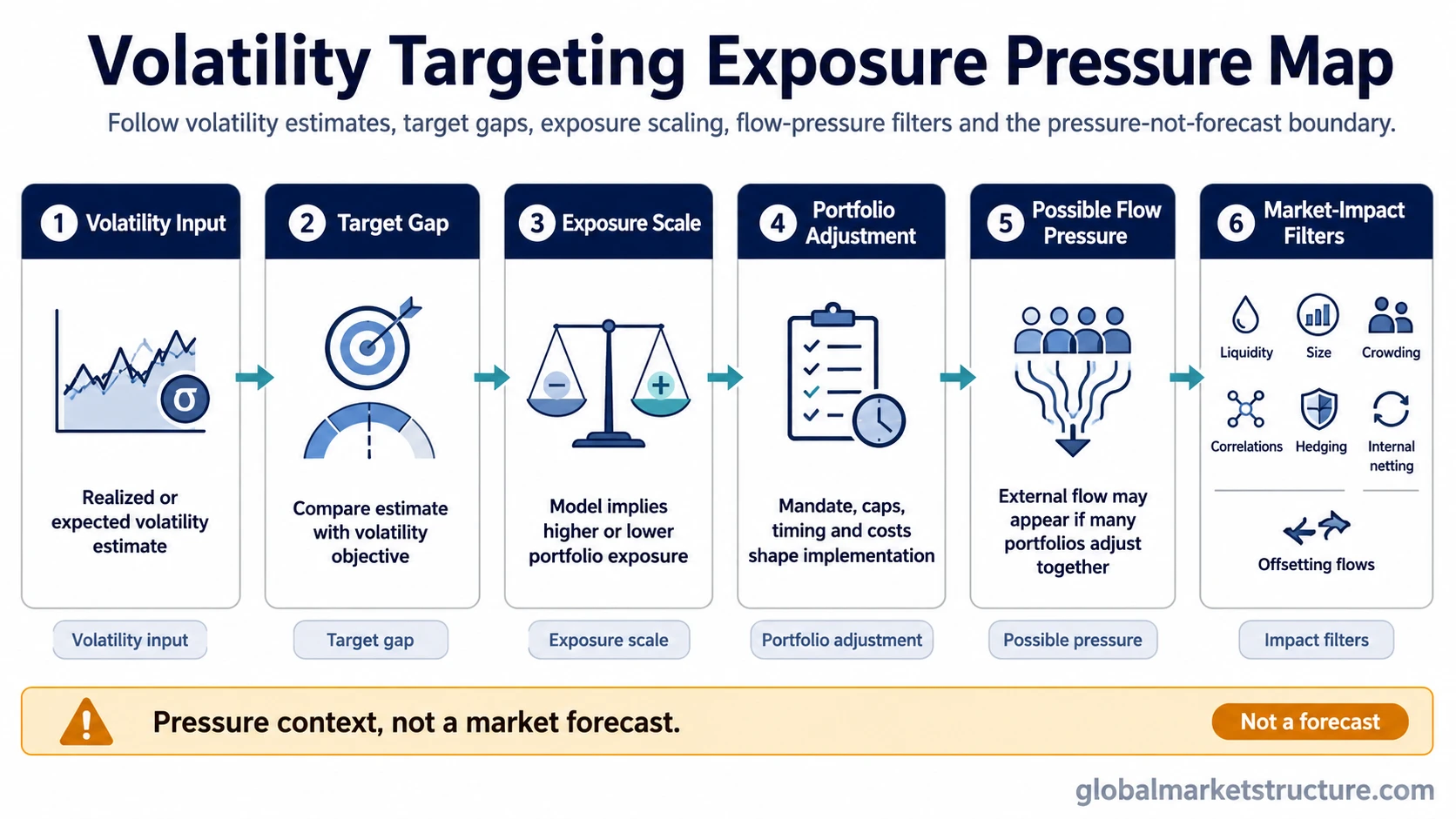
The Main Components of a Volatility-Targeting Process
Volatility targeting is easier to interpret when the process is separated into its main parts. Each component answers a different question: what risk level is desired, how risk is estimated, how exposure is adjusted, and what prevents the adjustment from becoming a clean market signal.
| Component | What it means | Why it matters | Common misread |
|---|---|---|---|
| Target volatility | The desired portfolio volatility level. | It sets the risk objective that exposure is scaled toward. | Treating it as a return target. |
| Volatility estimate | The realized, expected, or model-based risk input. | It drives the gap between current risk and target risk. | Treating the estimate as perfect or instantly current. |
| Exposure scale factor | The adjustment implied by target volatility versus estimated volatility. | It translates the risk gap into a possible exposure change. | Treating the scale factor as automatic market direction. |
| Leverage or exposure cap | The rule that limits how much exposure can expand or contract. | It prevents the model from scaling without constraint. | Ignoring mandate design and risk limits. |
| Liquidity and correlation filters | The market conditions that shape whether flows are visible. | They influence whether exposure changes create price pressure or get absorbed. | Assuming all model scaling becomes visible market flow. |
Why Volatility Targeting Can Affect Market Pressure
Volatility targeting can become market-structure relevant when many portfolios respond to similar volatility inputs at the same time. A volatility shock can push some models toward exposure reduction, while a prolonged low-volatility period can allow exposure to build.
The pressure becomes more important when the response is crowded, leverage is present, liquidity is thin, correlations are rising and offsetting flows are weak. Under those conditions, risk reduction may add to existing stress instead of remaining a quiet portfolio adjustment.
Effects can vary by asset class because volatility, liquidity, hedging practice and portfolio role differ across equities, credit, bonds, currencies and commodities. A single volatility number does not describe the whole cross-asset effect.
Limitation: volatility targeting can add pressure when exposure is scaled down into stress, but it does not prove that a market must keep falling. The final market effect depends on size, leverage, liquidity, timing, correlation, hedging, internal netting and other buyers or sellers operating at the same time.
What Volatility Targeting Does Not Prove
The most common mistake is treating volatility targeting as a directional signal. A rise in volatility may create de-risking pressure in some portfolios, but that does not prove the direction, persistence or size of future market moves.
Another mistake is reading low volatility as proof that risk is low. Low measured volatility can encourage higher exposure, but it can also coexist with leverage, crowded positioning or fragile liquidity. The risk may be quiet before it becomes visible.
Common misread: higher volatility can create exposure-reduction pressure in some portfolios, but visible impact depends on model design and market conditions. It is safer to separate possible exposure adjustment from actual external flow.
How Volatility Targeting Differs From Nearby Flow Concepts
Volatility targeting and risk parity can both use volatility and risk-budget logic, but they are not identical. Risk parity allocates risk across asset classes, while volatility targeting scales total exposure toward a volatility objective.
Passive flows describe broader rule-based or index-linked allocation behavior. Volatility targeting is narrower because the exposure change is driven by volatility estimates and target-risk mechanics.
Stock buybacks are different because they come from issuer-driven equity demand, not from portfolio-risk exposure scaling. Both can matter for equity-market flow interpretation, but the source of demand is different.
The clean distinction is that volatility targeting belongs to the risk-control and exposure-scaling family. It can interact with rebalancing and institutional flows, but it should not be collapsed into every other flow source.
A Practical Volatility-Targeting Scenario
Measured volatility rises above the level used by a group of target-volatility portfolios. Some portfolios reduce exposure to bring estimated portfolio volatility closer to the target. If similar mandates respond together, selling pressure may become more visible.
The interpretation remains conditional. If liquidity is deep, hedges absorb part of the adjustment, correlations stay contained and other investors provide offsetting demand, the visible pressure may be limited. If liquidity is thin, correlations rise and the strategy is crowded or leveraged, the same type of adjustment can matter more.
The narrower interpretation is that a volatility shock can change the demand for risk reduction and liquidity, but it does not identify the next market direction by itself.
Reading Volatility Targeting Without Turning It Into a Signal
Volatility targeting is strongest as a market-structure input when it is read beside liquidity, positioning, correlations, breadth, credit conditions and offsetting flow sources.
A useful reading separates three layers: the model may call for exposure adjustment, the portfolio may or may not turn that adjustment into external flow, and the market may or may not absorb the flow without visible pressure.
FAQ
Is volatility targeting a market forecast?
No. Volatility targeting adjusts exposure toward a risk objective. It can affect flow pressure, but it does not forecast direction by itself.
Is volatility targeting the same as risk parity?
No. Risk parity allocates risk across asset classes, while volatility targeting scales exposure toward a volatility objective. The two can overlap, but they solve different portfolio problems.
Why can volatility targeting add pressure during stress?
When volatility rises, some target-volatility portfolios may reduce exposure. The pressure becomes more important when strategies are large, leveraged, crowded, and operating in thin liquidity.
Does low volatility mean volatility-targeting risk is low?
Not necessarily. Low measured volatility can allow exposure to rise, but leverage, crowding, fragile liquidity and model lag can still make the later adjustment more sensitive.