
A discount rate is the required return used to convert expected future cash flows into present value. In market-structure analysis, it helps explain how changes in required returns can alter valuation sensitivity across equities, bonds, and other long-duration assets.
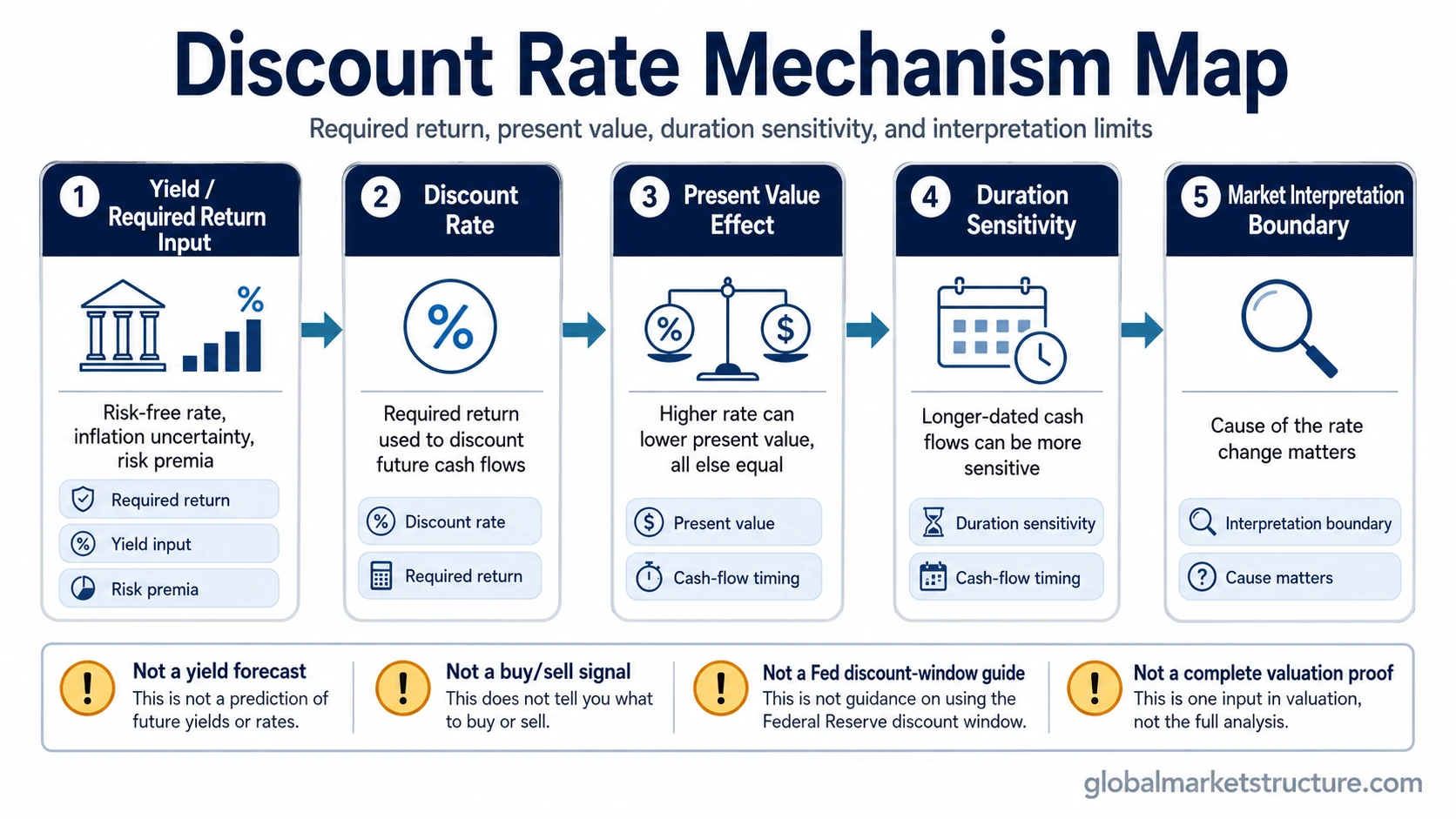
How Discounting Changes Present Value
A basic present-value relationship is:
Present value = future cash flow / (1 + discount rate)n
With expected cash flows unchanged, a higher discount rate reduces present value. The effect becomes larger when more of the asset’s value depends on cash flows expected further in the future. If cash-flow expectations also change, the market-price response can differ from the present-value effect of the discount-rate change alone.
Aswath Damodaran’s NYU Stern valuation materials make the consistency rule explicit: nominal cash flows should be discounted with nominal rates, while real cash flows should be discounted with real rates. Mixing the two changes the valuation mechanically rather than revealing a new market signal. Source: NYU Stern.
Valuation Discount Rate vs Federal Reserve Discount Rate
The required return used to convert expected future cash flows into present value. This is the meaning used on this page.
The rate associated with Federal Reserve discount-window credit to eligible depository institutions. It belongs to central-bank lending and monetary-policy implementation rather than this page’s valuation framework.
The Federal Reserve uses the term discount rate for discount-window credit to eligible depository institutions. That is a different concept from the required-return input used for present-value analysis on this page. Source: Federal Reserve Board.
Discount Rate and Related Market Concepts
A valuation discount rate can include a baseline return plus compensation for risks relevant to the cash flows being valued. The risk-free rate can provide a baseline, while the equity risk premium is one component used when interpreting required returns for equities.
| Concept | Primary job | Relationship to discount rate |
|---|---|---|
| Discount rate | Convert expected future cash flows into present value. | It is the required-return input applied to the cash flows being valued. |
| Risk-free rate | Provide a baseline return reference. | It can form the base layer of a required-return framework. |
| Equity risk premium | Represent additional required return for equity risk relative to a lower-risk benchmark. | It can be one component of an equity discount rate. |
| Bond yield | Express the return implied by a bond’s price and cash-flow structure. | It is closely related to discounting bond cash flows, but one bond yield is not a universal discount rate for other assets. |
| Bond duration | Measure sensitivity to yield changes. | Bond duration helps show how strongly a bond price may react when the relevant yield changes. |
How the Discount-Rate Channel Reaches Market Prices
Rates, inflation expectations, risk premia, liquidity conditions, or changes in perceived uncertainty can alter the return investors require.
The revised required return changes the present value assigned to expected future cash flows.
Assets with more value tied to distant cash flows are generally more sensitive to a given change in the discounting input.
A growth-led yield increase, an inflation-led increase, a real-yield move, and wider risk premia can produce different cross-asset outcomes even when required returns rise in each case.
Same Discount-Rate Direction, Different Market Interpretation
- Present value faces direct downward pressure.
- Longer-duration cash-flow profiles tend to be more sensitive.
- The discount-rate change carries more of the valuation explanation.
- The higher discount rate still lowers the value assigned to a given future cash flow.
- Stronger expected cash flows can offset part or all of that valuation pressure.
- The final price response depends on both sides of the valuation equation.
A change in required return needs to be read together with expected cash flows, inflation, growth, credit, liquidity, and risk premia. The framework helps explain why an asset may become more or less sensitive to repricing, but it does not provide a standalone forecast or trading signal.