
A carry trade pairs lower-cost funding with higher-yielding exposure. The expected carry comes from the spread between what the position earns and what it costs to finance. Currency moves, asset-price changes, funding terms, volatility, leverage, and liquidity determine how much of that spread is actually retained.
Currency carry is the most familiar expression, although the broad carry concept also appears in rates, credit, volatility, and other funded exposures. The structure becomes more fragile when the funding leg moves against the position or when leverage and crowding make the exposure harder to maintain.
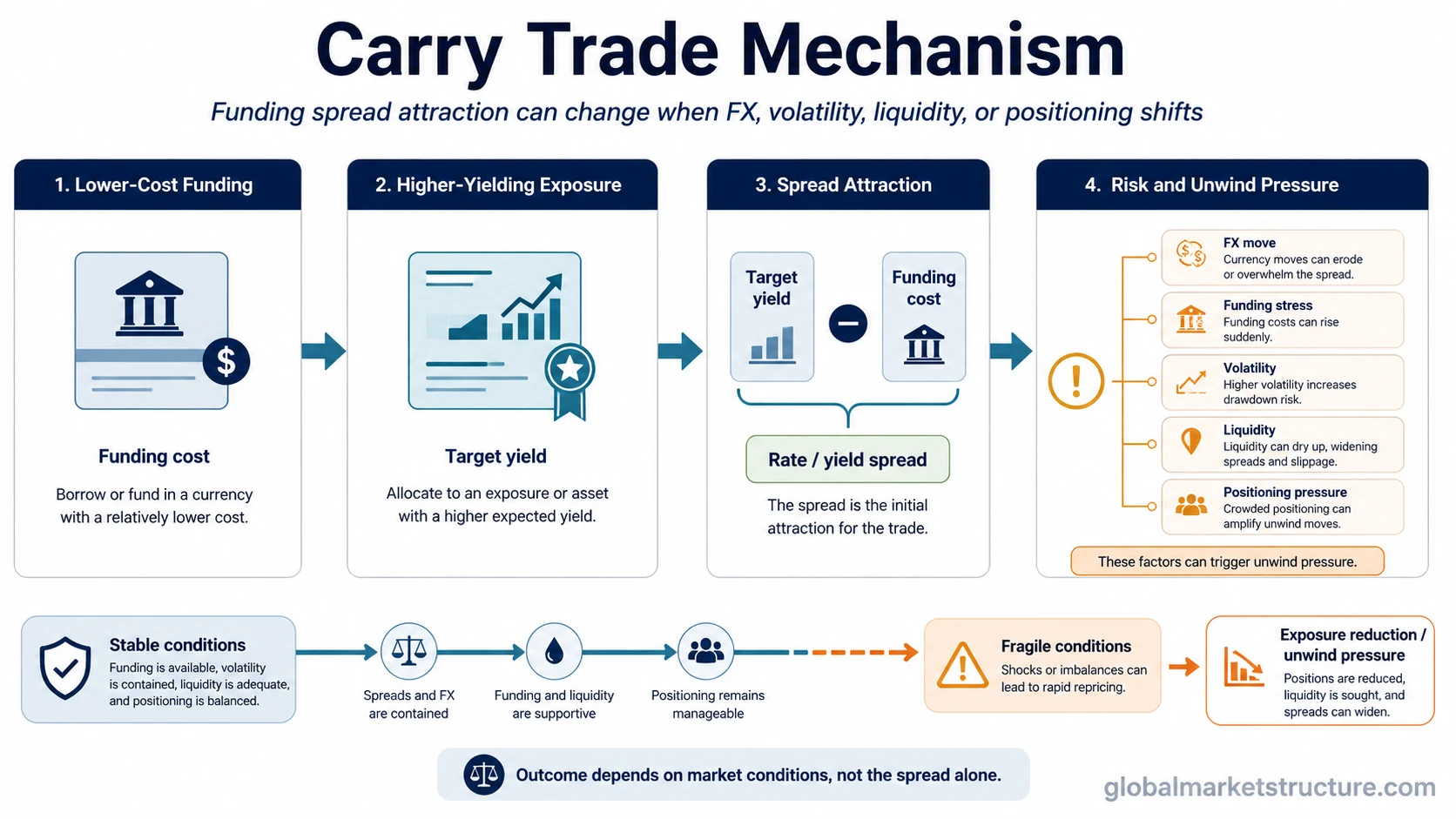
Carry Trade Mechanism
The mechanism starts with a financing advantage and ends with an outcome that depends on the path of both the funding leg and the higher-yielding exposure.
This pathway is conditional. A favorable spread can persist while market movement or financing conditions change the economics of the position.
What Determines the Outcome
The yield differential creates the attraction, while the realized result also reflects the path of the funded exposure and the cost of maintaining it.
| Risk channel | What can change | Why it matters |
|---|---|---|
| FX risk | The funding currency strengthens or the target currency weakens. | Currency losses can exceed the income earned from the rate differential. |
| Funding risk | Borrowing, rollover, or financing costs rise. | The net carry narrows and the position can become harder to maintain. |
| Volatility risk | Price movement becomes larger or less predictable. | Mark-to-market losses, margin pressure, or internal risk limits can force exposure reduction. |
| Liquidity risk | Exiting or resizing the position becomes more expensive. | Similar exits can move prices more sharply when market depth is weak. |
| Leverage risk | Borrowed exposure magnifies the effect of adverse moves. | A relatively small move can create a larger loss or collateral requirement. |
| Positioning risk | Many participants hold similar funding and target exposures. | Adjustment can become faster when several participants reduce comparable positions at the same time. |
The spread describes an income or funding advantage under the assumed structure. Currency movement, asset-price losses, higher financing costs, transaction costs, or forced deleveraging can outweigh that advantage.
Currency Carry and Funding-Currency Risk
In a currency carry trade, a lower-yielding currency forms the funding side and a higher-yielding currency or currency-linked asset forms the target side. A stable exchange rate leaves more of the rate differential intact. A strengthening funding currency or weakening target currency works in the opposite direction.
The yen carry trade is a familiar example of that structure. It is useful because it makes the funding leg visible, but the broad carry concept is not limited to the yen or to foreign exchange.
BIS Bulletin 124, published in May 2026, finds that significant carry-trader short positions in funding currencies can amplify the exchange-rate response to monetary-policy tightening through the unwinding of leveraged positions. The evidence supports the funding-and-unwind channel in currency carry; it does not imply that every carry position or policy move produces the same outcome. BIS Bulletin 124.
When Carry Becomes Fragile
A wide spread can remain attractive while the conditions around it deteriorate. Fragility rises when several pressure points begin to move together.
Funding is cheap, the spread is favorable, volatility is contained, and the position can be financed without unusual pressure.
The funding currency strengthens, the spread narrows, volatility rises, liquidity weakens, or financing constraints become tighter.
The expected carry deserves less weight once holding risk, leverage, and exit conditions start to dominate the original financing advantage.
Broader market effects require additional evidence. A funding-currency move alone does not establish a large unwind. Position reduction, volatility, liquidity pressure, and related cross-market moves make the interpretation stronger.
A Practical Diagnostic Sequence
Define what is being financed, what provides the higher yield or return exposure, and which market variables can change either side.
Compare the expected yield or income with funding, rollover, transaction, and other relevant costs.
Review currency movement, target-asset behavior, volatility, and policy changes that can offset the carry before it is earned.
Leverage, liquidity, collateral, funding access, and crowded positioning determine how much adverse movement the structure can absorb.
Separate a less attractive carry environment from evidence that participants are already reducing or closing exposure.
Carry Trade and Carry Trade Unwind
A lower-cost funding leg supports a higher-yielding exposure in an attempt to earn a positive carry profile.
Positions are reduced, closed, or hedged after changes in funding, spreads, market prices, volatility, liquidity, or risk constraints make the structure less attractive or harder to maintain.
Related Carry and Funding Concepts
| Concept | Primary focus | Boundary |
|---|---|---|
| Currency carry trade | Funding in one currency and higher-yielding exposure in another. | FX movement is central to the result. |
| Yen carry trade | Carry exposure where the yen is the funding currency. | A currency-specific expression of broader carry. |
| Carry trade unwind | Reduction or closing of existing carry positions. | Owns the exit and deleveraging phase rather than the original carry structure. |
| Volatility carry trade | Carry exposure whose economics depend materially on volatility conditions or volatility risk premium. | Volatility is the defining risk layer. |
| Basis trade | Relative pricing between linked instruments or markets. | The core mechanism is basis convergence or divergence rather than a broad yield differential. |
| Funding stress | Pressure on financing access, rollover, collateral, leverage, and holding capacity. | Explains funding pressure that can affect carry and other leveraged structures. |
FAQ
What is a carry trade?
A carry trade is a position funded at a lower borrowing or financing cost and placed into a higher-yielding currency, asset, or exposure. The goal is to benefit from the rate or yield difference, but market movement and funding conditions can change the result.
Why is positive carry not guaranteed profit?
Positive carry can be offset by currency losses, rising funding costs, volatility, leverage reduction, transaction costs, or forced unwinds. The yield spread is only one part of the total risk and return profile.
Is a carry trade always a currency trade?
No. Currency carry is the most familiar version, but carry logic can also appear in rates, credit, volatility, and other markets where a position is built around a yield, funding, or risk-premium differential.
What causes a carry trade unwind?
A carry trade unwind can happen when the funding currency strengthens, the rate differential compresses, volatility rises, liquidity tightens, or leveraged participants reduce exposure. The unwind is the exit pressure, not the carry trade definition itself.
How is a carry trade different from a basis trade?
A carry trade focuses on earning or holding a yield or funding differential. A basis trade focuses on pricing differences between related instruments or markets. Both can involve financing and risk, but the core mechanism is different.