
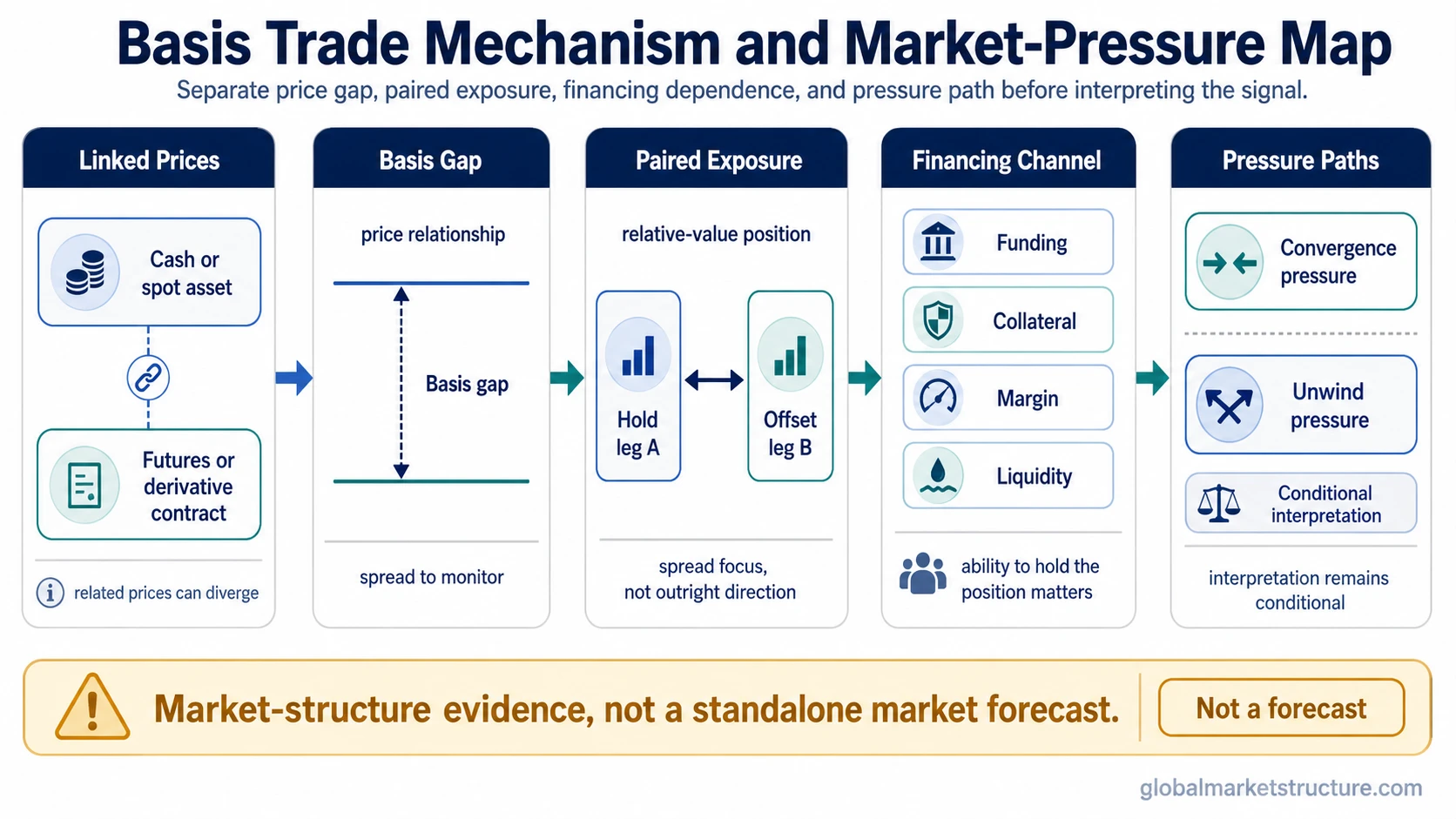
A basis trade is a relative-value position built around the price relationship between linked instruments, most often a cash or spot asset and a related futures contract. The position usually combines offsetting exposures and depends on how the spread behaves after financing, carry, margin, and other market frictions are considered.
Basis trading is the broader activity of managing these price relationships. The position can reduce outright directional exposure, while funding, liquidity, leverage, and the behavior of the spread still determine whether it can be held as intended.
The main exposure is to the relationship between linked prices, together with the financing and market frictions around the paired position.
The result depends mainly on whether the underlying market moves up or down relative to the position taken.
How a Basis Trade Works
A common structure begins when related instruments trade far enough apart to support a relative-value position after costs. One leg is held against the other, and the position is maintained only while the spread and the financing remain acceptable.
The sequence is conditional. A spread can remain open because of carrying costs, delivery terms, market segmentation, liquidity differences, or other frictions. Financing pressure can also force a position to change before the expected convergence is complete.
What Basis Means Across Markets
The basis is the price difference between linked cash or spot exposure and a related futures or derivative price. The exact calculation convention should be checked before interpreting a positive or negative reading.
The CFTC glossary says commodity basis is typically calculated as cash minus futures. CME equity-index materials quote basis as futures minus spot. The instrument pair and convention therefore need to be defined before a positive or negative basis is interpreted.
| Basis setting | Linked prices | Main drivers or frictions | Scope |
|---|---|---|---|
| General cash or spot versus futures | Cash/spot instrument and related futures contract | Carry, financing, time to expiry, liquidity, and contract terms | The broad basis relationship. |
| Treasury basis trade | Cash Treasury security and Treasury futures | Repo financing, delivery economics, futures positioning, margin, and Treasury-market liquidity | A Treasury-specific basis structure. |
| Commodity basis | Physical or local cash commodity and a related futures contract | Storage, delivery, location, inventory, financing, and contract maturity | A basis relationship with physical-market frictions. |
| Equity-index basis | Spot index value and related index futures | Financing costs, expected dividends, time to expiry, and market pricing | A financial-index basis relationship. |
| Cash and carry trade | Cash asset and related futures contract | Futures premium, financing, storage or holding costs, collateral, and execution | One basis-related implementation, rather than the entire basis-trade category. |
Basis Trade vs Carry Trade
The position is organized around the spread between linked instruments and how that spread converges, diverges, or remains financeable.
The position is organized around earning a yield, rate, funding, or risk-premium differential while the associated market risks remain manageable.
Funding, Leverage, and Holding Capacity
Small spreads can support large positions when financing is cheap and leverage is available. That changes the risk profile. A position that looks closely hedged in price terms can still depend heavily on collateral, margin, rollover terms, and the ability to fund both sides through changing market conditions.
The repo market is especially relevant when a cash security is financed through short-term borrowing. More broadly, funding liquidity affects whether leveraged positions can be maintained without costly resizing or forced sales.
Offsetting market legs can reduce outright price exposure while leaving the position sensitive to funding cost, margin, collateral, liquidity, balance-sheet capacity, and execution conditions.
When Basis-Trade Pressure Can Spread
Stress becomes more important when the basis, financing conditions, and market depth deteriorate together. The resulting position reduction can look directional even though the original trade was built as relative value.
The spread widens, financing becomes more expensive, or margin and collateral requirements become less favorable.
Liquidity in one leg weakens, leverage must be reduced, or the position becomes difficult to finance at its previous scale.
Forced resizing can create pressure across the linked cash, futures, and financing markets, but the basis trade alone does not establish a wider market crisis.
This stress path should also be separated from a carry trade unwind. Both can involve leverage and funding pressure, but the original exposures are organized around different relationships.
Measurement and Proxy Caution
Public data rarely identifies every leg of a basis trade directly. Futures positioning, cash holdings, repo borrowing, fund disclosures, and regulatory data can each reveal part of the structure without proving that every observed position belongs to the same strategy.
Specify the cash, spot, futures, forward, or derivative prices that create the basis being measured.
State which price is subtracted from which and account for the relevant carry, financing, delivery, or contract terms.
A futures short, cash holding, or repo position can support several strategies. One leg should not be treated as a complete basis-trade estimate by itself.
The interpretation becomes stronger when the cash leg, derivative leg, financing activity, and changes in the basis point toward the same structure.
That proxy boundary is visible in Treasury-market research. The Federal Reserve notes that leveraged funds’ short Treasury futures positions can overstate Treasury basis-trade activity because the same futures positions may also represent directional or other relative-value trades.
FAQ
Is a basis trade the same as a Treasury basis trade?
No. A Treasury basis trade is one specific cash-futures structure inside the broader basis-trade category.
Why can basis trades create market pressure?
Funding, leverage, margin, collateral, and liquidity can force a paired position to be reduced before the expected spread convergence is complete. Large or crowded reductions can transmit pressure across the linked markets.
Does basis-trade activity predict market direction?
No. It can reveal spread, financing, positioning, and unwind pressure, while broader market direction still depends on evidence outside the basis structure.