
A carry trade unwind begins when positions built around cheaper funding and higher-yielding exposure are reduced or closed. The pressure can come from a stronger funding currency, a narrower rate or yield spread, higher volatility, tighter liquidity, or leverage that becomes harder to maintain.
The market effect depends on how the position is funded and how many participants need to adjust at the same time. An orderly reduction can stay contained. A crowded, leveraged exit can feed back through currencies, target assets, margin requirements, and liquidity.
Lower-cost funding supports exposure with a higher expected yield or return while the relevant market risks remain manageable.
Participants reduce, close, or hedge that exposure after the funding, spread, volatility, liquidity, or risk conditions deteriorate.
How a Carry Trade Unwind Develops
The exit process can start with one adverse change and accelerate when several pressure channels begin to reinforce each other.
A stronger funding currency can raise the cost of closing a currency-funded position. Spread compression reduces the income advantage. Higher volatility can tighten risk limits or increase margin needs. Weaker liquidity can make exits more expensive. Leverage determines how quickly those changes become binding.
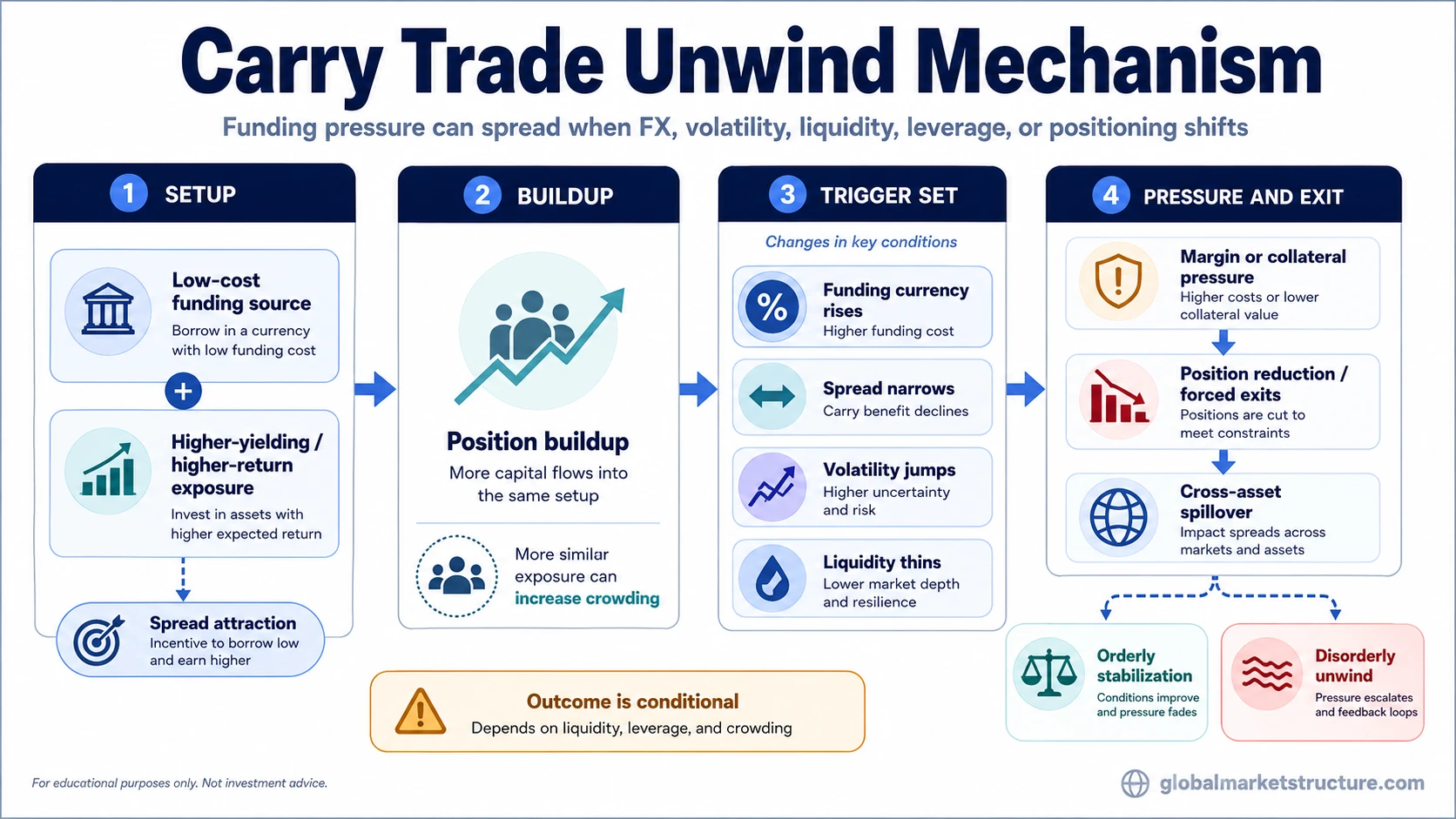
What Changes the Unwind Path
| Pressure channel | What changes | Effect on the position | Interpretation boundary |
|---|---|---|---|
| Funding currency | The borrowed currency strengthens. | Closing or maintaining the funded exposure can become less favorable. | Currency strength alone does not establish a broad unwind. |
| Rate or yield spread | The advantage between funding and target exposure narrows. | The compensation for holding the structure declines. | A smaller spread can reduce demand without forcing immediate exits. |
| Volatility | Market moves become larger or less predictable. | Risk limits, margin needs, and mark-to-market losses can become more restrictive. | Volatility can rise without being caused by carry positions. |
| Liquidity | Market depth weakens. | Reducing exposure can create larger price moves and higher execution costs. | Thin liquidity amplifies pressure but does not identify its original source. |
| Leverage and collateral | Losses or financing terms consume more balance-sheet capacity. | Voluntary reductions can become forced deleveraging. | The effect depends on actual leverage, collateral buffers, and risk controls. |
| Crowding | Many participants hold similar funding and target exposures. | Similar exits can reinforce currency moves and selling in target assets. | Crowding is usually estimated through incomplete positioning evidence. |
How to Tell Whether an Unwind Is Actually Underway
Carry positions are difficult to observe directly across the full market. One currency move or volatility spike is not enough to identify a broad unwind; the diagnosis improves when several pieces of evidence line up.
Define the currency or financing source and the higher-yielding assets or currencies that may be connected to the trade.
Look for changes in the funding currency, rate differential, volatility, financing terms, and liquidity.
Futures positioning, fund exposure, FX derivatives, margin pressure, or simultaneous selling in target assets can provide supporting evidence.
Cross-asset selling, rising volatility, weaker liquidity, and a stronger funding currency provide a stronger case that the adjustment is spreading beyond one market.
BIS research on the August 2024 turbulence found that leveraged-trade unwinds and margin increases amplified market volatility, while also noting that the overall size of FX carry trades was difficult to measure because of data gaps. A 2026 BIS study separately found that large short carry positions in funding currencies can amplify the exchange-rate response to policy tightening through the unwinding of leveraged positions. See BIS Bulletin 90 and BIS Bulletin 124.
When the Pressure Spreads Across Markets
Cross-asset transmission becomes more plausible when participants are forced to raise cash, reduce leverage, or close several positions at once. The original stress may begin in a funding currency while the visible adjustment appears in equities, credit, bonds, volatility, or other risk-sensitive exposures.
Positions are smaller, liquidity remains functional, and participants can reduce exposure without large forced sales.
Leverage, crowding, margin pressure, and weaker market depth make similar exits more sensitive to one another.
Funding-currency strength and target-asset selling occur alongside broader deleveraging and volatility across connected markets.
Unwind, Crash, and Related Carry Conditions
Some carry positions are reduced gradually. A crash-like episode requires stronger evidence of forced deleveraging, crowded positioning, weak liquidity, margin pressure, and broader market transmission.
| Related concept | Primary focus | Boundary |
|---|---|---|
| Yen carry trade | Carry exposure where the yen is the funding currency. | A currency-specific expression rather than the full unwind category. |
| Volatility carry trade | Carry whose economics depend materially on volatility exposure or volatility risk premium. | Its stress path can involve deleveraging, but the underlying carried exposure is different. |
| Funding stress | Pressure on financing access, rollover, collateral, and holding capacity. | Funding stress can trigger or amplify carry exits but is broader than the unwind of a carry position. |
| Carry trade crash | A disorderly unwind with stronger feedback and broader stress. | It is a possible severe outcome, not a separate assumption built into every unwind. |
FAQ
What is a carry trade unwind?
A carry trade unwind is the reduction or closing of positions that were funded through a lower-cost currency or financing source and invested in higher-yielding or higher-returning exposure. The exit can follow changes in FX, rates, volatility, liquidity, leverage, or positioning.
Why do carry trades unwind?
Carry positions may be reduced when the funding currency strengthens, the yield spread narrows, volatility rises, liquidity weakens, margin pressure increases, or the position becomes harder to finance or hold.
Does a carry trade unwind always cause a market crash?
No. Many exits can remain orderly. A crash-like outcome requires a more severe combination of leverage, crowding, weak liquidity, forced reductions, and broader transmission.
How is a carry trade unwind different from a carry trade crash?
A carry trade unwind is the general process of reducing or closing carry positions. A carry trade crash is a disorderly version in which forced deleveraging and weak liquidity produce sharper feedback across markets.
Why can yen strength affect carry trades?
Yen strength can pressure yen-funded carry positions because participants may face adverse currency moves while reducing target exposure and buying back the funding currency. The effect depends on the structure, leverage, positioning, volatility, and liquidity.
How do volatility and margin pressure affect carry trade exits?
Higher volatility can increase mark-to-market risk and tighten internal risk limits. Higher margin or collateral needs can also reduce holding capacity and accelerate position reductions.