
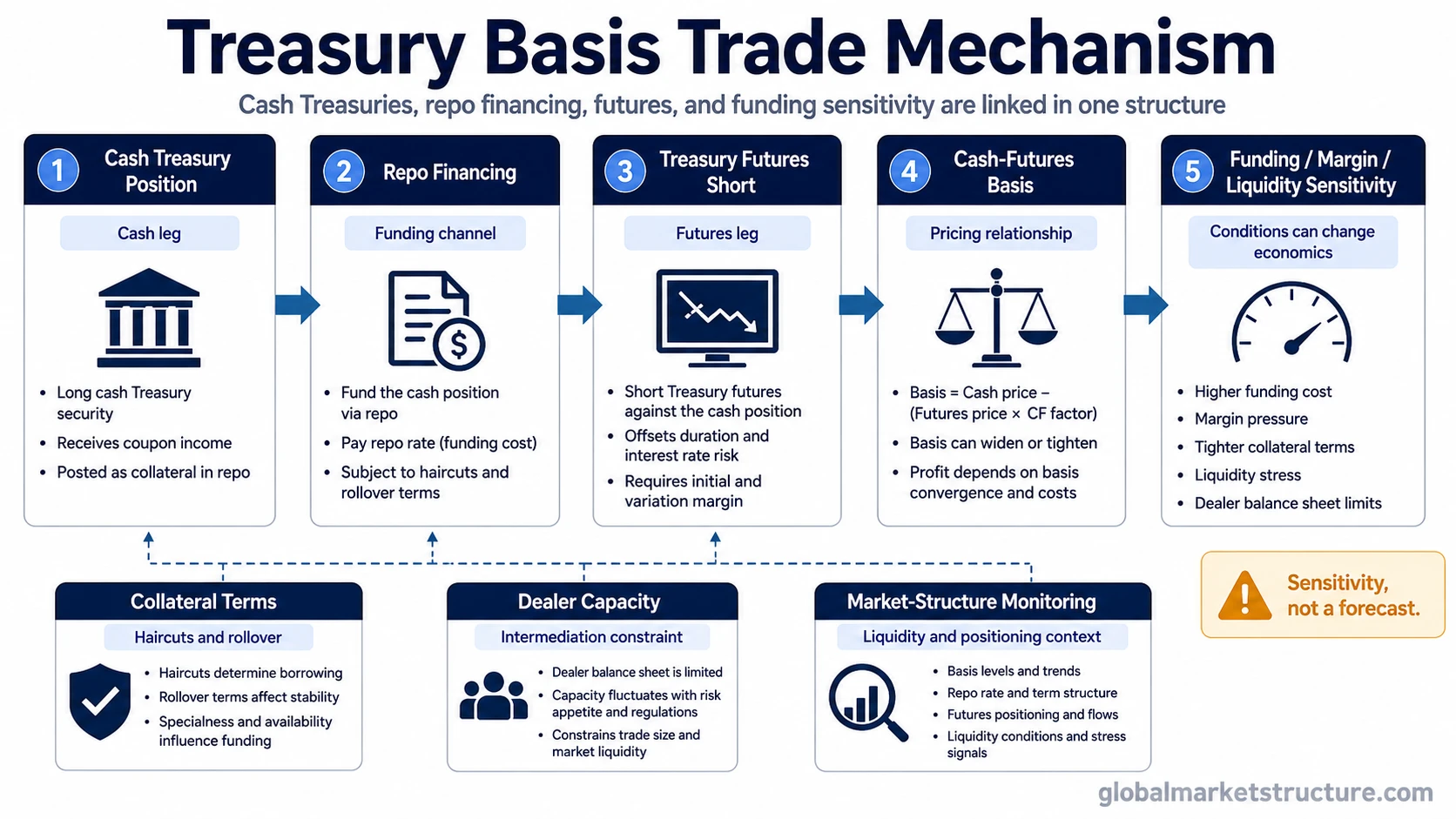
A Treasury basis trade is a cash-futures relative-value position that commonly combines a long cash Treasury security with a short related Treasury futures contract. The cash leg is often financed through repo. The expected return depends on the cash-futures basis after financing, carry, delivery, margin, and transaction costs are taken into account.
The structure links Treasury cash markets, futures, repo funding, collateral, leverage, and dealer intermediation. Those connections make it useful for monitoring funding and liquidity pressure when conditions around the position begin to change.
How a Treasury Basis Trade Works
A typical long-basis structure starts with a Treasury security that appears cheap relative to the corresponding futures contract after delivery economics and financing are considered. The participant holds the cash security, finances it, and offsets much of the outright duration exposure with a short futures position.
The trade can lose attractiveness before convergence is complete. Repo costs can rise, futures margin can increase, collateral terms can change, or liquidity can weaken in one of the legs.
Delivery Economics and the Cheapest-to-Deliver Security
Treasury futures can be settled with securities from an eligible delivery basket. Each eligible security has a conversion factor, so the relevant comparison is between the cash security and the converted futures price rather than a raw price difference between two unrelated quotes.
The cheapest-to-deliver, or CTD, security is central to many Treasury basis calculations because its delivery economics determine which cash security is most relevant to the futures contract. Changes in prices, financing, and contract economics can alter that relationship.
CME Group defines Treasury basis as the cash security price minus the converted futures price and uses the result as a starting point for cheapest-to-deliver analysis. A 2026 Chicago Fed primer likewise describes the trade around the futures price and the CTD security.
Funding, Leverage, and Holding Capacity
The cash Treasury leg is commonly financed in the repo market. A narrow spread can support a large position when financing is cheap and balance-sheet capacity is available, which makes the economics sensitive to repo rates, collateral terms, and leverage.
Funding liquidity is broader than repo itself. It describes the ability to obtain and maintain financing on workable terms. A basis position can remain closely hedged in price while becoming harder to fund or resize.
Repo rollover, margin, collateral, leverage, execution, and market depth can force a change in the position even when the original cash-futures relationship still appears attractive.
| Pressure point | What changes | Why it matters |
|---|---|---|
| Repo rate | The cost of financing the cash Treasury leg rises. | Net basis economics become less attractive. |
| Repo haircut or collateral terms | More capital or collateral is required. | The same position consumes more balance-sheet capacity. |
| Futures margin | Additional liquid resources may be needed on the futures leg. | Liquidity needs can rise before the basis converges. |
| Market depth | Cash or futures positions become harder to adjust. | Resizing the trade can create larger price impact. |
| Dealer capacity | Intermediaries become less able to absorb or finance flows. | Stress can transmit more easily between cash, futures, and repo markets. |
When Basis-Trade Pressure Can Spread
A Treasury basis position can be stable while financing is available, margin requirements are manageable, and both market legs remain liquid. Stress becomes more consequential when several of those conditions weaken together.
Funding costs rise, margin increases, the basis widens, or collateral terms become less favorable.
Leverage has to be reduced while liquidity or dealer balance-sheet capacity is becoming less elastic.
Selling cash Treasuries and covering futures shorts can transmit pressure across linked markets. The scale depends on positioning, liquidity, funding conditions, and the speed of the adjustment.
This mechanism explains why Treasury basis trades matter for market structure without turning the existence of the trade into a forecast of yields or a crisis call.
How Treasury Basis Activity Is Measured
No single public series identifies every matched Treasury basis position. Futures positioning, cash Treasury holdings, repo borrowing, and regulatory disclosures each capture part of the structure.
Identify the Treasury security, futures contract, delivery terms, and basis convention being examined.
Leveraged-fund short Treasury futures positions can indicate activity consistent with the trade, but they do not identify every strategy behind those shorts.
Repo borrowing and cash Treasury exposure help show whether the funding leg is consistent with a financed relative-value position.
The estimate becomes more credible when the cash leg, futures leg, repo activity, basis behavior, and participant data point in the same direction.
The Federal Reserve notes that leveraged funds’ short Treasury futures positions may also represent directional or other relative-value strategies. Using the futures leg alone can therefore overstate matched cash-futures basis activity.
Treasury Basis Trade and Related Basis Structures
The broad category covers relative-value positions built around price relationships between linked cash, spot, futures, or derivative instruments.
The Treasury-specific structure centers on cash Treasury securities, Treasury futures, delivery economics, and the financing required to hold the cash leg.
A cash-and-carry trade is another cash-and-derivative structure. Treasury basis trading shares some of that logic, while Treasury delivery rules, conversion factors, repo financing, and market-specific liquidity determine the details of this version.
FAQ
Is a Treasury basis trade the same as a basis trade?
No. Treasury basis trade is a Treasury-specific form of basis trading built around cash Treasury securities, Treasury futures, and the financing and delivery mechanics that connect them.
Why does repo financing matter in a Treasury basis trade?
Repo commonly finances the cash Treasury leg. Changes in repo rates, collateral terms, haircuts, or rollover conditions can alter the economics and holding capacity of the position.
Does Treasury basis trading predict a market crisis?
No. The trade can create funding and liquidity vulnerabilities when leverage is high or positions are reduced quickly, but crisis risk requires broader evidence about market depth, financing, positioning, and participant behavior.
Why is leverage important in Treasury basis trades?
The cash-futures spread is often small, so leverage can increase the return on the spread while also increasing sensitivity to funding costs, margin, collateral, and forced position reductions.