
A cash and carry trade pairs a cash or spot position with a related futures or derivative position, typically holding the cash asset while taking the offsetting futures side. The structure is evaluated against the relationship between the market futures price and an estimated fair-value futures price after relevant carry inputs are included. Financing, margin, liquidity, execution, settlement, and the ability to hold both legs can change the economics before convergence or expiry.
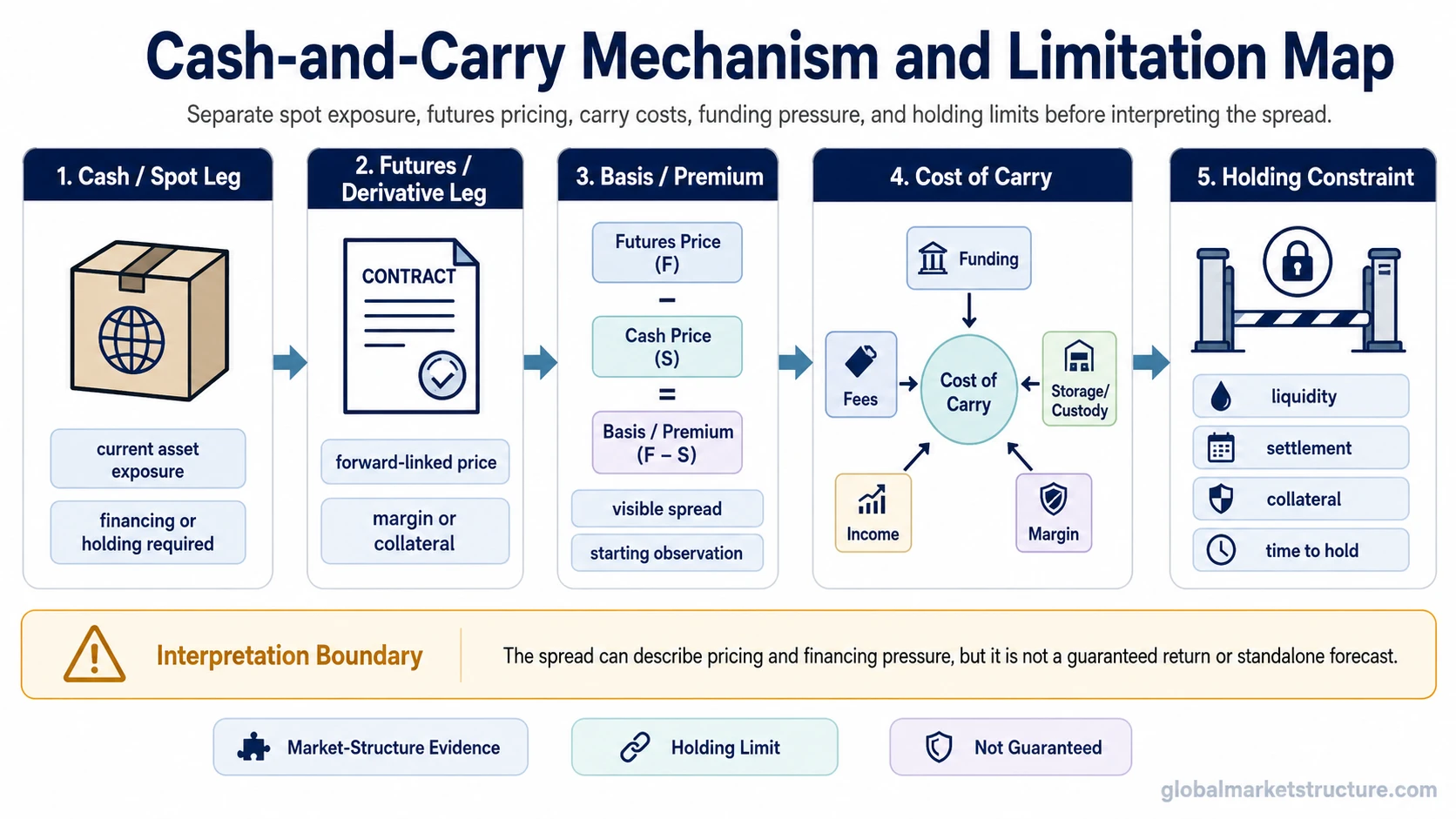
How the Cash-and-Carry Mechanism Works
The cash leg creates current ownership or exposure. The futures or derivative leg offsets part of the price exposure at a future-linked price. The visible gap between those two prices is only the starting point because holding the cash side has a cost and, in some markets, produces income that also belongs in the calculation.
| Component | What it represents | What can change the reading |
|---|---|---|
| Cash or spot leg | The current asset exposure that is bought, held, borrowed, or otherwise maintained. | Financing cost, borrow availability, custody, storage, income, collateral treatment, or balance-sheet capacity. |
| Futures or derivative leg | The related future-linked contract used to offset part of the cash asset’s price exposure. | Contract terms, margin, settlement assumptions, liquidity, roll cost, and execution quality. |
| Visible basis or premium | The price difference between the cash asset and the related futures or derivative price. | A premium over spot can reflect normal carry rather than an excess spread. |
| Fair-value reference | An estimate of the futures price after the relevant net carry inputs are applied to the spot position. | The inputs vary by market and can include financing, income, storage, insurance, or other contract-specific economics. |
| Cost of carry | The cost and income profile of maintaining the cash leg over the relevant holding period. | Funding rates, fees, storage, insurance, dividends, coupons, or other income can change the estimate. |
| Holding constraint | The ability to maintain both sides long enough for the price relationship to matter. | Liquidity shocks, margin calls, financing withdrawal, position limits, execution slippage, or changing collateral conditions. |
Cash-and-Carry, Fair Value, and Cost of Carry
Basis describes the observed relationship between the cash asset and the related futures or derivative contract. A cash-and-carry reading goes one step further by estimating what the futures price should be after the relevant carry inputs are included.
Spot and futures can trade at different prices even when the futures contract is close to fair value. The cash-and-carry question is whether the market futures price still sits above the carry-adjusted reference after the relevant costs and income are included.
Futures price minus spot price shows the visible basis or premium.
Futures price minus estimated fair-value futures price shows what remains after the carry-adjusted reference is considered.
CME Group’s credit-futures methodology measures net basis as the futures price minus a fair-value futures price that adjusts spot for financing. Its equity-index fair-value methodology also incorporates expected dividends. A single universal carry formula would therefore be misleading across asset classes.
For a simplified non-income-paying asset, the relationship can be expressed as estimated fair-value futures price = spot price + relevant net carry over the holding period. Markets with dividends, coupons, storage costs, foreign interest rates, or other contract-specific features require those inputs to be handled separately.
A Simple Cash-and-Carry Example
Assume a cash asset trades at 100 and the estimated all-in carry to the relevant futures expiry is 2. In this simplified example, the estimated fair-value futures price is 102. If the market futures price is 103, the visible futures premium over spot is 3, while the amount above estimated fair value is only 1.
| Input | Illustrative value | Reading |
|---|---|---|
| Spot price | 100 | Current cash-market reference. |
| Estimated net carry | +2 | Simplified holding cost to the relevant expiry. |
| Estimated fair-value futures price | 102 | Spot plus estimated net carry in this simplified example. |
| Market futures price | 103 | The observed future-linked market price. |
| Amount above estimated fair value | 1 | The remaining difference before execution costs, fees, margin effects, and estimation error are considered. |
The example separates a visible 3-point premium from the smaller 1-point difference above estimated fair value. If the carry estimate changes, the fair-value reference changes with it.
Why the Spread Can Change Before Convergence
A paired cash and futures position can reduce part of the directional price exposure while remaining sensitive to financing and balance-sheet conditions.
An apparent excess over fair value can shrink or disappear if funding becomes more expensive, margin consumes more liquidity, execution worsens, or the position cannot be maintained to the relevant settlement or expiry point.
| Risk or constraint | Why it matters | Market-structure reading |
|---|---|---|
| Funding cost | The cash leg may require financing or balance-sheet capacity. | A spread can narrow after financing costs rise even when the quoted spot and futures prices have not moved much. |
| Margin and collateral | The futures or derivative leg can require variation margin or additional collateral support. | Liquidity pressure can appear before the expected price relationship converges. |
| Liquidity | Both legs must be entered, maintained, adjusted, or exited under real market depth. | Thin liquidity can make a theoretical spread difficult to capture at assumed prices. |
| Execution | The two legs may not be executed at the same time or at the assumed prices. | Slippage, fees, and timing gaps can reduce or remove the remaining spread. |
| Settlement and delivery | The expected relationship depends on contract terms and settlement behavior. | A simplified convergence assumption may not match the practical settlement path. |
| Ability to hold | The structure may need time for the price relationship to converge or normalize. | Funding or margin pressure can force an adjustment before that point is reached. |
Cash and Carry Trade vs Related Concepts
Cash-and-carry belongs to the broader basis and carry family, but its defining structure is the paired cash or spot exposure and related futures or derivative exposure.
| Concept | Core distinction | Why the distinction matters |
|---|---|---|
| Cash and carry trade | Pairs a cash or spot position with a related futures or derivative position. | The reading depends on spot, futures, estimated fair value, carry, and the ability to maintain both legs. |
| Carry trade | Uses a broader funding and exposure relationship to seek a carry differential. | A carry trade does not require the same paired cash and futures structure. |
| Basis trade | Uses the price relationship between related instruments as the central relative-value evidence. | Cash-and-carry is one structure built around basis, while basis trading covers a broader set of relationships. |
| Treasury basis trade | Treasury basis trade focuses on the relationship between cash Treasuries and Treasury futures. | The Treasury-specific structure adds repo financing, delivery economics, collateral, and other market-specific mechanics. |
| Fixed income carry | Fixed income carry describes income, financing, and rates exposure in bonds or rate-sensitive instruments. | It can include coupon income and curve effects without using the same paired cash and futures structure. |
| Reverse cash-and-carry | Uses the opposite-direction structure when the relevant price relationship reverses. | The mechanics depend on the ability to establish and maintain the required opposite cash and derivative exposures. |