
Fixed income carry is the income or financing component generated by holding a bond or rates position before market-price changes are counted. For a financed position, the relevant carry also depends on what it costs to fund the exposure.
Rate moves, credit spreads, liquidity, and duration determine what happens around that carry. The curve-aging effect is separate and belongs to bond roll-down.
Income, accrual, or financing economics associated with maintaining the fixed-income exposure.
The value effect created as a bond or rate exposure ages toward a different maturity point on the yield curve.
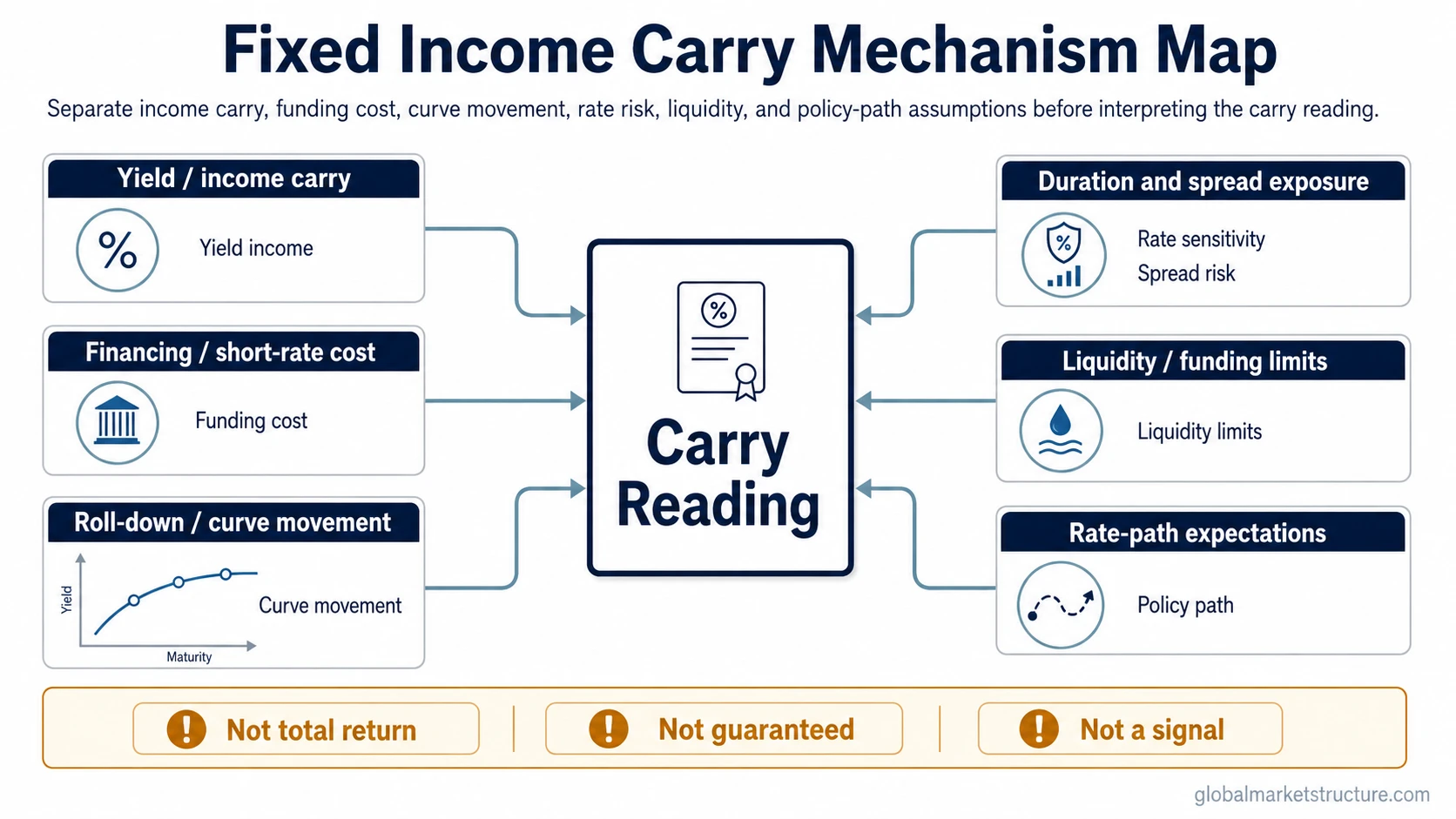
What Fixed Income Carry Includes
For a bond held without explicit financing, the starting point is the income earned while the security is held. In a financed position, the cost of borrowing against the bond reduces that income. A swap or other rate exposure can have a different accrual structure, so the exact calculation depends on the instrument and the convention being used.
CME Group describes fixed income carry by comparing the yield earned on a bond with the short-rate cost of financing the position. In its Treasury material, CME also describes carry as coupon income minus financing cost for a financed security.
FTSE Russell notes that fixed-income literature is not fully uniform about where carry ends and roll-down begins. Some frameworks combine both effects into a broader carry factor. On this site they are kept separate so the income component, curve effect, and combined measure remain distinct.
Carry, Roll-Down, and Total Return
| Concept | Primary job | Main dependency | What it does not capture by itself |
|---|---|---|---|
| Fixed income carry | Separates income, accrual, and financing economics from other return effects. | Yield, coupon or accrual terms, financing cost, and position structure. | Full mark-to-market return. |
| Bond roll-down | Measures the curve-aging effect as remaining maturity shortens. | Yield-curve shape, maturity point, and the curve assumption. | The income or financing component. |
| Carry and roll-down | Combines the holding-income effect with the maturity/curve effect. | Carry inputs plus curve shape and holding-period assumptions. | Unexpected rate, spread, liquidity, or funding changes. |
| Total return | Captures the full realized result over the holding period. | Income plus all relevant price and cost changes. | Nothing narrower should be treated as an automatic substitute for it. |
The combined framework is covered separately under carry and roll-down. Keeping that combined measure separate prevents curve movement from being counted as if it were simply holding income.
What Can Offset Positive Carry
A position can earn positive carry while its market value falls. Whether the carry provides a useful return cushion depends on the size and speed of the other changes affecting the exposure.
| Risk channel | What changes | Effect on the position | Interpretation boundary |
|---|---|---|---|
| Rates and duration | Market yields move against the exposure. | The price loss can exceed the income accumulated during the holding period. | Carry does not remove duration exposure. |
| Credit spreads | Required compensation for credit risk widens. | The bond can lose value even if the underlying government curve is stable. | Higher yield may partly reflect greater credit risk rather than better carry economics. |
| Funding cost | Repo, floating-rate, or other financing becomes more expensive. | Net funded carry falls and can become negative. | The security’s headline yield is not the same as the funded return. |
| Liquidity | Market depth weakens or transaction costs rise. | Reducing the position can become more expensive. | A clean carry estimate may not capture execution friction. |
| Currency | A foreign fixed-income exposure moves against the investor’s base currency. | FX gains or losses can materially change the holding-period result. | This matters only where currency exposure is actually present. |
A useful carry reading therefore keeps the income or financing component separate from duration, spread, liquidity, currency, and curve effects. The size of each component determines the eventual holding-period result.
Where Fixed Income Carry Fits in the Carry Family
The broader carry trade concept applies across currencies, rates, volatility, and other structures. Fixed income carry is narrower because the focus here is the income and financing economics of bond and rates exposure.
A cash-and-carry trade has a different structure. It links cash or spot exposure with a related futures or derivative position and therefore belongs to spot-futures basis mechanics rather than the carry-only decomposition used here.
FAQ
What is fixed income carry?
Fixed income carry is the income, accrual, or financing component generated by holding a bond, swap, or other fixed-income exposure before the full effect of market-price changes is counted.
Is fixed income carry the same as total return?
No. Total return includes carry together with relevant price changes, spread moves, currency effects, transaction costs, and other changes that affect the position over the holding period.
How is fixed income carry different from roll-down?
Carry focuses on income, accrual, and financing economics. Roll-down focuses on the value effect associated with an exposure aging toward a different point on the yield curve.
Can positive carry still lead to a weak result?
Yes. Positive carry can be outweighed by adverse yield moves, wider credit spreads, higher financing costs, weaker liquidity, or currency losses where the position has foreign-exchange exposure.