
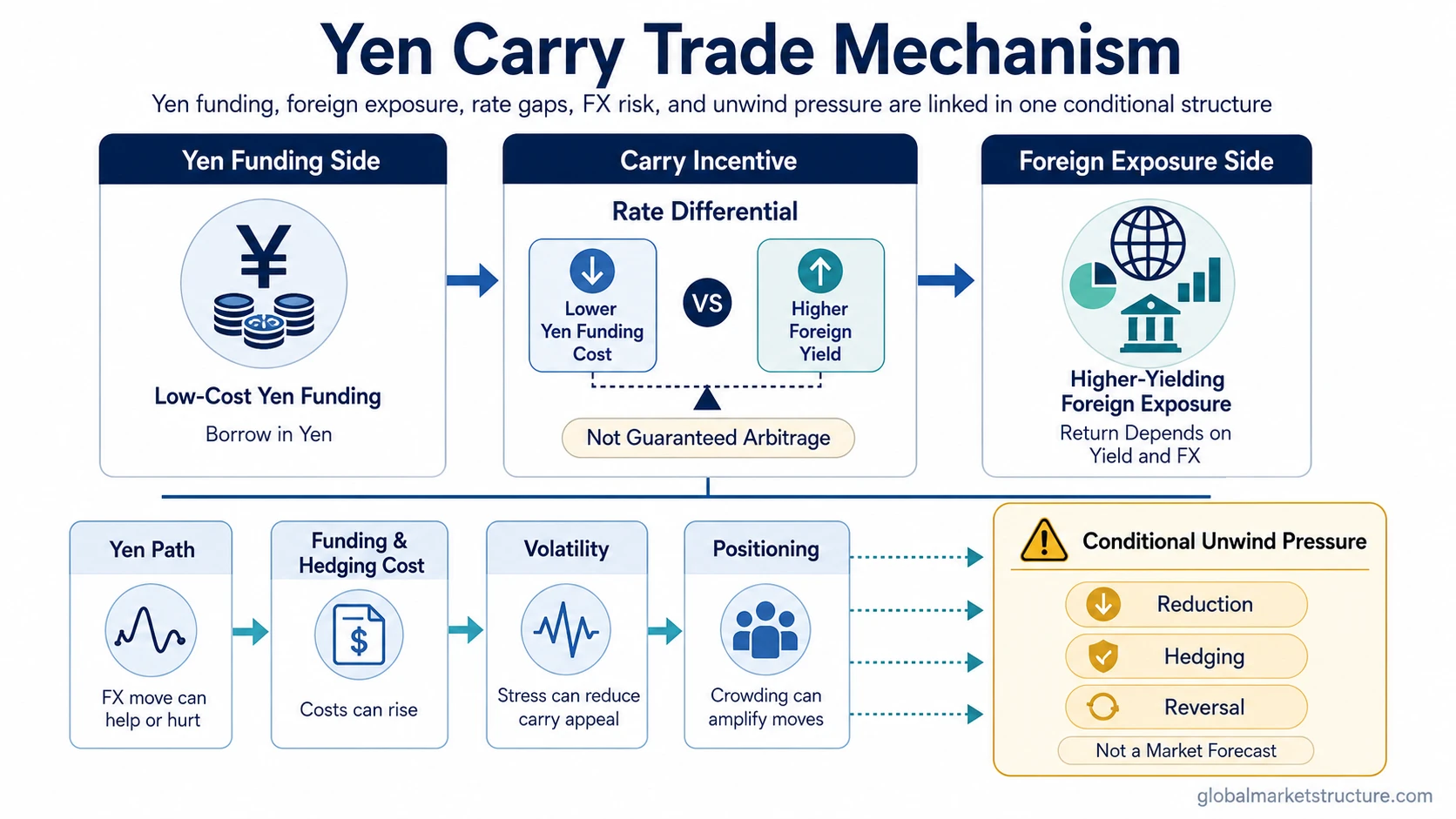
A yen carry trade uses yen funding to hold higher-yielding foreign-currency assets or exposures. The return comes from the carry advantage only if exchange-rate movement, financing costs, volatility, and the cost of maintaining the position do not offset it.
The yen-specific version sits inside the broader carry trade family. Japan’s funding conditions make the yen an important case, while the underlying logic remains conditional on the funding leg and the foreign exposure moving in a workable combination.
The investor retains material yen exchange-rate exposure while using cheaper yen funding to support a higher-yielding position elsewhere.
The foreign asset may still be financed or connected through yen funding, but currency risk is hedged rather than left as the main carry exposure.
How the Yen Carry Trade Works
The simplest version starts with a lower funding cost in yen and a higher expected yield or return in another currency or market. The position earns carry while the rate differential remains favorable and the yen does not strengthen enough to overwhelm that advantage.
This is the yen-funded expression of a broader currency carry trade. The rate gap creates the initial attraction. The realized outcome depends on the currency path and the cost of keeping the position open.
How Yen Funding Can Be Implemented
Direct yen borrowing is the easiest version to visualize, but institutional exposure can also be created through derivatives. A forward position can create the short-yen obligation, and that position can be rolled through FX swaps. The economic exposure therefore does not have to appear as a simple cash loan.
The BIS Annual Economic Report 2025 describes a dollar-based investor receiving yen through an FX swap, selling the yen for dollars, and investing the proceeds in a higher-yielding asset. BIS also notes that similar carry exposure can be created with forwards rolled through FX swaps or other derivatives. The same report distinguishes these unhedged carry positions from yen-funded foreign investments whose FX risk is hedged.
What Supports or Weakens Yen Carry
| Channel | More supportive | Less supportive | Interpretation boundary |
|---|---|---|---|
| Rate differential | Foreign yields remain above yen funding costs. | The differential narrows or expected rate paths converge. | The spread is only one component of the total position. |
| Yen direction | The yen is stable or weak against the exposure currency. | The yen appreciates enough to offset part or all of the carry. | Yen strength can have several causes and does not identify the position size. |
| Funding and hedging | Borrowing, rollover, and hedge costs remain manageable. | Financing or hedging becomes more expensive. | A headline policy-rate gap may differ from the economics of the actual implementation. |
| Volatility | Price movement remains contained enough for the exposure to be maintained. | Higher volatility increases mark-to-market and risk-management pressure. | Volatility can rise for reasons unrelated to carry positioning. |
| Positioning | Exposure can be adjusted without concentrated exits. | Crowded positioning makes simultaneous reductions more likely. | Aggregate carry positioning is difficult to measure directly. |
| Liquidity | Funding and target markets absorb normal position changes. | Market depth weakens as participants need to resize exposure. | Liquidity affects the transmission of an adjustment, not the definition of the trade. |
When Yen Carry Pressure Becomes an Unwind
A weaker carry setup does not require immediate position liquidation. Participants can accept lower carry, hedge more of the currency exposure, reduce leverage gradually, or close positions. The distinction becomes important when several pressures begin to force the same adjustment.
The rate gap narrows, the yen strengthens, or financing becomes less favorable.
Volatility, margin, liquidity, or leverage constraints make the existing exposure harder to maintain.
Position reduction, funding-currency buying, and selling in target exposures begin to align across the structure.
The exit mechanics belong to the broader carry trade unwind framework. On this page, the yen matters because it is the funding currency whose direction can change the economics of the original position.
What Yen Carry Can and Cannot Explain
Yen-funded carry can transmit changes in Japanese financial conditions into foreign markets when the positions are large enough and the funding connection is material. The effect can appear through currencies, bonds, equities, credit, or other risk-sensitive exposures held against yen funding.
A stronger yen can pressure yen carry, while the same market move may also reflect monetary policy, growth, credit, valuation, or liquidity conditions. Carry becomes a stronger explanation when changes in the yen, financing conditions, positioning, volatility, and target exposures support the same interpretation.
Related Carry Concepts
A volatility carry trade belongs to the same broader carry family but earns or holds a different type of risk premium. Yen carry is defined by the funding currency and the foreign exposure it supports.
FAQ
What is the yen carry trade in simple terms?
A yen carry trade uses lower-cost yen funding to hold higher-yielding foreign-currency assets or exposures. The result depends on the rate differential, yen movement, financing costs, volatility, and the structure used to maintain the position.
Is the yen carry trade guaranteed arbitrage?
No. Yen appreciation, narrower rate differentials, higher financing or hedging costs, volatility, leverage, and crowded exits can offset the expected carry.
What is the difference between a yen carry trade and a yen carry trade unwind?
The yen carry trade is the funded exposure. An unwind is the reduction, hedging, reversal, or forced adjustment of carry positions after the supporting conditions weaken.
Does a yen carry trade predict markets?
No. It can help explain one funding and positioning channel across markets, but market direction also depends on monetary policy, growth, credit, liquidity, valuation, and other sources of risk.