
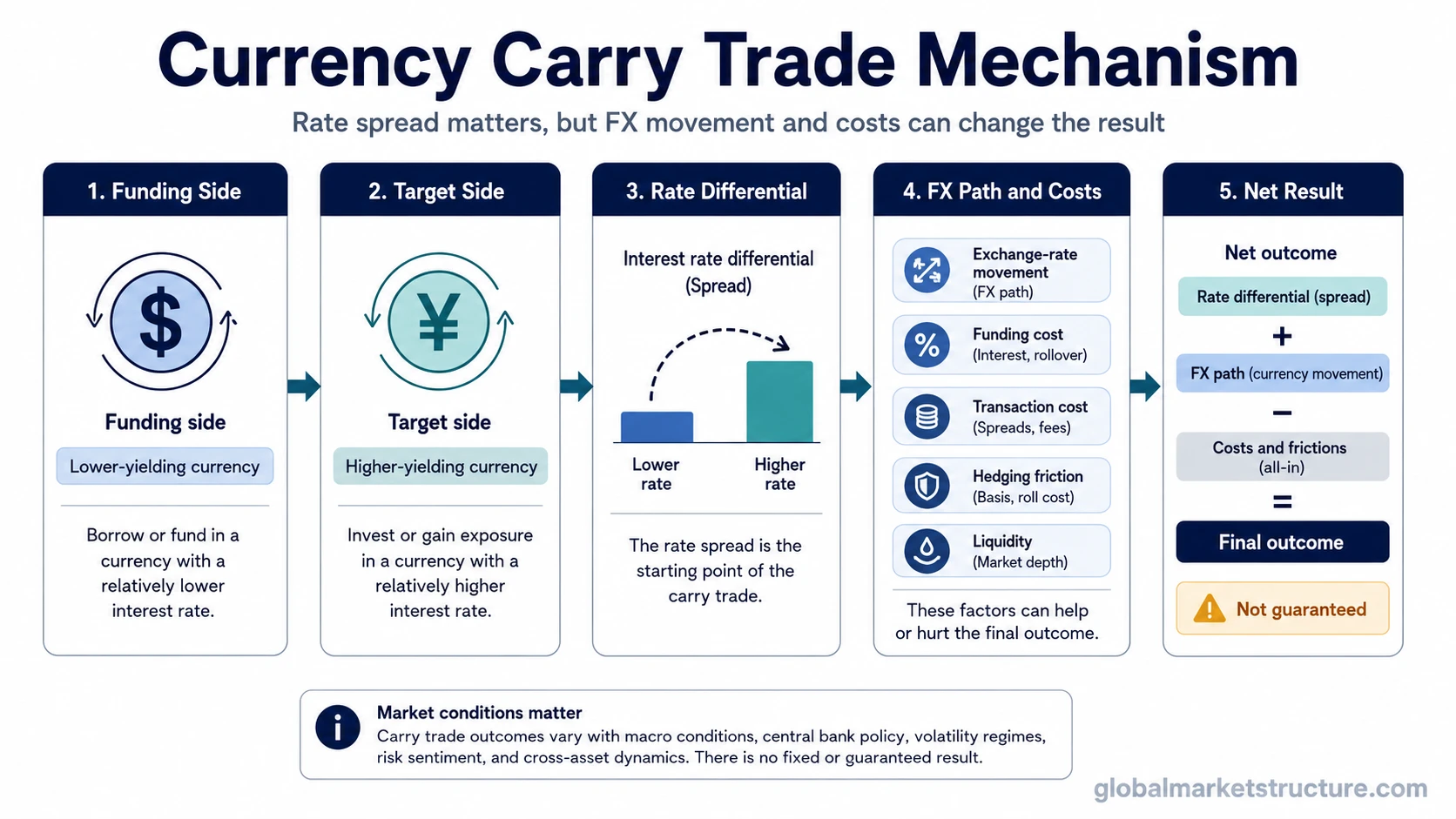
A currency carry trade uses a lower-yielding currency as the funding side and a higher-yielding currency as the exposure side. The rate differential creates the carry, while the exchange-rate path can preserve, reduce, or reverse that advantage.
The structure matters beyond the FX pair itself. Carry positioning can influence cross-border capital flows, funding demand, and the way risk is reduced when market conditions change.
The investor holds higher-yielding currency exposure against lower-rate funding and remains exposed to changes in the exchange rate between the two sides.
The underlying foreign asset can still be funded across currencies, but part or all of the FX exposure is offset through hedging. Its economics therefore differ from the classic unhedged carry position.
How a Currency Carry Trade Works
The starting point is a difference in interest rates between two currencies. The investor takes exposure against the lower-yielding funding currency and holds the higher-yielding target currency. Carry accumulates over time, while the spot exchange rate can move much faster.
This is the foreign-exchange version of the broader carry trade concept. Currency carry adds direct exchange-rate exposure to the underlying yield or funding differential.
Why the Rate Differential Is Not Free Return
The higher-yielding currency can depreciate against the funding currency while the position is open. If that currency loss is large enough, it can exceed the interest advantage accumulated during the same period.
Banque de France describes currency carry as borrowing in a low-rate currency and investing in a high-rate currency without hedging the FX exposure. Under uncovered interest parity, the interest-rate advantage should be offset by exchange-rate adjustment. Actual short-horizon currency behavior can differ, which leaves the strategy exposed to both the rate differential and the realized FX move.
The realized result also reflects spot currency movement, financing and transaction costs, volatility, and the conditions under which the position is maintained or closed.
How Currency Carry Can Be Implemented
The textbook structure uses direct borrowing in the funding currency, a spot currency conversion, and an investment in the target currency. Institutional positions do not always appear in that form.
The BIS Quarterly Review describes both the textbook cash-funded structure and derivative implementations using FX forwards, swaps, and options. These off-balance-sheet structures also make aggregate carry exposure difficult to identify directly in market statistics.
What Changes the Outcome
| Channel | Role in the position | Pressure point | Interpretation boundary |
|---|---|---|---|
| Rate differential | Provides the initial carry advantage between funding and target currencies. | The gap narrows or expected policy paths converge. | A positive spread can remain while the total position loses money. |
| Funding currency | Represents the currency on the short or financing side. | It appreciates against the target currency. | Funding-currency strength can have causes unrelated to carry positioning. |
| Target currency | Provides the higher-yielding currency exposure. | It depreciates enough to offset accumulated carry. | A higher yield can coexist with greater currency or macro risk. |
| Funding and transaction costs | Reduce the gross interest advantage. | Borrowing, rollover, hedging, or execution becomes more expensive. | Headline policy rates may not equal the economics of the actual position. |
| Volatility and leverage | Determine how easily the position can survive adverse moves. | Higher volatility increases drawdowns, margin pressure, or risk-limit reductions. | Volatility alone does not establish that carry positions are being unwound. |
| Liquidity and crowding | Affect the cost and speed of position adjustment. | Many similar positions need to resize into weaker market depth. | Crowding and aggregate carry exposure are difficult to measure directly. |
When Carry Pressure Becomes an Unwind
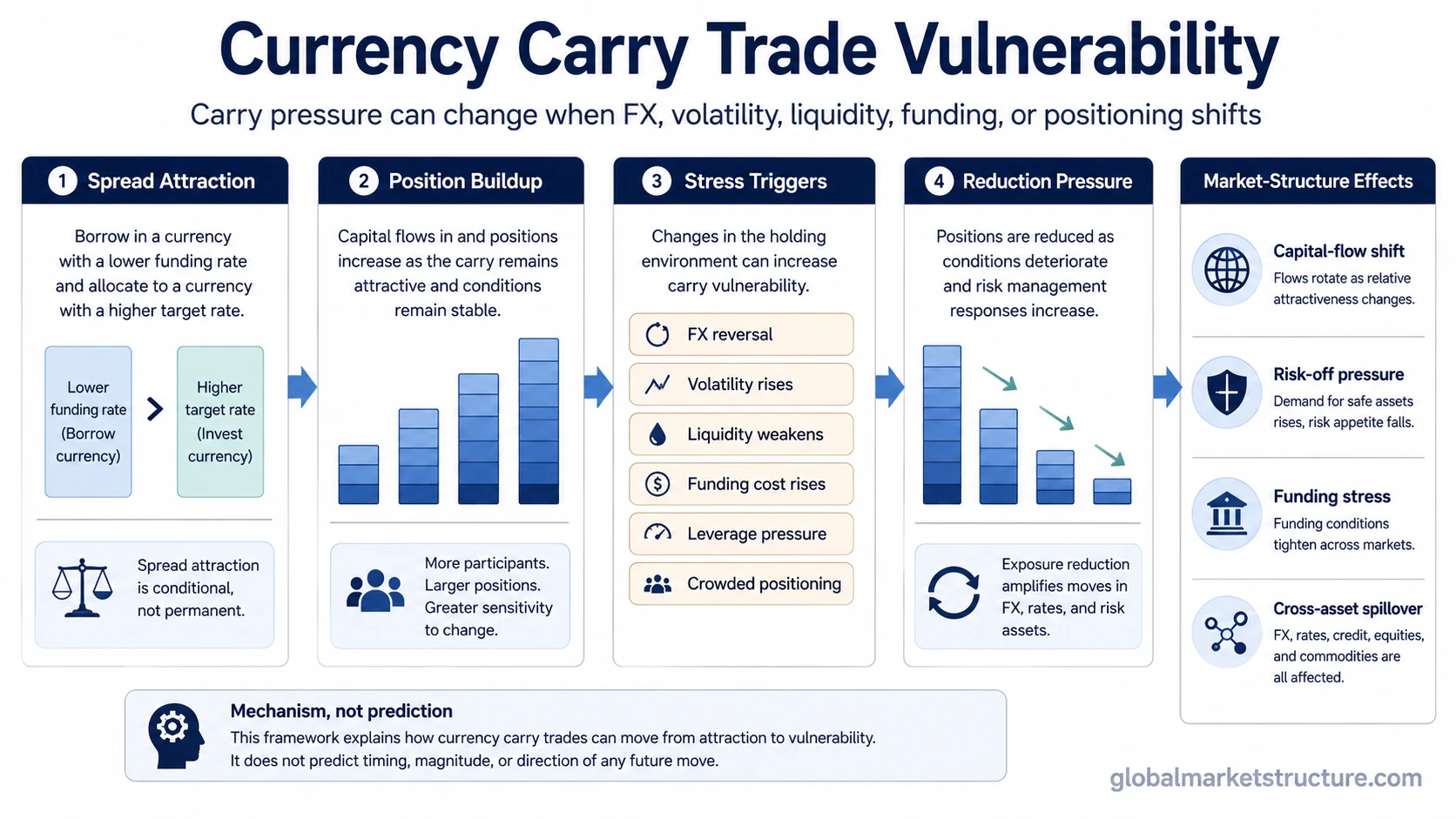
A weaker rate differential or an adverse currency move can reduce the attractiveness of a position without forcing an immediate exit. Investors may keep the exposure, reduce its size, hedge more of the currency risk, or close it.
The rate advantage narrows or the exchange-rate move reduces the expected return.
Volatility, leverage, financing, or risk limits make the exposure less comfortable to maintain.
Participants begin reducing similar positions, potentially reinforcing moves in funding and target currencies.
The actual reduction process belongs to carry trade unwind. If access to financing or balance-sheet capacity becomes the dominant constraint, funding liquidity becomes a separate part of the diagnosis.
Currency Carry Within the Carry Family
A Yen carry trade is a currency-specific case in which the yen serves as the funding currency. A Volatility carry trade earns a different form of carry associated with volatility exposure rather than an FX rate differential.
FAQ
What is a currency carry trade in simple terms?
A currency carry trade uses a lower-yielding currency as the funding side and a higher-yielding currency as the exposure side. The intended return comes from the interest-rate differential, while exchange-rate movement and costs determine how much of that carry is retained.
How is a currency carry trade different from a broader carry trade?
Currency carry is the foreign-exchange version of carry and therefore includes direct currency risk. A broader carry trade can involve other assets or structures in which funding, yield, or risk-premium differences create the carry.
Why can a currency carry trade lose money even when the rate spread is positive?
The target currency can weaken against the funding currency by more than the carry earned. Funding costs, transaction costs, volatility, leverage, and liquidity pressure can also reduce the result.
Is a yen carry trade the same as a currency carry trade?
A yen carry trade is a specific currency carry structure in which the yen is the funding currency. Currency carry trade is the broader FX category.