
A volatility carry trade seeks compensation for taking volatility risk. A common expression is short-volatility exposure when option-implied volatility is priced above the volatility that subsequently occurs, creating a volatility risk premium over the relevant horizon. The realized result still depends on the instrument, volatility path, term structure, hedging, and transaction costs.
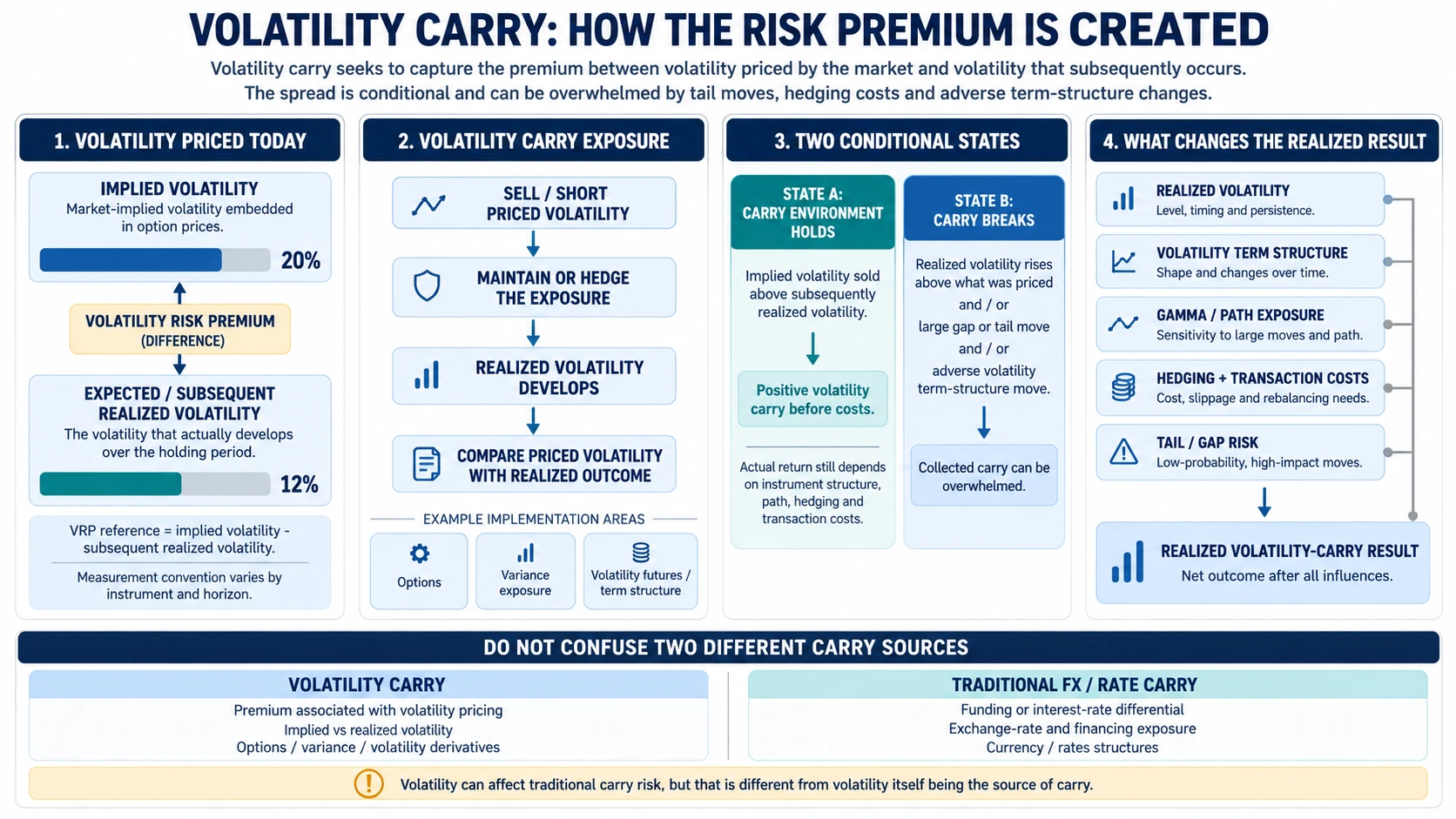
Volatility Carry vs Traditional Carry
On this page, the carry source is volatility pricing itself. Traditional FX or rate carry starts from a funding or yield differential and then faces volatility as one of several risks around that exposure.
Compensation is tied to volatility pricing, commonly through the relationship between implied volatility and subsequent realized volatility.
Compensation starts from an interest-rate, funding, or yield differential. Volatility can weaken the trade without being the original source of carry.
Macquarie describes an FX volatility carry strategy that sells FX options with delta hedging to capture the difference between implied and realized volatility. Cboe describes the volatility risk premium through the tendency of option-implied volatility to trade above subsequent realized volatility over long periods. Neither relationship guarantees a positive result in a specific period.
What Creates a Volatility Carry Reading
| Component | What it represents | Why it matters |
|---|---|---|
| Implied volatility | The volatility embedded in option prices for a specified maturity and market exposure. | It represents the volatility level being priced before the future path is known. |
| Subsequent realized volatility | The volatility that actually develops over the corresponding period. | It provides the later reference used to judge how expensive or cheap the earlier volatility pricing proved to be. |
| Volatility risk premium | A commonly used reference compares implied volatility with subsequent realized volatility over a matched horizon. | A positive gap can support short-volatility carry, although the measured gap is not itself the complete return of a strategy. |
| Term structure | The relationship between volatility priced across different maturities. | Carry can change when the volatility curve changes shape or when exposure moves through the term structure. |
| Hedging and transaction costs | The cost of maintaining, adjusting, and closing the actual exposure. | Gross volatility premium can be reduced by the path and cost of implementation. |
The comparison is useful for describing the volatility risk premium, but the return of an actual position depends on the instrument, strike and maturity structure, price path, hedging decisions, transaction costs, and other exposure-specific terms.
How Volatility Carry Can Be Expressed
The instrument determines how the carry appears. Option exposure can earn premium for bearing volatility risk. Delta hedging can reduce part of the underlying directional exposure while leaving the volatility exposure and the cost of repeated hedge adjustments. Volatility futures can introduce a different carry channel through the shape and movement of the volatility term structure.
| Expression | Primary carry source | Main interpretation issue |
|---|---|---|
| Option premium exposure | Premium received for taking option and volatility risk. | The payoff can become highly sensitive to large underlying moves and the option structure used. |
| Delta-hedged option exposure | A more direct attempt to separate volatility pricing from ordinary directional exposure. | Hedge adjustments are path-dependent and can materially affect the realized result. |
| Volatility futures or term-structure exposure | Carry associated with the pricing relationship across volatility maturities. | Changes in curve shape and contract convergence can alter the expected carry. |
When Positive Volatility Carry Can Fail
Volatility is priced at a level that appears high relative to the volatility subsequently realized over the relevant horizon.
Realized volatility rises sharply, a large gap or tail move occurs, hedge adjustments become expensive, or the volatility term structure moves against the exposure.
Previously collected premium may no longer compensate for the losses and costs generated by the changed volatility path.
A persistent historical volatility risk premium therefore describes a recurring pricing relationship, not a smooth income stream. Its size and the return available from taking the other side of that pricing can vary materially across periods and instruments.
Market-Structure Context
Funding, liquidity, positioning, and broader risk conditions can still matter for volatility carry, but they belong around the core volatility-pricing mechanism rather than inside its definition. A volatility shock can alter option prices, hedging requirements, liquidity, and the willingness of participants to maintain short-volatility exposure at the same time.
This distinction also prevents volatility carry from absorbing the role of ordinary currency and funding carry. A carry trade unwind describes the reduction of broader carry exposures when those positions become harder to maintain. A yen carry trade is a specific currency-funding structure. Both can be affected by volatility without making volatility itself their source of carry.
Volatility Carry Trade vs Nearby Concepts
| Concept | Primary return or risk source | Boundary |
|---|---|---|
| Volatility carry trade | Volatility pricing and the volatility risk premium. | Owns the relationship between priced volatility, subsequent realized volatility, implementation costs, and failure risk. |
| Volatility-selling strategy | Option or volatility premium received by taking short-volatility exposure. | It is one way to express volatility carry, while the exact risk depends on the instrument and structure. |
| Carry trade unwind | Reduction or forced adjustment of broader carry positions. | Describes an unwind process rather than the volatility risk premium itself. |
| Yen carry trade | Interest-rate and funding differences involving yen-funded exposure. | Volatility can affect the position, but the original carry source is the currency and funding relationship. |