
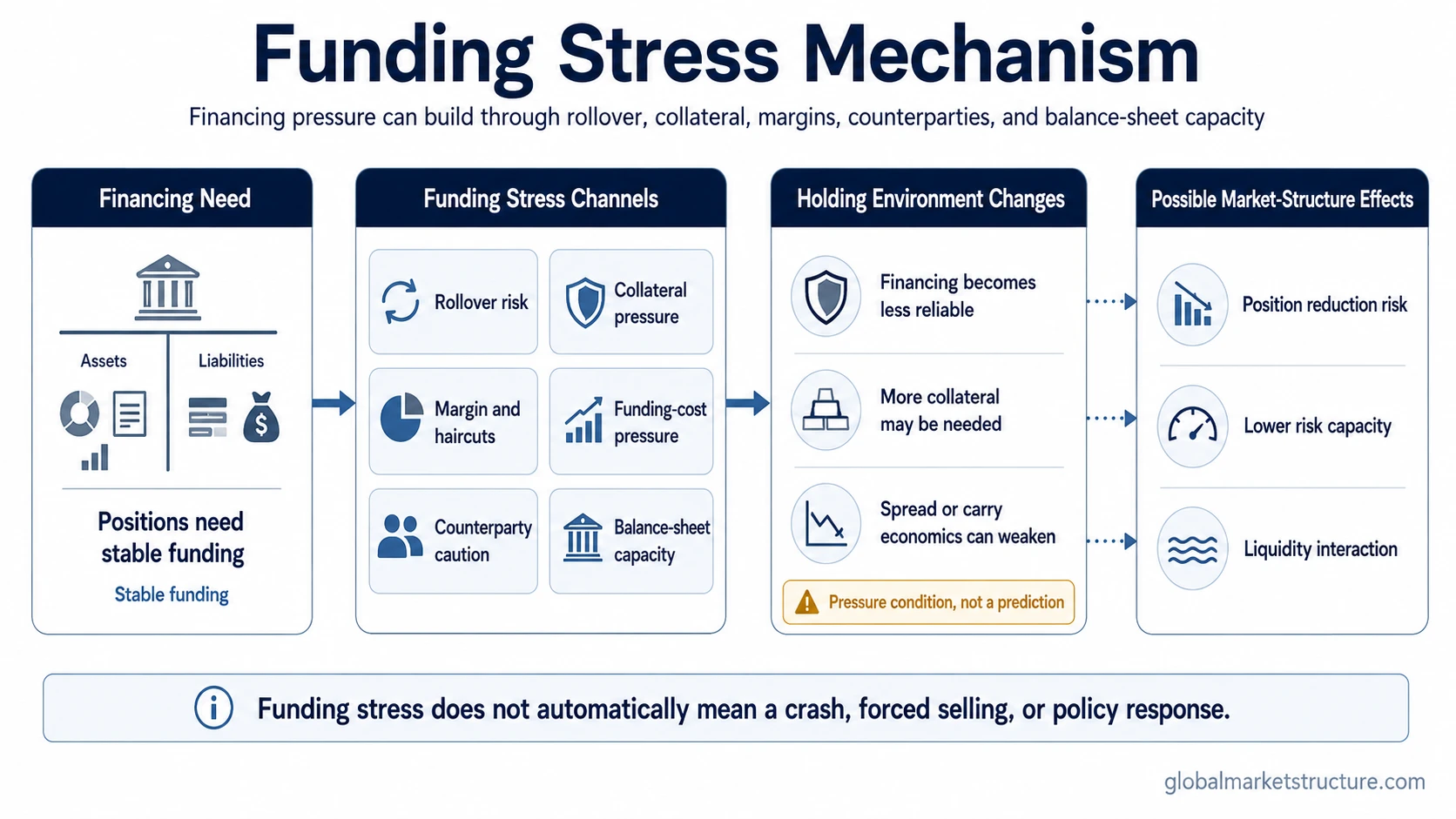
Funding stress is pressure on the ability to obtain, roll, or maintain financing on predictable terms. It can appear through higher funding costs, tighter collateral terms, larger margin or haircut requirements, shorter or less reliable rollover, counterparty pullback, or reduced balance-sheet capacity. For leveraged carry and basis positions, those changes can alter whether an exposure remains financeable before the underlying market view has changed.
Funding Stress vs Funding and Market Liquidity
| Concept | Primary question | Boundary |
|---|---|---|
| Funding stress | Are financing cost, availability, rollover, collateral terms, or balance-sheet capacity becoming harder to maintain? | Describes pressure on financing conditions. |
| Funding liquidity | Can a participant obtain the cash or financing required to meet obligations and maintain positions? | The funding liquidity concept describes financing capacity itself. Funding stress describes pressure developing around that capacity. |
| Market liquidity | Can an asset be traded in size without unusually large price impact? | The market liquidity concept concerns trading conditions rather than the financing of the position. |
| Financial stress | Are multiple parts of the financial system showing broader pressure? | Can include funding conditions together with credit, volatility, banking, liquidity, and other forms of stress. |
Funding Cost and Funding Access Are Different Pressure Channels
A higher interest or repo rate raises the price of maintaining financing. Stress can also develop when funding becomes shorter, harder to roll, more collateral-intensive, or less available because lenders and intermediaries reduce balance-sheet capacity.
Financing remains available, but the cost rises relative to the return or spread earned by the position.
The amount, maturity, reliability, or collateral terms of financing deteriorate even if the quoted funding rate alone does not capture the full change.
In a 2025 analysis of Treasury cash-futures basis trades, the Federal Reserve Bank of Dallas found the modeled stability of the trade was more sensitive to declines in intermediation capacity than to funding-rate increases. The result is specific to that structure, but it illustrates why financing capacity and the quoted price of funding should be examined separately.
How Funding Stress Builds
| Channel | What changes | Effect on financed exposure |
|---|---|---|
| Rollover | Borrowing becomes shorter, less reliable, or more expensive to renew. | A position that depends on continuous financing becomes harder to maintain on the original terms. |
| Collateral | Eligible collateral loses value, becomes less acceptable, or supports less borrowing. | More collateral may be required for the same financed exposure. |
| Margin and haircuts | Lenders, clearing arrangements, or counterparties require more protection. | Effective leverage falls and additional cash or collateral may be required. |
| Funding cost | The cost of borrowing rises relative to the return or spread being earned. | The economics of carry, basis, and other financed relative-value positions can deteriorate. |
| Counterparty willingness | Lenders and intermediaries become more selective about extending financing. | Funding access can tighten before a broad market breakdown is visible. |
| Balance-sheet capacity | Dealers or lenders have less room or willingness to intermediate financing demand. | Borrowers may face tighter terms even when the underlying asset remains actively traded. |
How Funding Stress Can Reach Leveraged Trades
Funding pressure becomes most relevant to this cluster when it changes holding capacity. A financed position can remain attractive on its original spread or relative-value logic while becoming harder to keep open under new collateral, margin, rollover, or balance-sheet constraints.
Funding becomes more expensive, shorter, less reliable, or more demanding in collateral terms.
Margin, haircut, collateral, counterparty, or internal balance-sheet constraints reduce the amount of exposure that can be maintained.
A carry trade, basis trade, or carry and roll-down exposure may need to be reduced even before its original market thesis fully changes.
Participants may sell assets, reduce leverage, close relative-value legs, or obtain cash and collateral through other adjustments. A broader carry trade unwind is one possible version of this exit process.
If many participants need to reduce exposure while trading depth is weakening, price impact can rise and the value of collateral can come under additional pressure.
IMF analysis of systemic liquidity risk describes the interaction between funding and market liquidity as a potential negative feedback process: funding shortages can contribute to asset sales, while weaker market liquidity can make it harder to raise cash or finance collateral. The sequence and severity depend on the market structure and the participants involved.
What Funding Stress Can Establish
The market effect depends on the size and duration of the pressure, where it is concentrated, the leverage of affected participants, collateral quality, available liquidity, balance-sheet capacity, and any policy or private-sector response. Funding stress can remain contained or become part of a broader deleveraging process.