
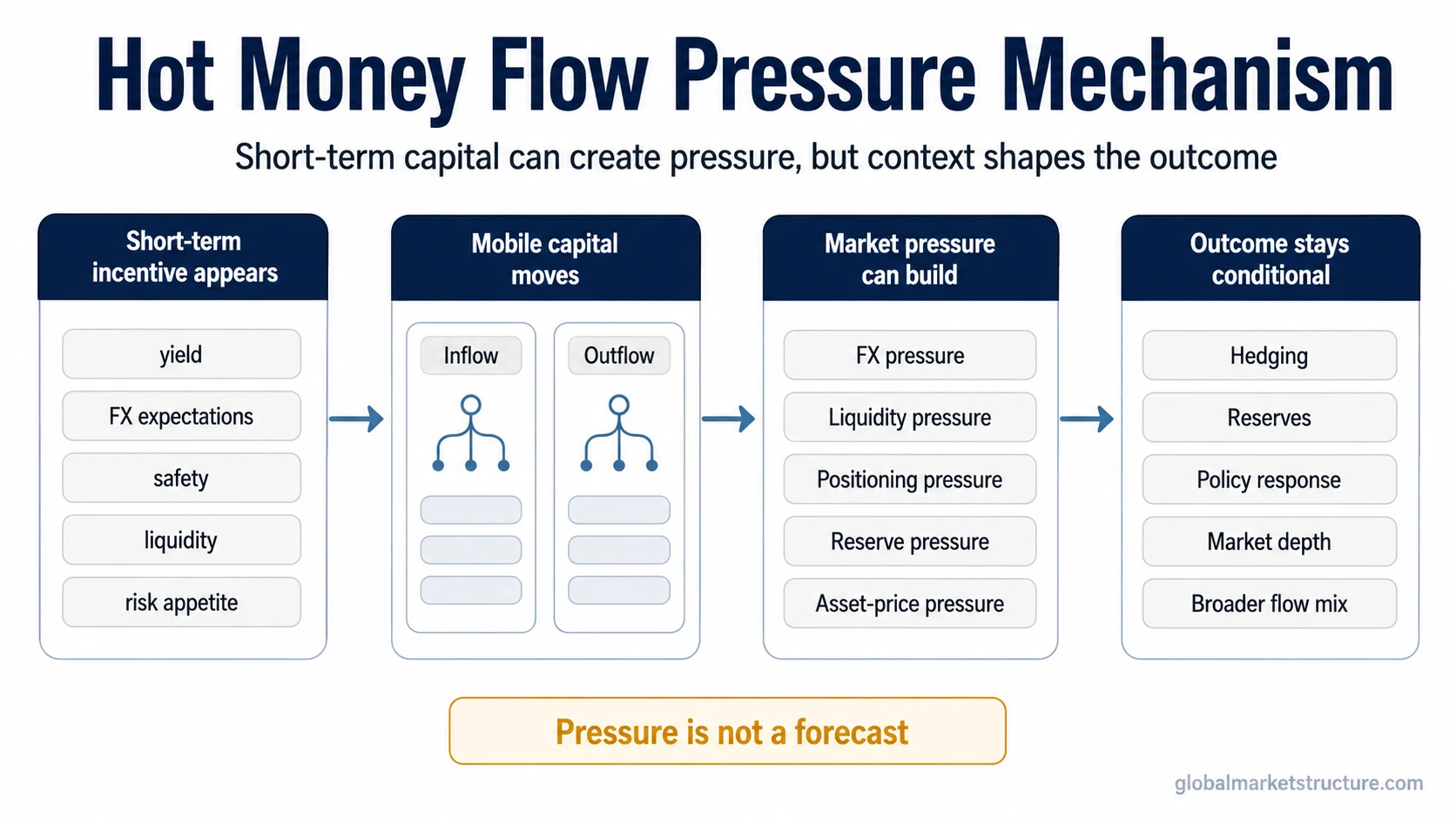
Hot money flows are short-term capital movements that can enter or leave a market quickly in response to yield, currency expectations, perceived safety, liquidity conditions, or risk appetite. They matter because fast-moving capital can create positioning, liquidity, exchange-rate, or asset-price pressure. The key limitation is that hot money flow is pressure, not a forecast: the final outcome depends on market depth, hedging, policy response, reserves, and broader flow context.
Hot money flows describe mobile capital that moves mainly because conditions look temporarily more attractive somewhere else. The “hot” part refers to speed and reversibility, not to a guaranteed crisis, opportunity, or trade signal.
- Hot money flows are short-term, mobile capital movements.
- They often respond to yield, currency expectations, safety, liquidity, policy credibility, and risk appetite.
- They can create market pressure, but they do not predict the final market outcome by themselves.
Where Hot Money Fits in Capital-Flow Taxonomy
Hot money is best understood as a behavior inside the wider flow universe. Capital flows describe the broader movement of capital between assets, sectors, countries, or financial systems. Cross-border flows narrow the focus to capital moving across national or market boundaries. Hot money flows narrow it further to capital that is especially short-term, yield-sensitive, currency-sensitive, or confidence-sensitive.
| Layer | What it describes | How hot money relates to it |
|---|---|---|
| Capital flows | The broad movement of capital across assets, markets, or economies. | Hot money is one mobile, short-term form of this wider category. |
| Cross-border flows | Capital moving from one country or market jurisdiction to another. | Hot money often appears as cross-border movement, but not every cross-border flow is hot money. |
| Short-term mobile flows | Capital that can shift quickly as incentives change. | This is the closest behavioral category for hot money. |
| Hot money flows | Fast-moving capital responding to yield, FX expectations, safety, liquidity, or risk appetite. | The focus is speed, sensitivity, and reversibility. |
What Drives Hot Money Flows
Hot money usually moves when investors, funds, banks, or other market participants see a short-term incentive to shift capital. That incentive can come from higher yields, expected currency gains, improved perceived safety, better liquidity, or a temporary change in risk appetite.
Yield is a common driver, but it is not the only one. A market offering higher interest rates may attract short-term capital if the yield advantage appears large enough. The same market may still fail to attract durable inflows if investors worry about currency losses, policy credibility, weak liquidity, or exit risk.
Currency expectations can also matter. If investors expect a currency to strengthen, short-term capital may move toward that market. If the currency view changes, the same capital can reverse quickly. This is why hot money is more useful as a pressure signal than as a final exchange-rate forecast.
Common drivers: yield differentials, FX expectations, perceived safety, policy credibility, market liquidity, funding conditions, and global risk appetite.
Common limitation: no single driver explains all hot money movement. The same inflow can have different meaning depending on market depth, hedging, policy response, and broader capital-flow context.
How Hot Money Creates Market Pressure
The mechanism is not complicated, but it is easy to overread. A short-term incentive appears, mobile capital responds, and pressure can build in the market receiving or losing the flow. That pressure can appear in exchange rates, local liquidity, asset prices, reserves, funding conditions, or short-term positioning.
| Step | Mechanism | Market-structure interpretation |
|---|---|---|
| 1. Incentive appears | Yield, currency, safety, liquidity, or risk appetite changes. | Capital has a reason to move, but the reason may be temporary. |
| 2. Capital enters or exits | Short-term money shifts toward or away from the market. | Flow pressure can begin before the longer-term picture is clear. |
| 3. Pressure builds | FX, liquidity, reserves, asset prices, or positioning may react. | The market may look stronger or weaker because the flow is affecting near-term pricing. |
| 4. Offsets change the result | Hedging, market depth, policy action, reserves, and other flows may absorb or amplify the pressure. | The final outcome remains conditional, not automatic. |
This is the main practical distinction: hot money can help explain why pressure appears, but it does not prove what the market must do next. A flow can support a currency for a period, then lose influence if positioning becomes crowded or if the original incentive disappears.
What Hot Money Can Indicate and What It Does Not Prove
Hot money flows can be useful because they show where short-term capital is responding to incentives. They become risky to interpret when the flow is treated as a complete market signal.
| Flow observation | What it can indicate | What it does not prove |
|---|---|---|
| Hot money inflow | The market may look attractive on yield, currency, safety, liquidity, or risk terms. | It does not prove durable economic strength or sustainable currency support. |
| Hot money outflow | Short-term capital may be reacting to weaker incentives, risk aversion, lower confidence, or liquidity stress. | It does not automatically prove a crisis or permanent capital exit. |
| Fast reversal | The original flow may have been crowded, temporary, or sensitive to one changing condition. | It does not guarantee that a full trend reversal is underway. |
| Large short-term movement | Positioning pressure may be influencing near-term price behavior. | It does not replace deeper analysis of liquidity, policy, reserves, current-account context, or broader flow mix. |
Common mistake: reading hot money as a directional market forecast. The more precise reading is that hot money can reveal short-term pressure, sensitivity, and crowding. The final effect depends on what absorbs, amplifies, or reverses that pressure.
Why Persistence and Reversibility Matter
The most important feature of hot money is not only that it moves quickly. It is that the reason for the movement may be unstable. If capital entered because a yield advantage looked attractive, the flow can weaken when the yield spread narrows, currency risk rises, liquidity deteriorates, or investors no longer trust the policy backdrop.
Persistence separates a temporary flow from a more durable capital allocation. If inflows continue across changing conditions, the market may be absorbing capital for more than one short-term reason. If inflows depend on a single narrow incentive, the flow can become crowded and vulnerable to reversal.
That makes hot money useful for interpreting pressure, not for declaring certainty. A market can receive hot money inflows and still face fragility if liquidity is thin or exits are crowded. A market can experience outflows and still stabilize if reserves, hedging, policy response, or broader capital flows offset the pressure.
Practical Scenario: How Hot Money Can Be Misread
A market starts offering a higher short-term yield while its currency also appears stable. Short-term capital begins moving in because the yield pickup looks attractive and the currency risk appears manageable. At first, the inflow may support local liquidity and reduce visible pressure on the exchange rate.
The tempting interpretation is that the inflow proves the market is structurally strong. That reading is incomplete. If the inflow depends mainly on a short-term yield advantage, the pressure can reverse when the yield gap narrows, hedging costs rise, liquidity weakens, or investors become less willing to hold the currency risk.
The stronger interpretation separates the observed flow from the final outcome. The inflow shows short-term attraction and positioning pressure. It does not prove that the market has durable capital support unless other conditions also confirm persistence.
Hot Money Flows vs Related Concepts
Hot money overlaps with several capital-flow terms, but it should not be treated as a substitute for all of them. The boundary is behavioral: hot money describes capital that is mobile, short-term, incentive-sensitive, and reversible.
| Concept | Core meaning | Difference from hot money flows |
|---|---|---|
| Capital flows | Broad movement of capital across markets, sectors, assets, or economies. | Hot money is narrower and focuses on short-term mobile capital pressure. |
| Cross-border flows | Capital movement across borders or jurisdictions. | Hot money may be cross-border, but not all cross-border movement is short-term or reversible. |
| Fund flows | Tracked movement into or out of investment funds, products, or asset classes. | Fund-flow data can show one tracking lens, while hot money describes a broader behavioral pressure. |
| Capital flight | Capital leaving because of confidence loss, stress, instability, or perceived safety concerns. | Hot money outflow can overlap with capital flight, but the terms are not automatically identical. |
| Safe-haven flows | Capital moving toward assets or markets perceived as safer during uncertainty. | Safety can drive hot money, but hot money can also respond to yield, FX expectations, liquidity, or risk appetite. |
How to Interpret Hot Money Without Turning It Into a Signal
A cleaner interpretation starts with three questions. First, what incentive attracted or pushed away the capital? Second, how persistent is that incentive? Third, what could absorb or reverse the pressure?
This keeps the concept inside market-structure analysis. Hot money inflows can reveal attraction and positioning pressure, but they do not automatically confirm strength. Hot money outflows can reveal stress or weaker incentives, but they do not automatically confirm crisis. The useful reading comes from comparing the flow with liquidity, hedging, policy response, market depth, currency behavior, and the broader capital-flow mix.
Interpretation boundary: hot money flows are useful for understanding short-term capital pressure. They are not enough, by themselves, to forecast exchange rates, asset direction, or regime change.
FAQ
What are hot money flows?
Hot money flows are short-term capital movements that can enter or leave a market quickly when yield, currency expectations, safety, liquidity, or risk appetite changes. They describe mobile capital pressure, not a guaranteed market outcome.
Are hot money outflows the same as capital flight?
No. Hot money outflows can overlap with capital flight when confidence loss or safety concerns drive the movement, but the terms are not identical. Hot money focuses on short-term, mobile, incentive-sensitive capital. Capital flight usually implies a stronger stress or confidence-loss context.
Do hot money flows predict exchange rates?
No. Hot money flows can create exchange-rate pressure, but the final effect depends on market depth, hedging, reserves, policy response, other capital flows, and whether the flow persists or reverses.