
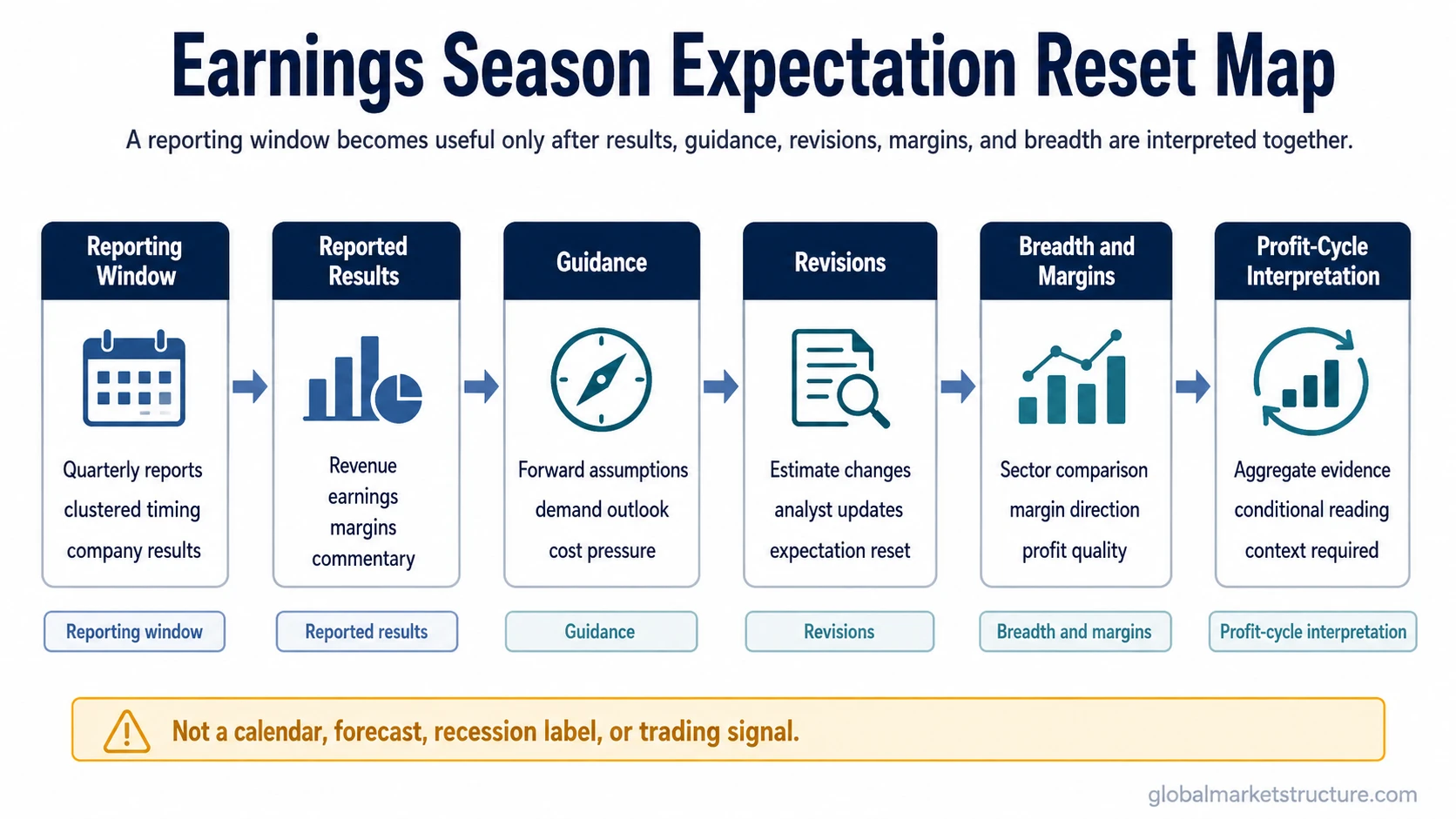
Earnings season is the recurring period when many public companies release quarterly results. Its main market-structure value is not the calendar date itself, but the way results, guidance, margins, and revisions reset expectations across companies, sectors, and the broader profit cycle.
Earnings season is not a market forecast, a recession label, a stock-picking list, or a trading signal. It is a concentrated evidence window. The same reporting period can reveal stronger demand, margin pressure, weaker guidance, improving revisions, or uneven sector performance, but those signals need context before they are treated as broader market information.
What Is Earnings Season?
Earnings season is the period after a fiscal quarter when many listed companies report financial results for the quarter that just ended. These reports usually include revenue, earnings, margins, management commentary, and, when provided, guidance about the coming period.
The compressed timing matters because many reports arrive close enough together to compare sectors, margins, guidance, and revisions.
What Earnings Season Is and Is Not
Earnings season is easiest to interpret when the reporting window is separated from the market conclusions people try to draw from it. Earnings season creates a recurring stream of company-level evidence, but the evidence does not automatically translate into a single market conclusion.
| Frame | Correct interpretation | Common overread |
|---|---|---|
| Reporting window | A recurring period when many companies release quarterly results. | Treating the calendar itself as the main insight. |
| Expectation reset | Reported results and guidance can change how future earnings are priced. | Assuming every surprise creates a durable market move. |
| Profit-cycle evidence | Aggregated patterns can help interpret earnings breadth, margins, and sector trends. | Using one company reaction as proof of the whole cycle. |
| Market context | Earnings data can interact with rates, credit, liquidity, and risk appetite. | Reading earnings season as a standalone forecast. |
When Earnings Season Usually Happens
Earnings season is tied to quarterly reporting cycles. It generally begins after a fiscal quarter ends and becomes most visible when large groups of companies start releasing results. Exact dates vary by company, exchange, fiscal calendar, and reporting schedule.
| Timing layer | What it means | Interpretation limit |
|---|---|---|
| Quarter end | The reporting period closes for companies using that fiscal quarter. | Not every company uses the same fiscal schedule. |
| Reporting window | Companies begin releasing quarterly results over the following weeks. | A general window is not the same as a live calendar. |
| Peak reporting period | Large clusters of companies report, making sector comparison easier. | Concentration improves comparison, but not certainty. |
| Post-report revisions | Analysts and market participants adjust expectations after results and guidance. | Revision direction can change as more companies report. |
What Companies Report During Earnings Season
Company reports usually give several layers of information. Revenue shows the scale of sales activity. Earnings and EPS show profitability after costs. Margins help separate sales growth from profit quality. Guidance and commentary give clues about management expectations, demand conditions, cost pressure, and operating conditions.
The important step is moving from isolated company numbers to broader profit-cycle interpretation. A single report may matter for one stock, but the profit-cycle signal becomes more useful when similar patterns appear across sectors, industries, or large parts of the market.
| Report element | What it can reveal | Why market context matters |
|---|---|---|
| Revenue | Demand, pricing, volume, or business activity. | Revenue growth can still be weak if costs rise faster. |
| Earnings / EPS | Profit generated after expenses and share-count effects. | EPS can improve for reasons that do not always imply stronger demand. |
| Margins | Pricing power, cost pressure, efficiency, and profitability quality. | Margins can change the meaning of revenue growth. |
| Guidance | Management’s forward-looking view, when provided. | Guidance can reset expectations even when current results look stable. |
| Commentary | Demand conditions, cost trends, supply constraints, and customer behavior. | Commentary needs comparison across companies before it becomes a broader signal. |
How Earnings Season Resets Expectations
Markets often enter earnings season with expectations already embedded in analyst estimates, valuation multiples, sector positioning, and recent price behavior. Reported results then either support those expectations, challenge them, or shift the focus toward the next quarter.
The expectation reset usually works through several channels at once: the reported quarter, forward guidance, analyst estimate changes, margin interpretation, and sector-level comparison. A result that looks strong in isolation may be less meaningful if expectations were already high. A result that looks weak may be treated differently if guidance stabilizes or margins hold up better than feared.
| Mechanism | What changes | Market-structure use |
|---|---|---|
| Reported results | Actual revenue, earnings, and margins become visible. | Helps compare expectations with delivered results. |
| Guidance | Forward assumptions may move higher, lower, or remain stable. | Connects the reporting window to future profit expectations. |
| Analyst revisions | Forward estimates may be revised after results and commentary. | Links earnings season to earnings revisions. |
| Margin interpretation | Profitability quality becomes clearer. | Shows whether revenue growth is translating into durable profit. |
| Sector comparison | Leadership and weakness can appear across industries. | Helps separate isolated stories from broader profit-cycle patterns. |
Why Earnings Season Matters for the Profit Cycle
The profit cycle is broader than any single reporting window. Earnings season matters because it provides recurring evidence about whether corporate profits are expanding, flattening, or contracting across the market. The strongest signal usually comes from breadth, margin direction, revisions, and guidance rather than from one headline result.
Aggregate weakness can raise questions about an earnings recession, but earnings season alone does not label the economy or forecast a downturn. It updates the evidence set. The interpretation depends on whether weakness is narrow or broad, temporary or persistent, margin-led or revenue-led, and confirmed by revisions.
Margins are especially important because earnings growth can weaken even when revenue is still growing. Cost pressure, pricing limits, wage pressure, input costs, and financing conditions can all affect profit margins. When revenue changes produce larger profit changes, operating leverage becomes part of the interpretation.
Earnings Season, Earnings Calendar, and Earnings Recession
Three related terms often get blurred. An earnings calendar answers who reports and when. Earnings season describes the recurring reporting window. Earnings recession refers to a broader contraction in aggregate earnings over a defined measurement basis.
| Term | Main job | What it should not be confused with |
|---|---|---|
| Earnings calendar | Lists reporting dates and scheduled company releases. | A full interpretation of profit-cycle conditions. |
| Earnings season | Groups a recurring wave of company reports into an interpretation window. | A direct market signal or forecast. |
| Earnings recession | Describes aggregate earnings contraction under a defined measurement approach. | A single weak company report or a normal quarterly reporting period. |
Common Misreads During Earnings Season
The most common mistake is treating company-level reactions as if they settle the macro picture. A stock can react sharply because expectations were too high, because guidance changed, because margins disappointed, or because positioning was crowded. That reaction may say more about expectations than about the entire profit cycle.
- A strong report does not automatically imply broad market strength.
- A weak report does not automatically confirm recession risk.
- A large price reaction does not always mean the earnings data itself was surprising.
- Guidance can matter more than the reported quarter when markets are focused on forward profits.
- Sector concentration can make aggregate results look stronger or weaker than the broader earnings base.
The cleaner reading comes from pattern recognition across reports: whether revisions are improving, whether margin pressure is spreading, whether weakness is sector-specific, and whether guidance changes align with broader macro conditions.
How to Interpret Earnings Season Without Turning It Into a Forecast
A useful earnings-season interpretation separates observation from conclusion. The observation may be that several companies report slower revenue growth, weaker guidance, or lower margins. The conclusion remains conditional until the pattern appears across enough companies, sectors, and revision data to matter beyond isolated reports.
| Observed pattern | Possible interpretation | What needs confirmation |
|---|---|---|
| Many companies beat low expectations | Expectations may have been too pessimistic. | Whether forward guidance and revisions also improve. |
| Revenue holds up but margins weaken | Cost pressure or pricing limits may be affecting profitability. | Whether margin compression is broad or narrow. |
| Guidance weakens across several sectors | Forward demand or cost assumptions may be deteriorating. | Whether analyst revisions follow the same direction. |
| Only one sector drives aggregate strength | Headline earnings may hide narrow leadership. | Whether earnings breadth improves outside the leading sector. |
Related Earnings and Profit-Cycle Concepts
Earnings recession, earnings revisions, profit margins, operating leverage, and margin compression each describe a narrower layer of the earnings and profit-cycle process. Earnings season can touch all of them, but it does not replace those concepts.
FAQ
What is earnings season in simple terms?
Earnings season is the recurring period when many public companies report quarterly financial results. It gives markets a concentrated update on revenue, earnings, margins, guidance, and management commentary.
When does earnings season happen?
Earnings season usually begins after a fiscal quarter ends and continues as companies release results over the following weeks. Exact reporting dates vary by company and fiscal calendar.
Is earnings season the same as an earnings calendar?
No. An earnings calendar lists reporting dates. Earnings season is the broader reporting window when those releases can reset expectations and update profit-cycle interpretation.
Does earnings season predict market direction?
No. Earnings season can update expectations, guidance, margins, and revisions, but it does not reliably predict market direction by itself. Broader interpretation needs sector breadth, revisions, liquidity, rates, credit, and risk appetite context.