
Real assets are physical or tangible assets whose value is tied to real-world use, scarcity, replacement cost, or productive capacity. Common examples include real estate, land, commodities, natural resources, infrastructure, energy assets, precious metals, farmland, and timberland. In market-structure analysis, real assets matter because they can reflect inflation pressure, supply constraints, commodity cycles, rates, liquidity conditions, and broader macro regime shifts, but they are not automatic inflation hedges, forecasts, or trading signals.
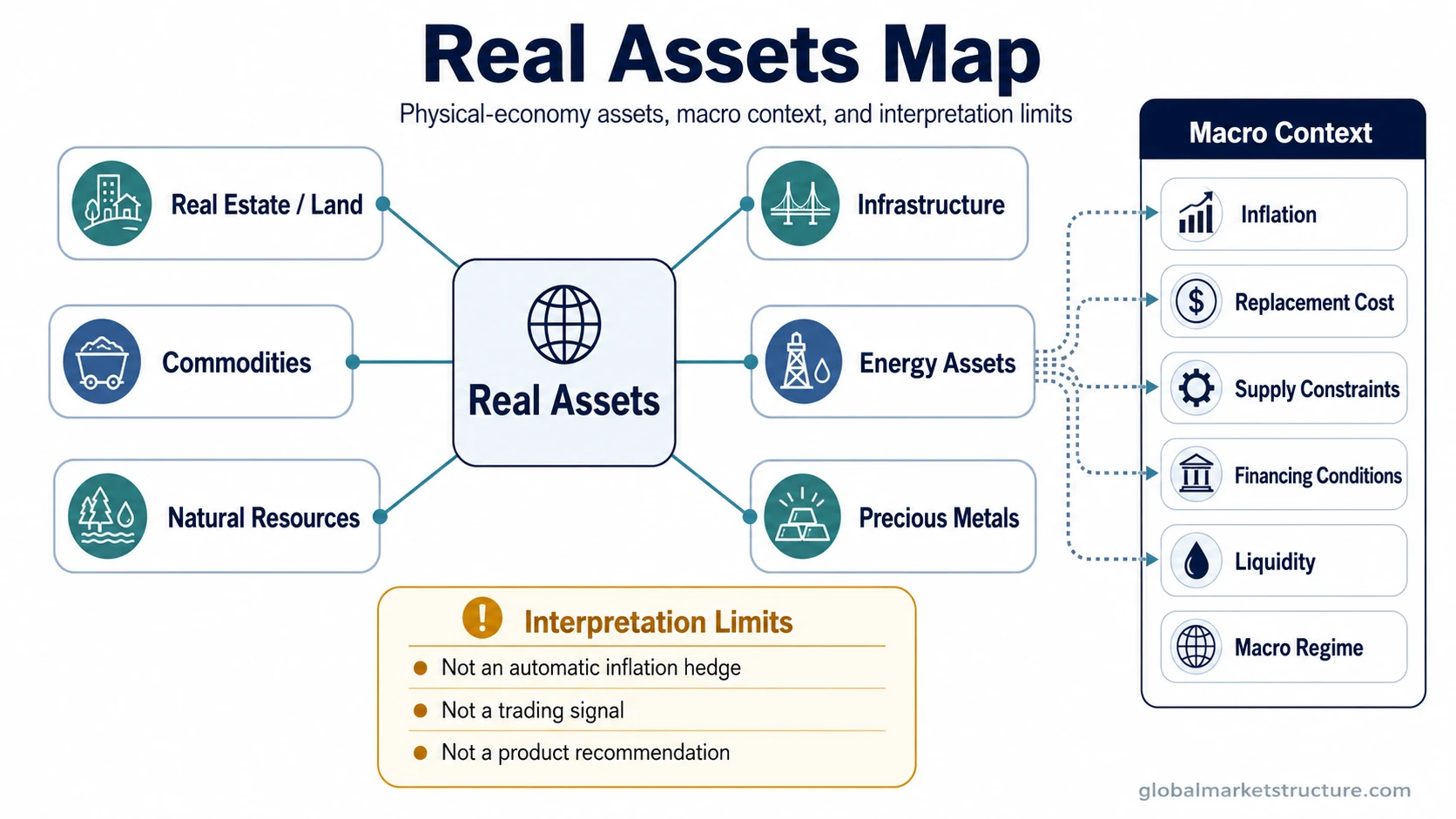
Key Points
- Real assets are tied to physical resources, usable property, infrastructure, or productive capacity.
- Common examples include real estate, commodities, land, natural resources, infrastructure, and precious metals.
- Financial vehicles linked to real assets are not the same thing as direct ownership of the physical asset.
- Digital-economy growth can create real-asset demand when it requires power generation, transmission capacity, substations, land, cooling, or other physical infrastructure.
- Real assets can help interpret inflation, supply pressure, commodity cycles, and liquidity conditions, but they do not guarantee protection from inflation.
What Are Real Assets?
Real assets are assets whose value is connected to something physical or productive in the real economy. A building, a piece of land, an oil reserve, a power grid, a copper deposit, or a timberland property can all fall into the real-asset category because their value is not based only on a contract or digital balance-sheet entry.
Real assets usually sit closer to physical scarcity, replacement cost, production capacity, or supply constraints. That makes them relevant for macro analysis because changes in inflation, real yields, financing costs, commodity supply, and liquidity can affect how these assets are interpreted across markets.
That does not make real assets automatically defensive. Their behavior depends on the asset type, the financing structure, the demand environment, the regulatory setting, and whether the exposure is direct ownership or a financial vehicle linked to the asset.
Real Assets Examples
Real assets are not one uniform group. Property, commodities, infrastructure, and precious metals can respond to different forces even though they all sit closer to the physical economy than a stock, bond, or derivative contract.
| Category | Examples | Macro relevance | Main limitation |
|---|---|---|---|
| Real estate / property | Land, buildings, property-linked assets | Replacement cost, financing conditions, rent pressure, inflation sensitivity | Rate sensitivity, local liquidity, regulation, and valuation risk |
| Commodities | Energy, industrial metals, agricultural commodities | Input costs, supply-demand stress, inflation pressure, production bottlenecks | Volatility, storage costs, futures-curve effects, and demand shocks |
| Natural resources | Oil, gas, minerals, timberland, farmland | Resource scarcity, production cycles, supply constraints, physical availability | Operational, policy, environmental, extraction, and transport risks |
| Infrastructure | Transport networks, utilities, pipelines, energy infrastructure | Capacity constraints, inflation transmission, bottlenecks, real-economy throughput | Regulation, financing cost, utilization risk, and long investment timelines |
| Precious metals | Gold, silver | Real-yield sensitivity, currency confidence, inflation and risk-environment context | No guaranteed safe-haven behavior, positioning shifts, and liquidity effects |
Real Assets vs Financial Assets
Real assets are linked to physical resources or productive capacity. Financial assets are claims, contracts, or ownership rights. A bond is a claim on future payments. A stock is an ownership claim on a company. A derivative is a contract whose value depends on another asset or variable.
The distinction matters because financial assets can reprice quickly when discount rates, risk appetite, earnings expectations, or liquidity conditions change. Real assets can also reprice, but their underlying value is often connected to physical supply, replacement cost, operating use, scarcity, or production capacity.
| Asset type | What value is tied to | Typical examples | Main interpretation risk |
|---|---|---|---|
| Real assets | Physical use, scarcity, productive capacity, replacement cost | Land, commodities, infrastructure, natural resources, precious metals | Assuming physical value prevents losses or guarantees inflation protection |
| Financial assets | Claims, contracts, cash flows, ownership rights, discount rates | Stocks, bonds, loans, derivatives, fund shares | Assuming the financial claim behaves exactly like the underlying physical asset |
| Intangible assets | Non-physical economic value | Patents, software, trademarks, brand value, data assets | Confusing non-physical economic value with real-asset exposure |
Physical Asset vs Financial Claim
A real asset and a financial vehicle linked to a real asset are not identical. A commodity future, a listed resource company, a REIT, an ETF, a fund, or another vehicle may provide exposure to the real-asset theme, but the exposure also contains its own structure, costs, liquidity profile, leverage, management decisions, contract mechanics, or equity-market sensitivity.
This boundary is important because a physical asset can have one set of drivers while the vehicle used to access it has another. For example, a property-linked security can be affected by financing costs, equity-market risk appetite, and balance-sheet structure. A commodity futures position can be affected by contract roll dynamics, storage economics, and liquidity. Those features can make the exposure behave differently from the underlying physical resource.
Practical distinction: direct physical ownership, operating exposure, listed equity exposure, futures exposure, and fund exposure can all connect to real assets, but they should not be treated as the same thing in macro interpretation.
Real Assets and Inflation
Real assets are often discussed in relation to inflation because many of them sit near replacement cost, input costs, resource scarcity, and supply constraints. When construction costs, energy prices, food inputs, metals, land values, or infrastructure capacity become more expensive, parts of the real-asset complex can become more relevant for macro analysis.
The mechanism is not automatic. A real asset may become more valuable if inflation reflects scarcity, strong nominal demand, or rising replacement costs. The same asset may struggle if inflation is accompanied by higher financing costs, weaker demand, tighter liquidity, or policy pressure. That is why real assets should be interpreted together with rates, liquidity, growth, and supply conditions rather than treated as a one-word hedge.
Energy and commodity-linked assets can be especially important when input costs affect inflation transmission. The oil prices and inflation channel is narrower than the full real-assets category because it focuses specifically on how energy costs can move through inflation expectations, production costs, and consumer prices.
When the Inflation Hedge Idea Weakens
Real assets do not protect purchasing power under all conditions. The inflation-hedge idea weakens when the asset is highly dependent on financing, demand falls, liquidity tightens, regulation changes the economics, operating costs rise faster than revenues, or the exposure vehicle behaves differently from the physical asset.
| Condition | Why it can weaken the real-asset thesis |
|---|---|
| Higher financing costs | Real estate, infrastructure, and capital-intensive assets can become less attractive when debt costs and discount rates rise. |
| Falling demand | Commodity and resource prices can weaken if inflation pressure fades into slower growth or demand destruction. |
| Liquidity stress | Even assets with long-term physical value can be repriced when investors need cash or financing becomes harder to obtain. |
| Regulation or policy limits | Infrastructure, utilities, energy assets, land use, and resource extraction can be affected by policy constraints. |
| Storage and operating costs | Physical assets can involve maintenance, transport, storage, insurance, taxes, or operational risk. |
| Vehicle mismatch | A fund, REIT, futures contract, or listed equity can behave differently from the physical asset it references. |
| Crowded exposure or overvaluation | A real-asset theme can still become expensive if too much capital chases the same narrative. |
Real Assets in Intermarket Analysis
In intermarket analysis, real assets can act as a physical-economy context layer. They help connect commodity supply, infrastructure capacity, inflation pressure, currency conditions, real yields, and liquidity into a broader market-structure view.
A broad commodity supercycle framework focuses on longer commodity-cycle structure. Real assets are wider because the category can include commodities, land, infrastructure, energy assets, and precious metals. Each can connect physical supply, replacement cost, scarcity, and financing conditions to the macro map.
Precious metals often require a separate lens because their behavior can depend on real yields, currency confidence, liquidity, and positioning rather than only consumer-price inflation. The relationship between real yields and gold is therefore a narrower intermarket mechanism inside the broader real-assets discussion.
Industrial commodities can also carry growth and risk information. Real assets define the broader physical and commodity-linked universe that can feed into cross-asset interpretation, but they do not create a standalone buy, sell, risk-on, or risk-off signal.
OpenAI and Georgia Power: Digital Demand Becomes Physical Infrastructure
OpenAI’s planned data center in Effingham County, Georgia, shows how growth in a digital industry can create demand for real assets. The project is expected to require approximately 3.2 gigawatts of power from Georgia Power, with electricity delivered in phases between 2028 and 2032.
The scale of that load turns a software and computing expansion into a physical-capacity problem. Serving large electricity demand requires grid capacity and can involve generation resources, transmission infrastructure, substations, land, and other long-lived physical systems. OpenAI has agreed to pay the full infrastructure and electric-service costs required to serve the facility under a 25-year agreement.
The contract also includes up to 1 gigawatt of flexible demand response. Georgia Power can reduce electricity delivered to the facility during certain periods of high system demand, allowing a large new load to become part of grid-balancing operations rather than functioning only as a fixed consumer of power.
The macro lesson is broader than AI or one utility project. Economic growth that begins in an intangible sector can still create demand for physical capacity. Data centers, electrification, manufacturing expansion, transport networks, and other large-load projects can convert investment in software or services into demand for energy infrastructure and other real assets.
This mechanism is different from a supply shock. A supply shock begins with a constraint or disruption in available supply. Large new infrastructure demand begins with additional required capacity. Both can affect physical assets, but the source of the pressure and the macro interpretation are different.
How Real Assets Connect to Other Macro Concepts
Real assets sit inside a wider intermarket framework. Inflation explains price-level pressure. Commodity-cycle analysis explains longer resource-cycle structure. Energy-inflation analysis explains the oil-specific channel. Real-yield analysis helps explain why precious metals can behave differently from other inflation-sensitive assets. Supply-shock analysis explains why physical constraints can create pressure that is not only demand-driven.
Macro connection: real assets are the broader physical-economy category, while inflation, oil prices, commodity cycles, real yields, and supply shocks explain narrower mechanisms that can change how those assets are interpreted.
FAQ
Are real assets the same as financial assets?
No. Real assets are tied to physical resources, productive capacity, or real-world use. Financial assets are claims, contracts, or ownership rights. A financial vehicle can provide exposure to a real asset, but it is not identical to owning the physical asset itself.
Do real assets always protect against inflation?
No. Real assets can be sensitive to inflation, scarcity, and replacement cost, but they do not guarantee purchasing-power protection. Higher financing costs, weaker demand, liquidity stress, regulation, operating costs, or vehicle mismatch can weaken the inflation-hedge idea.
Can digital growth create demand for real assets?
Yes. Digital businesses can require large amounts of electricity, land, cooling, transmission capacity, substations, and other physical infrastructure. The economic activity may begin in software or computing, while part of the investment ultimately appears in physical productive capacity.
Is a REIT or commodity ETF the same as owning the real asset?
No. REITs, commodity ETFs, futures, funds, and listed equities are financial vehicles or claims linked to real-asset exposure. Their behavior can differ from direct physical ownership because of fees, liquidity, leverage, contract structure, management decisions, and market pricing.