
A supply shock is an unexpected change in supply conditions, productive capacity, input availability, or output capacity. A negative supply shock can reduce available supply and raise price pressure. A positive supply shock can expand available supply and ease price pressure. The label does not automatically create an inflation forecast, recession forecast, or market timing signal.
Supply shocks begin on the production side of the economy. They change what can be produced, how easily inputs can be obtained, how much capacity is available, or how expensive production becomes.
The market relevance comes from the transmission path. A supply shock must be interpreted through scale, persistence, pass-through, expectations, policy response, and financial conditions, not through the shock label alone.
What a supply shock changes
A supply shock changes the conditions under which goods or services are produced. It can affect raw materials, labor availability, transportation, energy costs, technology, regulation, or the usable capacity of an economy or sector.
The first question is not whether prices moved. The first question is what changed on the supply side. A price increase caused by stronger spending is different from a price increase caused by constrained production or missing inputs.
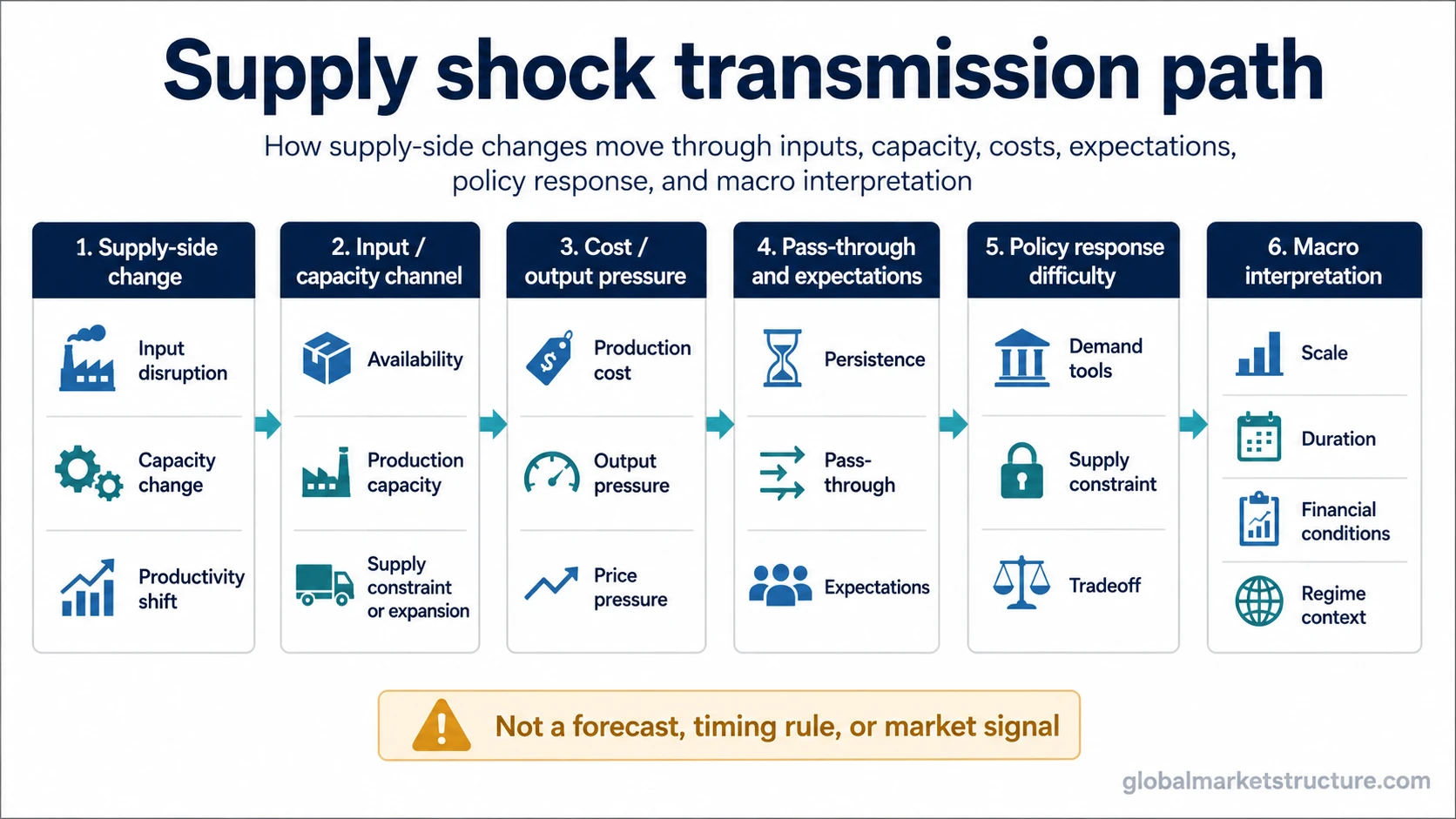
A supply shock usually works through one or more of these channels:
- Input availability: key materials, energy, labor, or components become easier or harder to obtain.
- Productive capacity: the economy can produce more or less at a given level of demand.
- Production cost: firms face higher or lower costs before final prices adjust.
- Output constraint: firms may be unable to supply the same quantity even if demand remains present.
- Price pressure: the shock can push prices up or down depending on direction, pass-through, and persistence.
Positive vs negative supply shocks
Supply shocks can move in either direction. Negative shocks restrict supply or raise production costs. Positive shocks expand supply potential, improve productivity, reduce bottlenecks, or lower production costs.
| Shock type | Supply-side change | Typical pressure | Important limitation |
|---|---|---|---|
| Negative supply shock | Input scarcity, lower capacity, higher production cost, or disrupted output | Lower output capacity and higher price pressure | The macro effect depends on scale, persistence, substitution, and demand conditions. |
| Positive supply shock | Better productivity, lower input costs, improved logistics, or higher usable capacity | Higher output capacity and lower cost pressure | Prices may not fall if demand rises faster than supply or if firms absorb the benefit in margins. |
This distinction matters because supply shocks can push output and prices in different directions. A negative shock can create weaker output capacity and stronger price pressure. A positive shock can do the opposite by improving supply potential and reducing cost pressure.
How supply shocks move through the economy
A supply shock begins with a change in production conditions. From there, it can move through input availability, production capacity, cost pass-through, output constraints, inflation pressure, expectations, and financial conditions.
Simple mechanism path:
Supply condition changes → input or capacity channel shifts → production cost or output capacity changes → price and output pressure appear → expectations, policy response, and financial conditions shape the macro interpretation.
If a key input becomes harder to obtain, firms may produce less or pay more to maintain production. If higher costs are passed into final prices, price pressure can rise even if demand is not strengthening.
If productivity improves or a bottleneck clears, the economy may be able to produce more with the same resources. In that case, supply capacity can improve and price pressure may ease, especially if demand does not accelerate faster than supply.
The effect is rarely mechanical. A shock that looks large in one sector may have limited macro impact if it is short-lived, easy to substitute around, or weakly connected to broader production costs. A narrower shock can become more important if it affects essential inputs, expectations, or financing conditions.
Common causes of supply shocks
Supply shocks can come from many sources. The cause matters because different causes transmit through the economy in different ways.
Common supply-shock sources include:
- Energy and commodity input changes: production costs can shift when important inputs become more expensive or cheaper.
- Labor availability changes: worker shortages or labor-force improvements can affect output capacity.
- Transportation or logistics bottlenecks: firms may face delays, higher shipping costs, or inventory constraints.
- Technology and productivity changes: better tools or processes can raise supply potential.
- Regulatory or tax changes: production incentives, restrictions, or compliance costs can change supply conditions.
- Sector-specific disruptions: a narrow supply problem can matter more if the affected sector is a key input for other sectors.
The same cause can have different market meaning depending on the surrounding policy and shock transmission environment. A supply restriction during strong demand can create different inflation pressure than the same restriction during weak demand.
Supply shock vs demand shock
A supply shock starts with the economy’s ability or cost to produce. A demand shock starts with spending, credit demand, orders, income, confidence, or willingness to buy.
| Question | Supply shock | Demand shock |
|---|---|---|
| Where does it begin? | Production conditions, inputs, capacity, or costs | Spending, orders, credit demand, income, or confidence |
| What changes first? | Ability or cost to supply goods and services | Willingness or ability to buy goods and services |
| Why can prices move? | Supply becomes more constrained or less constrained | Demand becomes stronger or weaker |
| Why can output move? | Capacity or input availability changes | Sales, orders, and utilization change |
The confusion happens because both shocks can affect prices and output. The distinction is the starting point. If the first change is production capacity or cost, the analysis starts with supply. If the first change is spending or credit demand, the analysis starts with demand.
Supply shock and inflation pressure
A negative supply shock can raise price pressure by increasing production costs or limiting the quantity that can be supplied. This is different from demand-led inflation pressure, where stronger spending pulls prices higher.
Whether a supply shock turns into broader inflation depends on pass-through, persistence, expectations, demand conditions, and policy response. Firms may absorb some cost changes in margins. Consumers may reduce demand. Substitution may reduce the pressure. Policy may influence financial conditions and demand.
That is why the term inflation should not be treated as identical to supply shock. A supply shock can be one source of inflation pressure, but it is not the same as the measured rise in the general price level.
What supply shock does not mean
A supply shock is not a market signal by itself. It does not automatically mean inflation will keep rising, output will collapse, a recession will happen, or a particular asset should be bought or sold.
The same supply shock can produce different outcomes under different conditions. The interpretation changes if demand is strong or weak, if inventories are high or low, if firms can substitute inputs, if expectations remain anchored, or if policy tightens into weaker output.
For market-structure analysis, the useful question is not “Was there a supply shock?” The useful question is how the shock changes the balance between output capacity, price pressure, expectations, policy reaction, and broader market regime interpretation.
Why policy response can be difficult
Supply shocks can create a policy problem because output and prices may move in uncomfortable directions at the same time. A negative supply shock can reduce output capacity while raising price pressure.
Demand-focused policy tools can influence spending, credit, and financial conditions, but they do not directly create missing inputs or restore lost capacity. Tightening policy may reduce demand and inflation pressure, but it can also add pressure to output if the supply side is already constrained.
This is why a supply shock often requires a more careful reading of monetary policy, fiscal response, expectations, and the reason behind the policy reaction. The policy action matters, but the reason for the action matters as much as the action itself.
Illustrative supply shock scenario
Consider a generic economy where a key production input becomes harder to obtain. Firms that depend on that input face higher costs and may not be able to produce the same quantity as before. Some firms pass higher costs into final prices, while others absorb part of the cost in margins.
At first, the shock is a supply-side event. It becomes a broader macro issue only if it persists, affects essential sectors, changes expectations, or forces policy to respond. If demand remains strong, price pressure may be more visible. If demand weakens at the same time, the output effect may become more important.
The lesson is that supply-shock analysis should separate the initial supply constraint from the later macro channels. The shock label is only the starting point.
Key takeaways
- A supply shock begins with supply conditions, productive capacity, input availability, output capacity, or production cost.
- Negative supply shocks can reduce output capacity and raise price pressure.
- Positive supply shocks can increase supply potential and ease cost pressure.
- Supply shocks are different from demand shocks because the starting point is production, not spending.
- A supply shock is not automatically an inflation forecast, recession forecast, or market timing signal.
- The macro interpretation depends on scale, persistence, pass-through, expectations, policy response, and financial conditions.
Supply shock FAQ
What is a supply shock?
A supply shock is an unexpected change in supply conditions, input availability, productive capacity, or output capacity. It changes the economy’s ability or cost to produce goods and services.
What is the difference between a positive and negative supply shock?
A negative supply shock restricts supply or raises production costs. A positive supply shock expands supply, improves productivity, or lowers cost pressure.
Is a supply shock the same as inflation?
No. A supply shock can affect inflation pressure, but inflation is the measured rise in the general price level. Whether a supply shock becomes broader inflation depends on persistence, pass-through, demand, expectations, and policy response.
How is a supply shock different from a demand shock?
A supply shock starts with production, inputs, costs, or capacity. A demand shock starts with spending, credit demand, orders, or willingness to buy.
Why can supply shocks make policy response difficult?
A negative supply shock can weaken output while raising price pressure. Policy can influence demand and financial conditions, but it cannot directly create missing inputs or restore lost capacity by itself.