
Demand shock means a demand-side disturbance that shifts aggregate demand away from its prior path. It can be positive when spending pressure rises or negative when spending pressure falls. The concept helps interpret growth, employment, prices, and inflation pressure, but it does not by itself identify supply conditions, policy response, recession risk, or asset direction.
Key Points
- A demand shock starts with a change in spending willingness or spending ability.
- Positive demand shocks raise demand pressure, while negative demand shocks reduce it.
- The shock is usually interpreted through aggregate demand because it affects total spending pressure across the economy.
- Output, employment, prices, and inflation pressure may change, but the result depends on supply capacity, persistence, and policy context.
- A demand shock is an interpretation input, not a standalone forecast for markets, recession, or central bank action.
What a Demand Shock Means
A demand shock is a sudden or meaningful change in demand-side pressure relative to the expected baseline. The change can come from households, businesses, government spending, credit availability, confidence, income, wealth, external demand, or tax and transfer changes.
The starting point is demand-side pressure. A demand shock is not the same as aggregate demand itself. Aggregate demand is the broader total-spending concept. A demand shock is the disturbance that moves demand away from where it was expected to be.
| Concept | What changes | What it can help explain | What it does not prove |
|---|---|---|---|
| Demand shock | Spending pressure changes relative to baseline | Why aggregate demand may rise or fall | It does not prove the cause of every price or output move |
| Positive demand shock | Demand pressure rises | Stronger spending, output pressure, employment demand, or price pressure | It does not guarantee durable inflation or a market rally |
| Negative demand shock | Demand pressure falls | Weaker spending, lower output pressure, softer labor demand, or disinflation pressure | It does not automatically mean recession or policy easing |
| Aggregate demand | Total spending demand across the economy | The broad channel through which demand shocks are usually interpreted | It is not itself the shock |
| Supply shock | Production capacity, input costs, availability, or supply conditions change | Why output or prices may move from the supply side | It should not be treated as a demand-side disturbance |
Positive vs Negative Demand Shock
A positive demand shock occurs when spending pressure rises faster than expected. Consumers may spend more, firms may increase investment, credit may become easier to access, or government demand may increase. If supply cannot adjust quickly, stronger demand can raise output pressure, employment demand, prices, or inflation pressure.
A negative demand shock occurs when spending pressure falls below the prior path. Consumers may reduce purchases, firms may delay investment, credit may tighten, confidence may weaken, or external demand may decline. The result can be weaker output pressure, softer hiring, lower pricing power, or disinflation pressure, depending on the surrounding conditions.
Boundary: Positive and negative describe the direction of demand pressure, not whether the outcome is good or bad for every market participant. The same shock can affect growth, inflation, rates, profits, and risk appetite differently across time horizons.
Demand Shock and Aggregate Demand
Demand shocks are usually analyzed through aggregate demand because they change total spending pressure. A stronger demand impulse can push the aggregate demand curve outward relative to baseline. A weaker demand impulse can pull aggregate demand inward relative to baseline.
The mechanism is conditional. If supply capacity is flexible, stronger demand may translate more into output and employment. If supply is constrained, more of the pressure may appear in prices. If the shock fades quickly, the macro effect may be limited. If it persists, the interpretation can become more important for inflation, growth, and policy context.
Mechanism Sequence
The practical interpretation of a demand shock improves when the sequence is separated into steps instead of treated as a single label.
- Demand-side trigger: spending willingness or ability changes because of income, credit, fiscal policy, confidence, wealth, or external demand.
- Spending pressure shifts: households, firms, government, or foreign buyers spend more or less than expected.
- Aggregate demand moves: total demand across the economy shifts relative to the prior baseline.
- Macro pressure changes: output, employment, prices, and inflation pressure may adjust.
- Interpretation depends on context: supply capacity, persistence, policy reaction, and broader financial conditions determine how much the shock matters.
This sequence prevents a common error: treating a visible outcome, such as a price change, as proof of the shock type. Price movement can reflect demand, supply, policy, positioning, or a combination of forces.
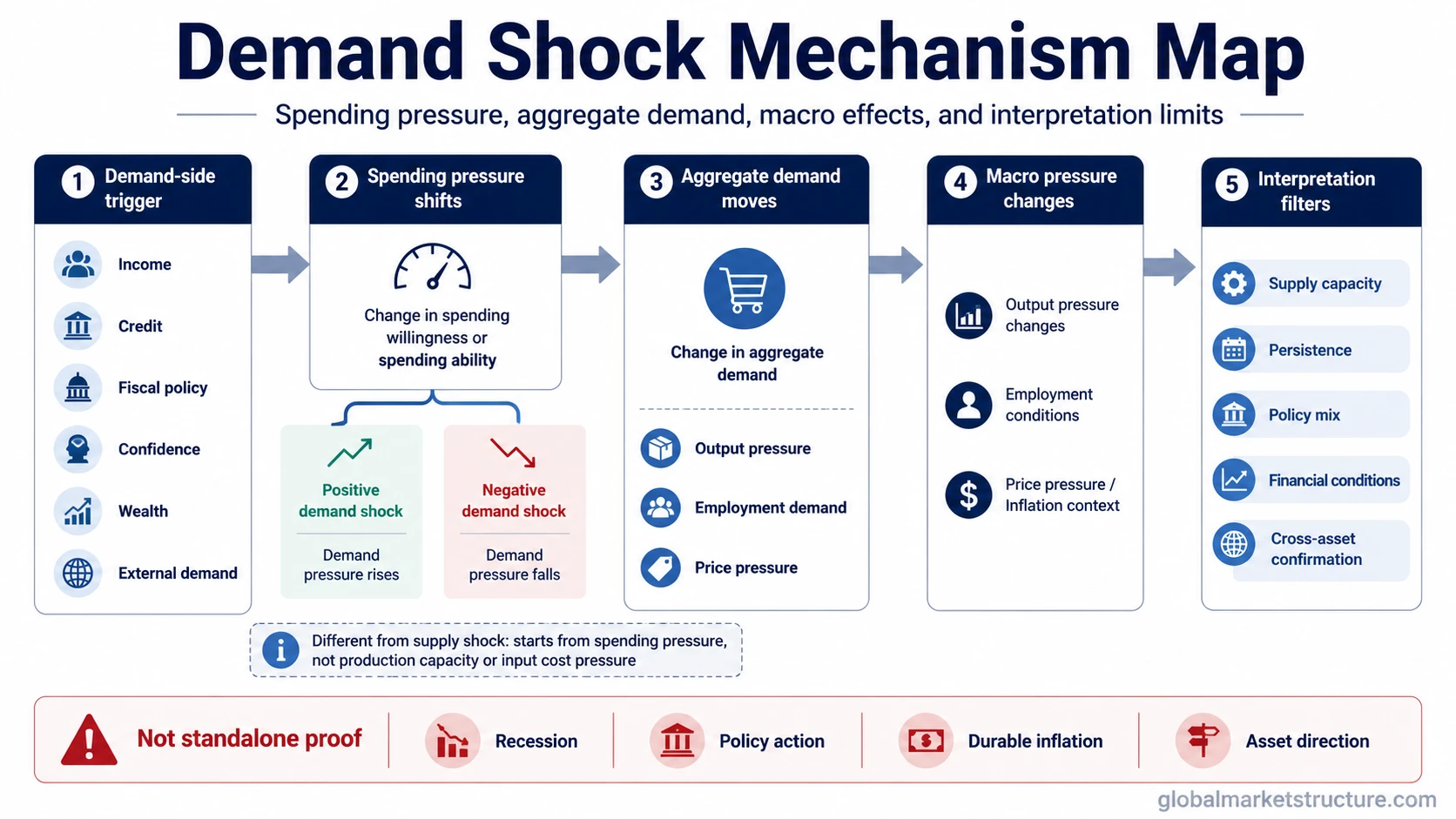
Common Demand Shock Triggers
Demand shocks can come from several macro channels. The trigger matters because different channels have different persistence and policy implications.
| Trigger | Demand-side channel | Interpretation limit |
|---|---|---|
| Fiscal stimulus or withdrawal | Government spending, transfers, or taxes change private or public demand | The effect depends on timing, scale, savings behavior, and supply conditions |
| Income or wealth effects | Households feel more or less able to spend | Asset gains or income gains may not translate evenly into consumption |
| Credit conditions | Borrowing becomes easier or harder for households and firms | Credit supply, risk appetite, and repayment capacity can change the result |
| Confidence and expectations | Future income or business expectations change current spending plans | Survey sentiment and actual spending can diverge |
| External demand | Foreign demand for domestic goods or services rises or falls | Exchange rates, global cycles, and trade exposure affect transmission |
Demand Shock vs Supply Shock
A demand shock starts with spending pressure. A supply shock starts with production capacity, input costs, availability, or other supply-side conditions. Both can affect prices and output, but they begin from different sides of the economy.
The distinction matters because the same observed price move can have different meanings. Rising prices alongside stronger spending may suggest demand pressure. Rising prices alongside constrained supply may point to supply-side pressure. Mixed episodes require more care because both channels can operate at the same time.
When both forces are present, the supply shock vs demand shock distinction helps clarify whether the first disturbance came from spending pressure or from production, cost, capacity, or availability constraints.
What Demand Shock Does Not Prove
Demand shock is useful because it identifies a demand-side impulse. The label becomes risky when it is treated as a complete forecast.
- Price movement alone is not proof: prices can move because of demand, supply, policy, margins, currency effects, or market positioning.
- Stronger demand is not enough to establish durable inflation: persistence depends on supply capacity, expectations, margins, wages, and policy response.
- Weaker demand is not enough to establish recession: the size, breadth, and duration of the shock matter.
- A demand shock does not determine central bank action by itself: policymakers also evaluate inflation, labor markets, financial conditions, and risk balance.
- A demand shock is not an asset-direction signal: markets may react differently depending on rates, earnings expectations, liquidity, positioning, and valuation context.
Policy and Market-Structure Interpretation
Demand shocks often matter for policy interpretation because they can change the balance between growth pressure and inflation pressure. A stronger demand impulse may increase concern about overheating if supply is constrained. A weaker demand impulse may raise concern about growth slowdown if it is broad and persistent.
The policy implication still depends on the broader policy mix. Fiscal support, monetary policy, credit conditions, and external demand can reinforce or offset each other. A demand shock viewed in isolation can misread the actual macro transmission path.
For market-structure interpretation, demand shock is best treated as one input in a broader regime map. It can help explain why growth expectations, inflation pressure, yields, credit conditions, or risk appetite may change, but it should be checked against supply conditions, policy stance, persistence, and cross-asset confirmation.
Illustrative Scenario
A generic positive demand shock could occur when household income support and easier credit conditions lead to stronger spending than businesses expected. If firms can increase production, the first effect may be higher output and hiring. If supply is constrained, more of the pressure may show up in prices.
The same scenario still does not establish durable inflation, a specific policy decision, or a market direction. The interpretation depends on whether demand strength persists, whether supply catches up, and whether policy conditions amplify or offset the shock.
Related Concepts
Supply shock, policy mix, and the direct comparison between demand shock and supply shock clarify three different questions: which side of the economy changed first, how policy conditions interact with the shock, and why the same price or output move can carry different meanings.
Demand shock remains a narrow macro-driver concept. It explains a demand-side disturbance and its possible transmission path, not a complete forecast of inflation, recession, central bank behavior, or asset prices.
FAQ
What is a demand shock?
A demand shock is a demand-side disturbance that shifts aggregate demand above or below its expected path. It changes spending pressure and may affect output, employment, prices, or inflation pressure depending on supply conditions and policy context.
What is the difference between a positive and negative demand shock?
A positive demand shock raises demand pressure, while a negative demand shock reduces it. Positive shocks can increase output or price pressure. Negative shocks can weaken spending, output pressure, or pricing power.
Is a demand shock the same as aggregate demand?
No. Aggregate demand is total spending demand across the economy. A demand shock is a disturbance that shifts that demand relative to the expected baseline.
Does rising inflation prove a demand shock?
No. Inflation can come from demand pressure, supply constraints, policy effects, currency moves, margins, wages, or several forces together. Demand shock is only one possible explanation.
Can a demand shock predict a recession?
No. A negative demand shock can contribute to recession risk if it is large, broad, and persistent, but the concept alone does not forecast recession. Supply conditions, policy response, credit conditions, and labor-market data also matter.