
Policy mix is the combined stance of fiscal policy and monetary policy. It describes how government spending, taxation, transfers and borrowing interact with central-bank policy rates, liquidity settings and financial conditions.
For market-structure interpretation, policy mix helps explain whether public policy is adding demand, restraining demand, easing financing conditions or creating tension between the fiscal and monetary sides. It is useful because fiscal policy can reinforce or offset the central-bank stance, but it does not independently forecast recession, inflation, yields, equities, FX, credit spreads or risk appetite.
Policy mix definition
A policy mix is the combined fiscal and monetary policy stance in an economy. A loose policy mix usually means policy is supporting demand or financing conditions. A tight policy mix usually means policy is restraining demand, credit or inflation pressure. The important point is the interaction between the two sides, not either tool in isolation.
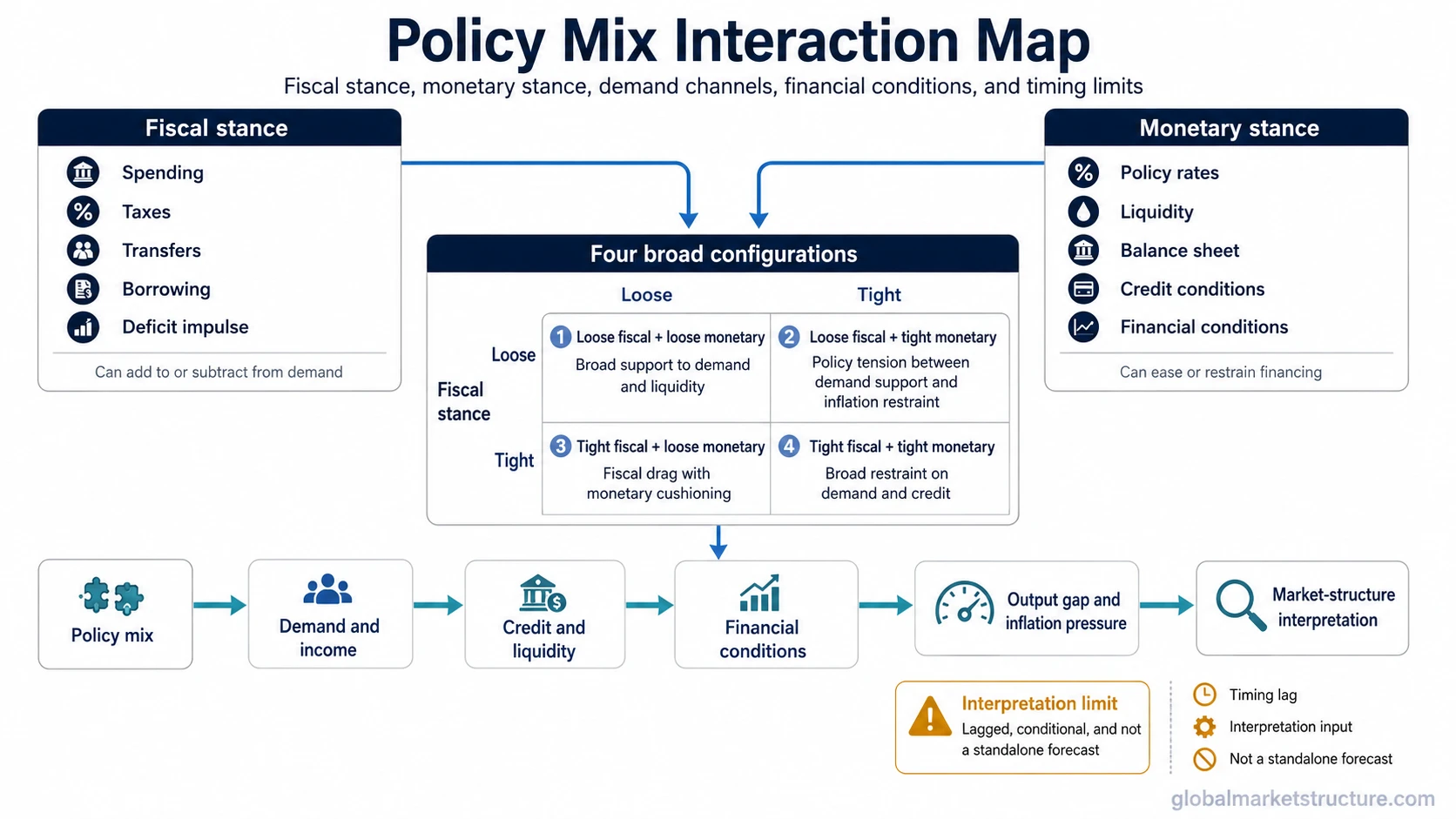
What policy mix includes
The fiscal side covers government spending, taxation, transfers, deficits, borrowing and the targeting of support. Fiscal policy can lift household income, support corporate revenue, change public-sector demand or shift the burden between current spending and future financing needs.
The monetary side covers central-bank policy rates, balance-sheet policy, liquidity operations, communication, financial-condition management and the credibility of the inflation objective. A central bank can loosen or tighten financing conditions through interest-rate expectations, credit conditions, bank funding, market liquidity and the broader transmission of policy.
A policy mix is therefore not simply “the government and central bank working together.” It can also describe conflict. Fiscal policy may support demand while monetary policy tries to restrain inflation, or fiscal tightening may reduce demand while monetary easing tries to cushion growth.
The four broad policy mix configurations
The clearest way to read policy mix is to separate the fiscal stance from the monetary stance. Each combination can create a different macro interpretation, but no configuration should be treated as a mechanical forecast.
| Fiscal stance | Monetary stance | Broad macro interpretation | What to confirm | What it does not prove |
|---|---|---|---|---|
| Loose fiscal | Loose monetary | Policy is broadly supportive of demand, income, borrowing and liquidity. | Growth data, inflation pressure, credit creation, market breadth and financial conditions. | It does not prove a durable expansion or a risk-asset rally. |
| Loose fiscal | Tight monetary | Fiscal support may keep demand firm while monetary policy restrains borrowing and inflation pressure. | Inflation persistence, real rates, credit stress, fiscal targeting and expectations. | This does not confirm that the central bank will cool inflation quickly. |
| Tight fiscal | Loose monetary | Fiscal drag may weigh on demand while monetary easing tries to support credit and financial conditions. | Private-sector credit, labor income, bank lending, liquidity and policy transmission. | This should not be read as proof that easier money will offset fiscal drag. |
| Tight fiscal | Tight monetary | Both sides may restrain demand, credit and inflation pressure, especially if starting conditions are fragile. | Policy lag, unemployment, credit spreads, liquidity stress and downside growth data. | It does not prove recession or falling asset prices by itself. |
How policy mix moves through the macro environment
Policy mix works through several channels at the same time. Fiscal policy can affect income, demand and public borrowing. Monetary policy can affect borrowing costs, credit supply, liquidity and asset discount rates. The combined stance shapes the environment in which households, businesses, banks and investors make decisions.
Basic mechanism sequence:
- Fiscal stance and monetary stance set the broad policy backdrop.
- That backdrop affects demand, income, borrowing costs, credit availability and liquidity.
- Those effects influence inflation pressure, growth context and financial conditions.
- Market participants interpret the result as part of the broader regime.
- Confirmation still has to come from actual data, cross-asset behavior and timing.
This is why policy mix is related to the monetary transmission mechanism, but it is not the same thing. Monetary transmission focuses on how central-bank policy passes through rates, credit, expectations and asset prices. Policy mix focuses on the combined stance between the fiscal and monetary sides.
Policy mix and inflation pressure
Policy mix can affect inflation pressure when it changes demand relative to supply capacity. Loose fiscal policy can support spending power, while loose monetary policy can make financing easier. If both happen while supply is constrained, inflation pressure may become harder to cool.
The interpretation changes when one side offsets the other. Fiscal support can keep demand resilient even as rates rise. Monetary easing can support financial conditions even when fiscal policy is becoming more restrictive. These combinations matter most when they are checked against inflation data, labor conditions, credit growth and the behavior of inflation expectations.
Practical scenario:
A common scenario is that fiscal support keeps household or business demand firmer than expected while the central bank tightens policy to slow inflation. The mixed signal is not automatically bullish or bearish for markets. It tells the analyst to watch whether tighter financing conditions are strong enough to offset the demand support, and whether inflation expectations remain anchored.
Why timing and policy lag matter
Policy mix is not interpreted only by looking at today’s announcements. Fiscal measures can take time to reach households, firms or public projects. Monetary policy can take time to move through banks, credit creation, refinancing, asset prices and expectations.
That delay is why policy lag matters. A country can appear to have a supportive or restrictive policy mix before the full effect is visible in growth, employment, inflation or financial stress. The current policy stance and the realized economic effect are not always synchronized.
Policy mix versus nearby concepts
Policy mix is often confused with related policy terms because fiscal stance, monetary stance, transmission and timing can appear in the same macro discussion.
| Concept | Main question it answers | How it differs from policy mix |
|---|---|---|
| Fiscal policy | What is the government doing through spending, taxes, transfers and borrowing? | It covers one side of the policy mix, not the combined stance. |
| Monetary policy | What is the central bank doing through rates, liquidity and financial conditions? | It covers the central-bank side, not the fiscal interaction. |
| Fiscal policy vs monetary policy | How do the two policy tools differ? | It separates the tools, while policy mix studies how they combine. |
| Policy transmission | How does a policy decision move through the economy and markets? | It explains the channel of effect, while policy mix classifies the combined stance. |
| Policy lag | Why do policy effects appear with delay? | It explains timing risk, while policy mix explains the combined direction of policy. |
The comparison between fiscal policy vs monetary policy is useful before analyzing policy mix, because the mix only becomes clear after the two tools are separated.
How to use policy mix in market-structure interpretation
Policy mix is best used as one macro input inside a broader regime framework. It can help explain why demand remains resilient, why inflation pressure is sticky, why credit conditions are changing or why markets are responding differently from headline economic data.
The interpretation becomes stronger when policy mix is confirmed by other evidence. Useful confirmation layers include inflation data, labor-market strength, growth momentum, credit spreads, lending standards, liquidity conditions, yield curves, DXY behavior, equity breadth and sector leadership.
What policy mix does not prove:
Policy mix does not independently forecast recession, durable inflation, bond yields, equities, FX, credit spreads or risk appetite. Its meaning depends on timing, starting conditions, supply constraints, credit creation, expectations, fiscal targeting, central-bank credibility and financial-condition feedback.
Key points
- Policy mix combines the fiscal stance and the monetary stance into one macro interpretation input.
- The two sides can reinforce each other or pull in opposite directions.
- The four broad configurations help organize the policy backdrop without predicting markets.
- Inflation effects depend on demand, supply capacity, credit conditions, expectations and policy lag.
- Policy mix should be confirmed with data and cross-asset conditions before it becomes part of a regime view.
FAQ
What is policy mix?
Policy mix is the combined stance of fiscal policy and monetary policy. It shows how government spending, taxes, transfers and borrowing interact with central-bank rates, liquidity settings and financial conditions.
What is an example of a policy mix?
A loose fiscal and tight monetary mix can occur when government support keeps demand firm while the central bank raises rates or tightens financial conditions to restrain inflation pressure. The example describes a policy tension, not a market forecast.
Why does policy mix matter for inflation?
Policy mix matters for inflation because fiscal support can lift demand while monetary policy can either support or restrain borrowing and credit. The inflation effect depends on supply capacity, expectations, policy lag and the strength of transmission.
Is policy mix the same as fiscal policy?
No. Fiscal policy is only the government side of spending, taxes, transfers and borrowing. Policy mix looks at fiscal policy and monetary policy together.
Does policy mix predict markets?
No. Policy mix is a macro interpretation input, not a standalone forecast. It should be checked against inflation data, growth data, credit conditions, liquidity, rates, currency behavior and market breadth.