
A supply shock starts from the economy’s ability or cost to produce goods and services. A demand shock starts from the willingness or ability to spend. Both can affect output, prices, inflation pressure, employment, and policy response, so the useful distinction is the dominant channel behind the move.
Key Points
- A supply shock begins with production capacity, input costs, availability, logistics, labor supply, or other supply-side constraints.
- A demand shock begins with spending demand, income, credit, confidence, fiscal support, or external demand.
- Both shock types can raise or lower output and inflation pressure, so the visible result alone is not enough to classify the shock.
- Mixed episodes can contain both supply and demand forces, which makes the dominant channel more important than a single label.
- The distinction helps interpret macro pressure and policy tradeoffs, but it does not predict recession, inflation durability, rates, yields, equities, FX, credit spreads, or risk appetite by itself.
Supply Shock vs Demand Shock Comparison Table
| Criterion | Supply shock | Demand shock | Why it matters |
|---|---|---|---|
| Origin | Starts from the economy’s ability or cost to produce goods and services. | Starts from the willingness or ability of households, firms, governments, or foreign buyers to spend. | The origin separates production-side pressure from spending-side pressure. |
| First pressure point | Production capacity, input costs, supply chains, labor availability, energy costs, or product availability. | Income, confidence, credit conditions, fiscal transfers, investment appetite, or external demand. | The first pressure point helps identify the channel before output and inflation data blur together. |
| Output effect | Can reduce output if firms cannot produce enough or must cut activity because costs rise. | Can raise output when spending expands or reduce output when spending contracts. | The same output decline can have different causes. |
| Inflation effect | Can push prices higher even when output weakens if supply becomes constrained or production costs rise. | Can push prices higher when spending demand runs ahead of available capacity, or lower when demand falls. | Inflation alone does not prove which shock is present. |
| Employment effect | Can weaken hiring if production becomes less profitable or less feasible. | Can strengthen hiring when demand rises and weaken hiring when demand falls. | Labor-market data need context from both production and spending conditions. |
| Policy-response difficulty | Harder when inflation rises while output weakens because demand-management tools may reduce spending pressure without quickly removing the original supply constraint. | More direct when demand is the main excess or shortfall, but still dependent on persistence, labor-market conditions, inflation expectations, and broader financial conditions. | Policy interpretation depends on whether the pressure is mainly supply-side or demand-side. |
| Market interpretation limit | Does not automatically forecast asset direction, recession, or inflation persistence. | Does not automatically forecast asset direction, recession, or policy path. | Shock classification is an interpretation input, not a standalone forecast. |
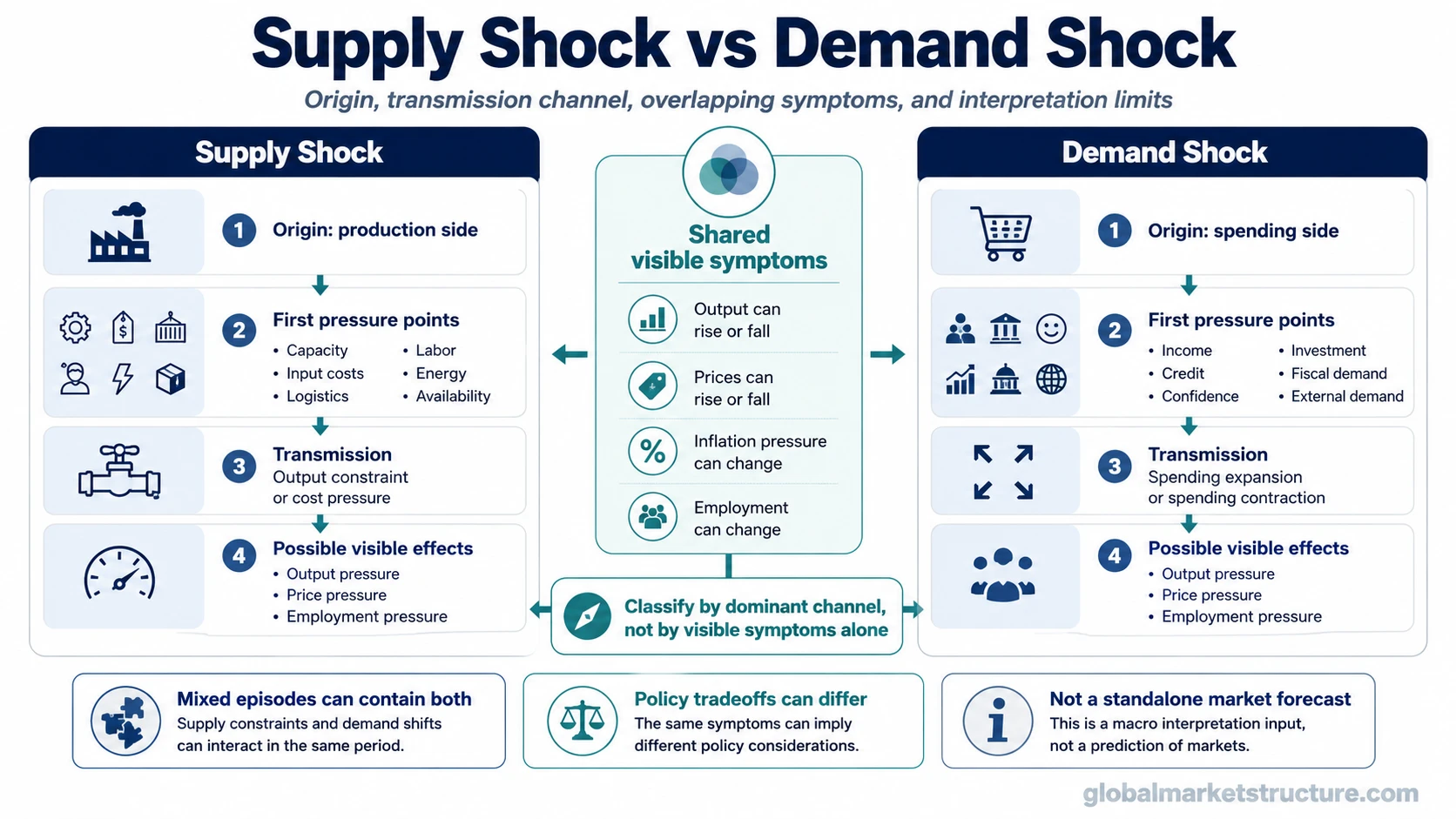
What Makes a Shock Supply-Driven
A shock is supply-driven when the main disturbance comes from production conditions rather than from the desire to spend. The pressure can come from constrained capacity, higher input costs, unavailable goods, disrupted logistics, labor shortages, energy costs, or any other condition that limits how easily goods and services can be produced.
A supply shock can create an uncomfortable mix for macro interpretation. Output may weaken because production is harder or more expensive, while prices may rise because fewer goods or higher costs are moving through the system. That combination is why a supply-driven shock cannot be read only through demand weakness or inflation strength.
Classification rule: If the first pressure comes from capacity, cost, or availability, the shock is more likely supply-driven even if the visible symptoms later include weaker demand, lower confidence, or financial-market stress.
What Makes a Shock Demand-Driven
A shock is demand-driven when the main disturbance comes from spending behavior. The pressure can come from stronger or weaker household consumption, business investment, government spending, credit availability, confidence, income, or foreign demand.
A demand shock can lift output and inflation pressure when spending rises faster than supply can respond. It can also weaken output and prices when spending falls, confidence deteriorates, credit tightens, or incomes come under pressure.
Classification rule: If the first pressure comes from the willingness or ability to buy, borrow, invest, or spend, the shock is more likely demand-driven even if supply later adjusts in response.
Same Scenario, Different Classification
Two economies can show similar inflation and output symptoms while having different underlying shocks.
Illustrative scenario: Prices rise while output slows. In one case, the trigger is a sudden jump in energy input costs that makes production more expensive and reduces available supply. That is mainly supply-driven. In another case, prices rise because households and firms increase spending faster than the economy can satisfy that demand. That is mainly demand-driven.
The surface result can look similar: higher prices and pressure on output. The classification changes because the starting channel is different.
This is the main reason supply shock vs demand shock should not be reduced to a simple inflation test. Inflation can appear in both. Output weakness can appear in both. The more useful question is whether the disturbance began with production conditions or spending demand.
When Both Shocks Appear Together
Real macro episodes can contain both supply and demand forces. A supply constraint can reduce production and then weaken income, confidence, or spending. A demand surge can strain capacity and make supply bottlenecks more visible. A demand collapse can also cause firms to cut production, which can make the later data look supply-related even when the first impulse came from spending weakness.
Mixed-shock boundary: A mixed episode does not require forcing one clean label onto the entire period. The safer approach is to separate the first impulse, the strongest transmission channel, and the later feedback loops.
The dominant channel may also change over time. A shock can begin as a supply disruption, then become a demand problem if income, confidence, or credit conditions deteriorate. It can also begin as demand strength and later expose capacity limits. The label is most useful when it describes the current dominant channel, not when it becomes a permanent description of the whole episode.
Why Policy Response Can Differ
Supply-driven inflation can be difficult for policy interpretation because demand-management tools may reduce spending pressure without quickly removing the original supply constraint. Higher interest rates or tighter financial conditions may cool spending, but they do not quickly restore missing supply, lower input costs, repair logistics, or expand productive capacity.
Demand-driven pressure is more directly connected to spending, credit, and financial conditions, but the final policy response still depends on persistence, labor-market conditions, inflation expectations, and broader financial conditions. The distinction clarifies the transmission channel, not the exact policy path.
Policy interpretation limit: Supply-driven pressure can make policy tradeoffs sharper, while demand-driven pressure can make demand management more relevant. Neither classification tells you the exact policy path without broader evidence.
Common Mistakes When Reading Supply and Demand Shocks
| Mistake | Why it is weak | Better interpretation |
|---|---|---|
| Classifying the shock by inflation alone | Both supply and demand shocks can raise inflation pressure. | Check whether the first pressure came from production constraints or spending demand. |
| Classifying the shock by output alone | Output can weaken after either a supply constraint or a demand decline. | Look at the channel behind the output change. |
| Treating every episode as purely one type | Feedback loops can mix supply and demand effects. | Separate the initial impulse from later transmission. |
| Turning the label into a market forecast | Shock type does not automatically determine asset direction. | Use the classification as one macro input, then check policy, liquidity, credit, earnings, and cross-asset confirmation separately. |
What This Comparison Does Not Tell You
The supply shock vs demand shock distinction helps identify the dominant macro channel. It does not, by itself, tell you whether inflation will persist, whether a recession will occur, how central banks will respond, or how yields, equities, FX, commodities, credit spreads, or risk appetite will move.
Interpretation boundary: Shock classification is a starting point for macro analysis. It needs confirmation from inflation composition, output data, labor conditions, credit conditions, policy stance, financial conditions, and cross-asset behavior before it can support a broader market-regime view.
Related Concepts
The two core concepts are best read separately after the comparison. Supply-driven pressure focuses on production capacity, cost, and availability. Demand-driven pressure focuses on spending willingness, income, confidence, credit, and policy-supported demand.
| Concept | Use when the main question is… |
|---|---|
| Supply shock | Whether production capacity, input costs, or availability are driving the macro disturbance. |
| Demand shock | Whether spending willingness, income, confidence, credit, or fiscal support are driving the macro disturbance. |
FAQ
Is inflation always a supply shock?
No. Inflation can come from supply constraints, demand strength, or a combination of both. The classification depends on the dominant origin and transmission channel, not inflation alone.
Can a shock be both supply-driven and demand-driven?
Yes. A shock can begin on one side and create feedback on the other. The safer interpretation separates the initial impulse, the current dominant channel, and the later feedback effects.
Does the shock type predict markets?
No. Shock type is one macro interpretation input. Market behavior also depends on policy expectations, liquidity, earnings, credit conditions, positioning, valuation, and cross-asset confirmation.