
Foreign exchange intervention is an official action by a central bank, treasury, finance ministry, or monetary authority to influence exchange-rate conditions through currency purchases, currency sales, reserve use, communication, coordination, or related operations. It may aim to reduce disorderly volatility or manage currency pressure, but it does not guarantee exchange-rate control and is not a trading signal.
What it is: an official policy action intended to influence exchange-rate behavior or reduce disorderly currency-market conditions.
What it can use: foreign currency purchases, domestic currency purchases, reserve sales, reserve accumulation, communication, coordinated action, and sometimes sterilization operations.
What it does not prove: a guaranteed currency reversal, a confirmed reserve drawdown, a durable policy success, or a standalone buy or sell signal.
- Foreign exchange intervention is a policy action, not a market forecast.
- It can involve currency purchases, currency sales, reserve use, official communication, or coordinated action.
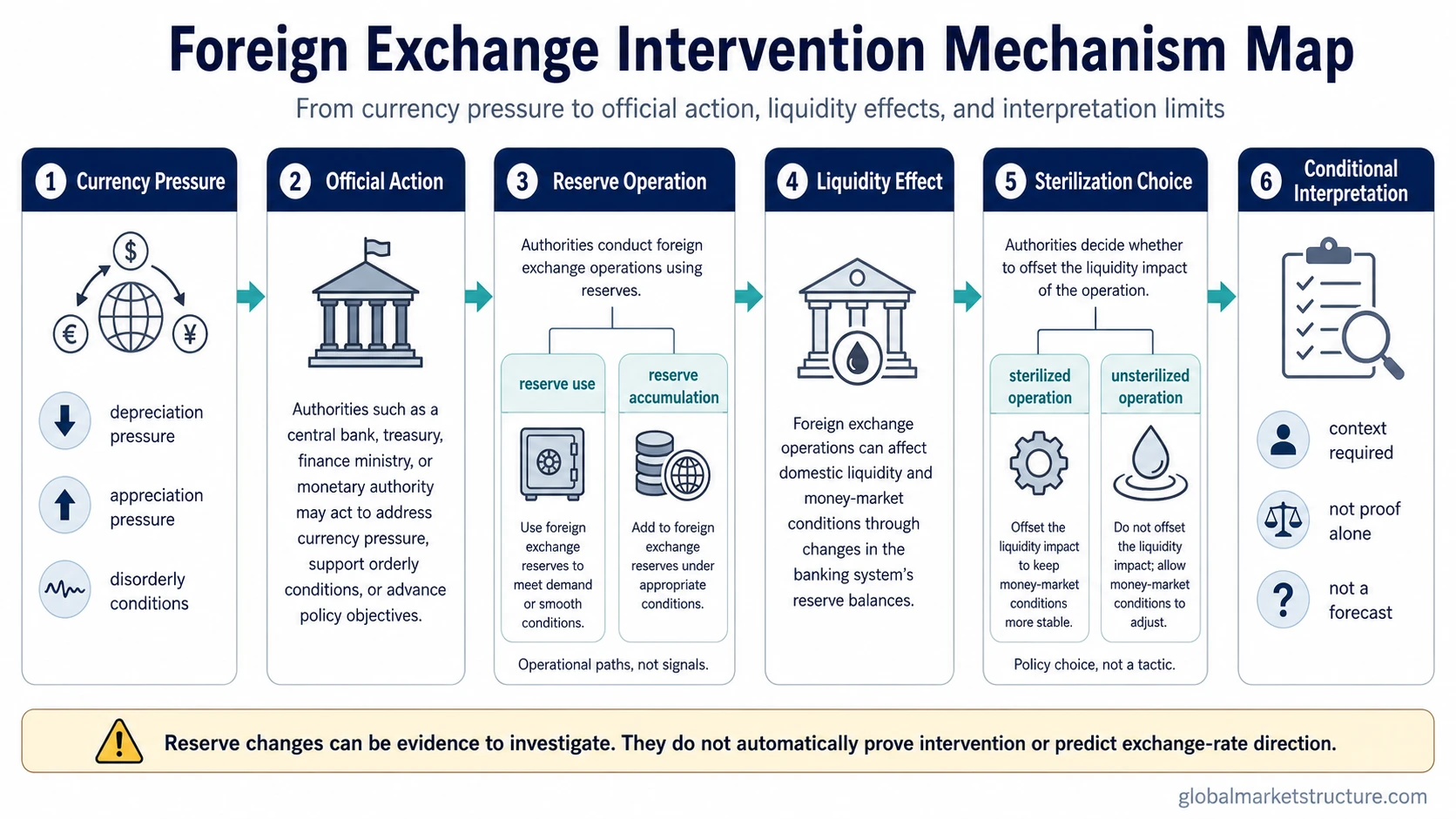
- Reserve changes can be evidence to investigate, but they are not automatic proof of intervention.
- Effectiveness depends on scale, credibility, reserve adequacy, market liquidity, capital-flow pressure, and policy consistency.
- For market-structure analysis, intervention is best treated as reserve-flow and policy-pressure evidence, not as a trading instruction.
What Foreign Exchange Intervention Means
Foreign exchange intervention means that an official authority enters or influences the currency market to affect exchange-rate conditions. The action can be direct, such as buying or selling currency, or indirect, such as official communication that changes expectations around future currency operations.
The concept belongs inside reserve and sovereign-flow analysis because it connects currency pressure, official reserve management, domestic liquidity conditions, and capital-flow stress. A country facing depreciation pressure may sell foreign assets or foreign currency to support its domestic currency. A country facing appreciation pressure may buy foreign currency to slow the rise of its domestic currency. In both cases, the market meaning depends on the surrounding policy and liquidity context.
The useful boundary is simple: foreign exchange reserves are the stock of official foreign assets, while foreign exchange intervention is the operation or action that may use those assets. A reserve movement may point analysts toward a question, but it does not answer the question by itself.
How Foreign Exchange Intervention Works
Foreign exchange intervention usually works through a currency transaction or policy communication. If a domestic currency is under pressure, the authority may sell foreign currency reserves and buy domestic currency. If the domestic currency is rising in a way the authority considers disruptive, it may buy foreign currency and sell domestic currency. The transaction can change market supply and demand directly, while official communication can affect expectations.
Intervention can also be coordinated with other authorities, combined with monetary-policy communication, or paired with operations that manage the domestic liquidity impact. This is why the same surface action can have different market implications depending on whether it changes liquidity conditions, offsets liquidity effects, or mainly works through expectations.
| Mechanism | What the authority may do | Market-structure interpretation |
|---|---|---|
| Support domestic currency | Sell foreign currency or foreign assets and buy domestic currency | Can indicate depreciation pressure, reserve use, or an attempt to reduce disorderly movement |
| Limit domestic currency appreciation | Buy foreign currency and sell domestic currency | Can indicate concern about excessive appreciation, export competitiveness, or capital inflow pressure |
| Influence expectations | Use official communication, guidance, or coordinated signaling | Can matter even before or without a clearly visible reserve transaction |
| Manage liquidity effects | Offset or leave in place the domestic liquidity impact of the currency operation | Connects intervention to domestic money-market conditions and liquidity transmission |
The liquidity channel should not be overstated inside an entity definition. The deeper question is handled by FX intervention and liquidity, where the focus is how currency operations can interact with domestic liquidity, funding pressure, and sterilization choices.
Foreign Exchange Intervention vs Foreign Exchange Reserves
Foreign exchange reserves and foreign exchange intervention are related, but they are not the same concept. Reserves are the balance-sheet stock of foreign assets held by an official authority. Intervention is an action that may use, add to, or change the composition of that stock.
A reserve decline can occur for reasons other than intervention. Valuation changes, debt service, reserve reallocation, accounting effects, or other official transactions can affect reported reserves. A reserve increase can also reflect accumulation, valuation changes, or policy choices that are not a simple intervention signal.
Foreign exchange reserves: the stock of official foreign assets available for liquidity, confidence, payment, and policy purposes.
Foreign exchange intervention: the operation that attempts to influence exchange-rate conditions through transactions, reserve use, communication, coordination, or related policy actions.
Practical boundary: reserves show capacity and balance-sheet movement; intervention describes the action and intent. One can inform the other, but they should not be treated as identical.
Sterilized vs Unsterilized Intervention
The sterilization boundary matters because an exchange-rate operation can also affect domestic liquidity. In a simplified form, unsterilized intervention allows the currency operation to affect domestic money conditions. Sterilized intervention attempts to offset that domestic liquidity effect through separate monetary operations.
This distinction changes interpretation. An intervention that is sterilized may still affect expectations, portfolio balance, signaling, and market behavior, but its domestic liquidity impact is partly or fully offset. An unsterilized intervention may have a more direct connection to domestic liquidity, but its effect still depends on scale, credibility, market depth, and the broader policy setting.
The full comparison belongs on the dedicated sterilized vs unsterilized intervention page. Here, the important point is that sterilization affects the transmission path. It does not make intervention irrelevant, and it does not guarantee success.
How to Observe Intervention Without Overreading It
Foreign exchange intervention is easiest to interpret when official confirmation exists. Without confirmation, analysts usually work with indirect evidence. That evidence can be useful, but it should be treated as a prompt for investigation rather than proof.
For confirmed operations, official authority statements and official data releases carry more weight than price action alone; market moves can suggest pressure, but they cannot confirm the policy action without supporting evidence.
| Evidence type | What it may suggest | Why it can be misleading |
|---|---|---|
| Official announcement | Confirms or clarifies the authority’s action, objective, or coordination | May not reveal full size, timing, execution detail, or follow-through |
| Foreign exchange reserve data | May show reserve drawdown, reserve accumulation, or balance-sheet pressure | Can reflect valuation effects, accounting changes, debt payments, or non-intervention flows |
| Sharp currency movement around policy communication | May show that markets are reacting to intervention risk or official communication | Can also reflect rates, positioning, liquidity, macro data, or broader dollar movement |
| Money-market or funding conditions | May help identify whether intervention is interacting with domestic liquidity | Liquidity effects can be offset, delayed, or overwhelmed by other policy operations |
| Capital-flow and positioning pressure | May show why intervention pressure is rising | Capital-flow stress does not prove that an authority has intervened |
A safer reading combines official communication, reserve data, exchange-rate behavior, domestic liquidity conditions, and broader policy context. No single market move is enough to prove intervention by itself.
Why Foreign Exchange Intervention Has Limits
Foreign exchange intervention is conditional because the authority is acting inside a larger market structure. Scale matters because a small operation may not offset large capital flows. Credibility matters because markets may discount intervention if the policy framework looks inconsistent. Reserve adequacy matters because the authority’s capacity can be questioned if reserves are limited relative to the pressure it is facing.
Market liquidity also matters. A given intervention can have more visible short-term impact in a thin market than in a deep market, but that does not automatically make the effect durable. Communication can strengthen the market impact if it is credible and consistent with policy, but communication can weaken the effect if markets see it as unsupported by action or reserves.
Limit: intervention can influence exchange-rate conditions, but it does not eliminate the underlying macro pressure.
Limit: a currency reaction after intervention does not prove a durable reversal.
Limit: reserve capacity can support credibility, but reserves are not unlimited and may not offset persistent capital-flow pressure.
Limit: sterilization can change the domestic liquidity channel, but it does not remove every market effect.
A Practical Scenario
A common scenario is that a currency weakens during capital outflows while domestic policy credibility is under pressure. An authority may sell foreign reserves and buy domestic currency to reduce disorderly movement. The first read may be that the currency is being defended, but that reading is incomplete without checking reserve adequacy, policy consistency, market liquidity, and whether the domestic liquidity effect is sterilized.
The stronger interpretation is not “intervention means reversal.” The stronger interpretation is that official pressure has entered the market structure. If capital outflows keep building and policy credibility remains weak, the intervention may slow the move without changing the underlying pressure. If the intervention is large, credible, and aligned with broader policy, the market impact can be more meaningful, but it still remains conditional.
Common Mistakes and False Readings
Mistake 1: Treating reserve decline as automatic proof of intervention. Reserve data can be useful, but reserve changes can come from valuation, debt service, portfolio reallocation, and other official transactions.
Mistake 2: Treating intervention as a trading signal. Intervention is a policy action. It may affect price behavior, liquidity, and expectations, but it does not create a standalone market instruction.
Mistake 3: Assuming sterilized intervention has no market effect. Sterilization can offset domestic liquidity effects, but expectations, signaling, and portfolio-balance channels can still matter.
Mistake 4: Assuming official action guarantees currency control. Intervention can influence conditions, but persistent capital-flow pressure, weak policy credibility, or inadequate reserves can limit effectiveness.
Why It Matters for Global Market Structure
Foreign exchange intervention matters because it can reveal stress at the intersection of reserves, capital flows, policy credibility, liquidity, and exchange-rate pressure. For a Global Market Structure reader, the key is not to convert intervention into a direct market instruction. The key is to understand what official action says about the broader environment.
Intervention can point to reserve-flow pressure, capital outflow risk, funding stress, or a policy attempt to stabilize disorderly conditions. It can also affect cross-asset interpretation when currency pressure interacts with rates, credit, commodities, sovereign risk, or risk appetite. The concept is therefore useful as part of a broader regime map, not as a standalone forecast.
Related Concepts
Use the foreign exchange reserves page for the asset-stock side of the topic: what reserves are, why authorities hold them, and how reserve adequacy affects policy flexibility.
Use the FX intervention and liquidity page for the deeper transmission question: how currency operations can interact with domestic liquidity, funding conditions, and sterilization choices.
Use the sterilized vs unsterilized intervention page for the comparison between offsetting and not offsetting the domestic liquidity impact of intervention.
Use sovereign wealth fund when the question shifts from currency stabilization toward sovereign asset allocation and long-term reserve-linked investment vehicles.
Use petrodollar recycling when the question shifts toward how commodity revenues can move through reserves, external balances, and global capital markets.
FAQ
What is foreign exchange intervention?
Foreign exchange intervention is an official action by a central bank, treasury, finance ministry, or monetary authority to influence exchange-rate conditions through currency purchases, currency sales, reserve use, communication, coordination, or related operations.
Is foreign exchange intervention the same as foreign exchange reserves?
No. Foreign exchange reserves are the stock of official foreign assets. Foreign exchange intervention is an action that may use, add to, or alter that stock to influence exchange-rate conditions.
Does foreign exchange intervention always strengthen a currency?
No. Intervention can influence conditions, but its effect depends on scale, credibility, reserve adequacy, market liquidity, capital-flow pressure, and consistency with broader policy.
What is sterilized foreign exchange intervention?
Sterilized intervention attempts to offset the domestic liquidity effect of a currency operation through separate monetary operations. It can change the transmission path, but it does not make the intervention irrelevant.
Is FX intervention a trading signal?
No. FX intervention is a policy action. It can affect exchange-rate behavior and market expectations, but it should not be treated as a standalone trading signal or a buy or sell instruction.