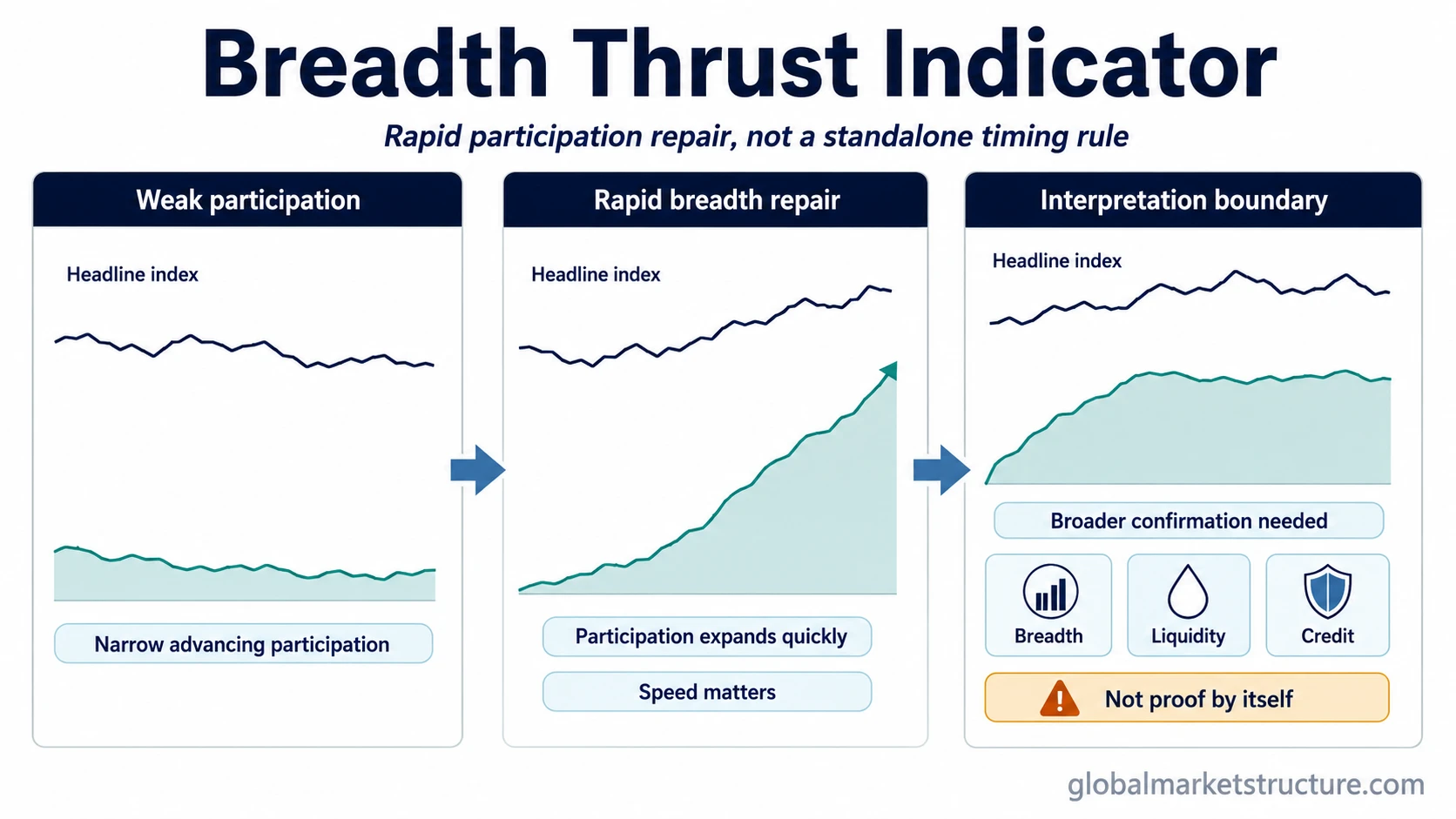
A Breadth Thrust Indicator is a market breadth indicator that tracks a rapid improvement in advancing participation across a broad stock universe. It is used to observe how quickly market participation repairs after weakness, but it is not a standalone forecast, buy signal, or proof that a durable risk-on regime has started.
Key Points
- Breadth thrust focuses on the speed of participation improvement, not just the level of an index.
- Classic versions use a short smoothing window for advancing participation, but exact methodology depends on the version being used.
- The signal can suggest participation repair after broad weakness.
- It does not prove liquidity improvement, credit confirmation, earnings support, or lasting regime change.
- It is strongest when broader risk-environment evidence confirms the participation improvement.
What the Breadth Thrust Indicator Measures
The Breadth Thrust Indicator measures how quickly advancing stocks expand relative to declining stocks. Instead of asking whether a headline index has risen, it asks whether a broad group of stocks is beginning to participate in the move.
That makes it part of market breadth analysis. The indicator is most useful when the market has recently been weak or narrow, because a fast expansion in advancing participation can show that buying interest is spreading beyond a small leadership group.
The important distinction is that breadth thrust is an observation about participation speed. It does not, by itself, prove that the underlying macro regime, liquidity backdrop, credit environment, or earnings outlook has improved.
How the Breadth Thrust Indicator Is Measured
A common construction starts with advancing issues as a share of advancing plus declining issues. That participation ratio is then smoothed over a short window, depending on the specific breadth-thrust version being used.
Some classic breadth-thrust approaches define the signal as a fast move from depressed advancing participation to broad participation strength over a short window. The exact thresholds, universe, and smoothing method depend on the version being used, so the indicator should be interpreted through the methodology behind that specific reading.
| Measurement layer | What it tracks | Boundary to keep clear |
|---|---|---|
| Advancing participation | The share of stocks advancing relative to advancing plus declining stocks. | This is participation breadth, not index return. |
| Short smoothing window | A short smoothing method applied to advancing participation. | The smoothing method depends on the version being cited. |
| Threshold concept | A fast move from weak participation to broad participation strength. | Thresholds are not universal across every dataset or vendor. |
| Completed thrust | A rapid participation improvement that satisfies the chosen definition. | A completed reading is still context, not a complete market-timing system. |
What a Breadth Thrust Can Indicate
A breadth thrust can indicate that participation is repairing quickly after a weak or narrow market phase. When more stocks begin advancing together, the market move may be less dependent on a small group of leaders.
In a market-structure framework, the useful reading is participation repair inside the broader risk environment. A thrust can show that risk appetite has improved across more of the equity market, but that interpretation becomes more meaningful only when it aligns with other evidence such as credit conditions, liquidity behavior, volatility, sector leadership, and index-level follow-through.
This is where the indicator differs from a generic price signal. The signal is not simply “the market went up.” It is “participation improved quickly enough to change the quality of the move.”
What It Cannot Prove
A Breadth Thrust Indicator cannot prove that a durable bull phase has begun. It cannot prove that liquidity conditions have improved, that credit risk has disappeared, that earnings support is in place, or that renewed market stress is no longer possible.
The indicator also cannot prove that every market universe is giving the same message. A breadth thrust based on one exchange, index group, or data vendor may not match another version built from a different stock universe.
The safest interpretation is conditional. Breadth thrust can strengthen a participation-repair thesis, but it should not replace broader regime analysis.
Observation, Interpretation, and Limitation
The clearest use of the indicator separates what is observed from what may be inferred. The observation is about participation. The interpretation is about risk appetite. The limitation is that participation alone does not confirm the full market regime.
| What is observed | What it may suggest | What it does not prove |
|---|---|---|
| Advancing participation rises quickly after weak breadth. | Buying interest may be spreading across a broader part of the market. | It does not prove that the broader risk environment has fully repaired. |
| A threshold or trigger condition is reached under a chosen method. | The move may qualify as a breadth thrust under that method. | It does not create a universal buy signal or guarantee follow-through. |
| Participation improves after a period of narrow leadership. | The market may be less dependent on a few large index leaders. | It does not prove that leadership quality is durable. |
| Other risk-environment evidence fails to confirm. | The breadth improvement may be less reliable as a regime signal. | It does not prove the thrust is false, but it weakens the interpretation. |
Setup Versus Completed Thrust
A setup and a completed breadth thrust are not the same thing. A setup may appear when participation starts improving from a weak level, but the completed thrust depends on whether the chosen definition is actually satisfied.
This distinction matters because early improvement can fade. Treating a developing setup as a completed signal can turn a participation observation into an unsupported market call.
A completed breadth thrust still needs context. It can improve the evidence for participation repair, but it does not remove the need to check whether the broader risk environment is confirming or contradicting the move.
How It Differs From Nearby Breadth Concepts
Breadth thrust is related to several breadth concepts, but it does a narrower job. It focuses on rapid change in participation rather than the entire breadth landscape.
| Concept | Main focus | How it differs from breadth thrust |
|---|---|---|
| Market breadth | Broad participation across stocks or sectors. | Breadth thrust is one specific rapid-change condition inside breadth analysis. |
| Market breadth indicators | The broader tool family used to measure participation. | Breadth thrust is one indicator type, not the full indicator category. |
| Breadth divergence | Non-confirmation between index direction and participation. | Breadth thrust looks for rapid participation improvement, not divergence. |
| Advance Decline Line | A cumulative measure of advancing versus declining issues. | Breadth thrust is a short-window participation surge, not a cumulative breadth line. |
Practical Limitation Scenario
A breadth thrust can appear after a weak market phase when advancing stocks expand quickly. That can look like participation repair, especially if the prior decline or consolidation was broad.
The interpretation is weaker if credit spreads are still widening, liquidity conditions remain tight, volatility stays elevated, or leadership quality remains narrow. In that situation, the thrust may show a fast improvement in equity participation without proving that the broader risk environment has repaired.
The useful lesson is not that the signal should be ignored. The useful lesson is that breadth thrust should be treated as one layer of evidence inside a broader participation and regime framework.
When the Interpretation Is Stronger or Weaker
The interpretation is stronger when the breadth thrust is supported by broader participation, healthier leadership distribution, calmer volatility, stable credit conditions, and a liquidity backdrop that does not contradict the equity move.
The interpretation is weaker when the move is short-lived, dependent on a narrow group of stocks, specific to one data universe, or unsupported by other risk-environment evidence. A fast breadth rebound can still matter, but the context decides whether it is a durable participation shift or a temporary burst.
For that reason, the Breadth Thrust Indicator is best read as a participation-repair signal with boundaries. It can improve the quality of a market interpretation, but it should not be treated as a complete timing model.
FAQ
What is the Breadth Thrust Indicator?
The Breadth Thrust Indicator is a market breadth indicator that tracks a rapid improvement in advancing participation. It is used to observe whether more stocks are joining a market move after a weak or narrow period.
Is a breadth thrust a buy signal?
No. A breadth thrust can suggest participation repair, but it is not a standalone buy signal, forecast, or proof that a durable market regime has changed.
What does a breadth thrust measure?
It measures the speed of improvement in advancing participation, usually through a short smoothing method applied to advancing issues as a share of advancing plus declining issues.
How is breadth thrust different from breadth divergence?
Breadth thrust focuses on a rapid improvement in participation. Breadth divergence focuses on non-confirmation between index direction and underlying participation.
Why can a breadth thrust fail?
A breadth thrust can fail as a broader interpretation if participation improvement is not confirmed by follow-through, leadership quality, credit conditions, liquidity behavior, or other risk-environment evidence.