
Put Call Ratio measures put option activity relative to call option activity for a defined market, product group, and time period. The basic formula is put/call ratio = put activity / call activity. The ratio can show whether measured options activity is tilted toward puts or calls, but its interpretation depends on the data universe, whether volume or open interest is used, and what is driving the underlying transactions.
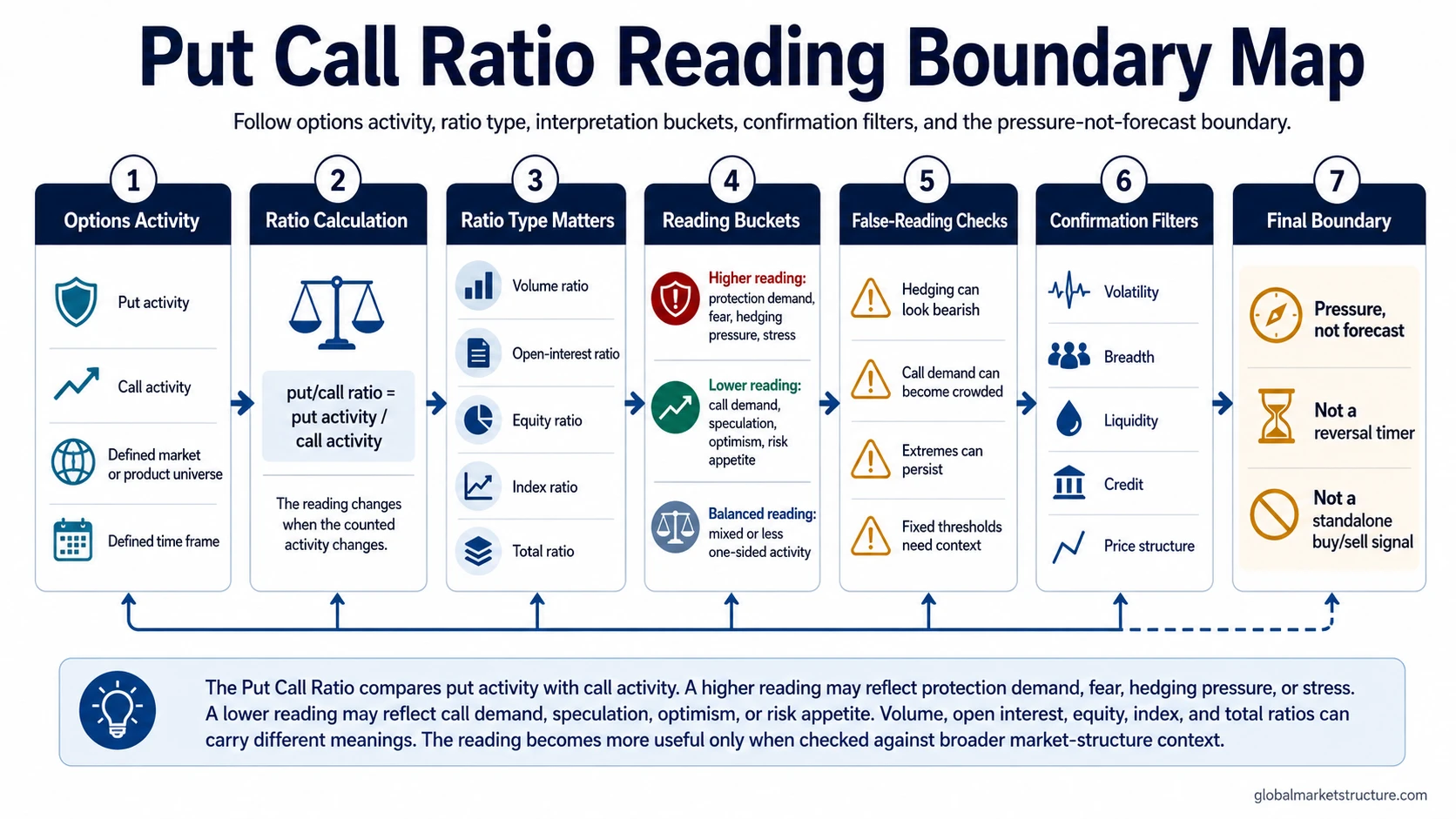
How Put Call Ratio Is Calculated
The calculation divides put activity by call activity within the selected data set. If 900,000 puts and 600,000 calls are counted, the ratio is 1.5. If 400,000 puts and 800,000 calls are counted, the ratio is 0.5.
The numerator and denominator must refer to the same defined universe. A ratio based on equity-option volume is different from an index-option ratio, and a volume ratio is different from an open-interest ratio.
For market sentiment, the ratio is most useful when the series being measured is clearly identified and compared with its own history rather than with a universal threshold.
Activity and Directional Intent Are Different
A high put/call ratio shows more measured put activity relative to call activity. It does not establish that every put represented a new bearish position. The activity can include hedging, speculation, spreads, exercises, closing transactions, and other portfolio adjustments.
The relative amount of put and call activity within the specified calculation.
Whether the activity represents new directional risk, hedging, position reduction, structural options activity, or another purpose.
Cboe notes that common put/call interpretation relies on assumptions about puts being bearish and calls being bullish, and documents a case where exercise-related put activity produced a sharp nondirectional increase in the equity put/call ratio. Cboe also publishes separate daily put/call statistics for different option universes rather than treating one ratio as interchangeable across products.
Put Call Ratio Types
The ratio should be identified before it is interpreted. Volume describes contracts traded during the measurement period. Open interest describes outstanding contracts. Product-specific ratios can also differ because equity, index, and other option markets are used for different purposes.
| Ratio type | What it measures | Useful for | Main limitation |
|---|---|---|---|
| Volume put/call ratio | Put volume divided by call volume over a defined period. | Reading current options activity and short-term changes in activity mix. | Trading volume can include hedges, spreads, exercises, opening activity, and closing activity. |
| Open-interest put/call ratio | Outstanding put contracts divided by outstanding call contracts. | Comparing the stock of outstanding put and call contracts. | Open interest does not reveal when positions were established or the economic intent behind them. |
| Equity put/call ratio | Put and call activity in single-stock options. | Reading activity within individual equity options. | Can be affected by company-specific events, speculation, hedging, and structural option activity. |
| Index put/call ratio | Put and call activity in index options. | Reading index-level options activity and protection demand. | Institutional portfolio hedging can make its baseline different from an equity-option ratio. |
| Total put/call ratio | Combined put and call activity across a broader options universe. | Providing a broad options-activity measure. | Aggregation can hide differences between product groups and participant use cases. |
How High and Low Readings Are Interpreted
A high Put Call Ratio means put activity is elevated relative to call activity in the selected universe. Depending on the market and period, that can be consistent with greater protection demand, caution, stress, or bearish speculation.
A low Put Call Ratio means call activity is elevated relative to put activity. That can be consistent with optimism, speculative upside demand, lower protection demand, or other call-heavy positioning.
The relevant baseline depends on the ratio type, product universe, historical distribution, volatility environment, and the composition of the underlying option activity. An extreme reading can persist and does not establish reversal timing by itself.
Put Call Ratio and Contrarian Interpretation
Put Call Ratio is often used as a contrarian signal when the reading becomes unusually high or low relative to its own history. The contrarian interpretation comes from the possibility that sentiment or positioning has become one-sided, not from the ratio mechanically predicting a reversal.
Context becomes more important when options activity is concentrated on one side. Strong call demand, for example, can contribute to a crowded trade interpretation if other evidence also shows increasingly one-sided exposure. Heavy put activity can instead reflect portfolio protection while investors continue to hold the underlying risk.
Options activity should also be kept separate from futures-positioning data. The Commitments of Traders report classifies reportable futures and options-on-futures positions by participant categories, while Put Call Ratio compares put and call activity within the selected options universe.
What Can Confirm the Reading
A Put Call Ratio extreme becomes more informative when other parts of market structure begin to support the same interpretation. Breadth can show whether participation is weakening or stabilizing. Volatility can show whether stress is expanding or receding. Credit and liquidity conditions can indicate whether defensive activity is part of a broader deterioration. Price structure shows whether the market itself has begun to respond differently.
The confirmation does not need to come from every measure at once. The purpose is to avoid treating one options statistic as a complete model of sentiment, positioning, or market direction.
Practical Scenario
A market can show a rising Put Call Ratio while the underlying index remains broadly stable. The ratio establishes that put activity has increased relative to call activity in the measured universe. It does not establish whether the change comes from new bearish speculation, portfolio hedging, spread activity, or another source.
If breadth then weakens, volatility rises, credit conditions deteriorate, and price structure begins to break down, the options reading has more supporting context. If those conditions remain stable, the higher ratio may primarily reflect protection demand rather than a broader directional change.
Common Interpretation Errors
| Interpretation error | Why it can mislead | Better reading |
|---|---|---|
| Using one fixed threshold across every series | Equity, index, total, volume, and open-interest ratios can have different historical distributions. | Compare the ratio with the history of the same series and the same options universe. |
| Treating put volume as bearish buying | Put activity can come from hedging, selling, spreads, exercises, opening trades, or closing trades. | Read higher put activity as an observed shift in activity first, then look for evidence about transaction intent. |
| Treating call volume as bullish buying | Call activity can also reflect selling, hedging, spreads, exercises, and portfolio adjustments. | Separate the activity count from the directional interpretation. |
| Ignoring the data universe | The same numerical ratio can describe different behavior when it comes from equity options, index options, total options, volume, or open interest. | Identify the product universe and calculation method before comparing readings. |
| Using the ratio as a reversal timer | Extreme options activity can persist while the broader market structure continues in the same direction. | Use the ratio as a pressure input and look for confirmation from volatility, breadth, liquidity, credit, and price structure. |
Where Put Call Ratio Fits in Market Structure
Put Call Ratio is an options-derived sentiment and positioning input. Its strongest use is to identify a change or extreme in relative put and call activity, define the data universe behind that observation, and then compare the reading with broader evidence from volatility, breadth, liquidity, credit, positioning, and price structure.
FAQ
Is the Put Call Ratio bullish or bearish?
Not by itself. A high ratio shows more put activity relative to call activity in the selected data set, while a low ratio shows more call activity. The directional interpretation depends on the product universe, historical baseline, transaction context, and broader market conditions.
Can the Put Call Ratio predict market reversals?
No. Extreme readings can identify one-sided options activity, but they do not establish reversal direction or timing without additional market evidence.
What is the Put Call Ratio formula?
The basic formula is put/call ratio = put activity / call activity. The activity can be measured using volume, open interest, or another clearly defined options data set.
Does high put activity mean investors are buying bearish positions?
Not necessarily. A simple put/call ratio counts activity in the selected data set but does not identify the economic intent of every transaction. Put activity can include hedging, speculation, selling, spreads, exercises, opening trades, and closing trades.